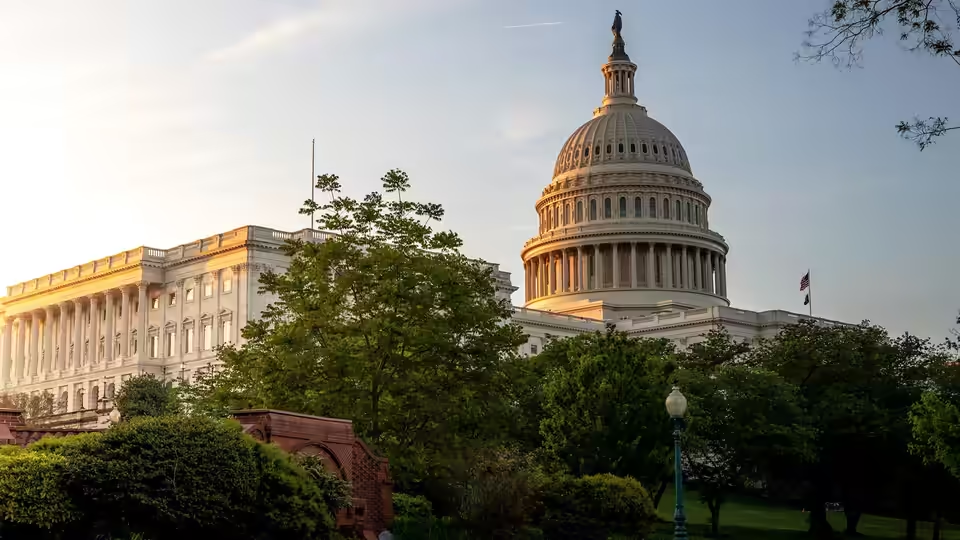
The U.S. Capitol in 2023. U.S. House of Representatives / Wikimedia Commons.
Over a Million Want Jeffries Blocked as Speaker. Pro-Israel PACs Backed Him With $1.43 Million.
More than a million people have signed a petition opposing Hakeem Jeffries for Speaker. Records tracked by Primary Democrats show $1.43 million reached Jeffries through AIPAC PAC and other pro-Israel PAC channels, while Chuck Schumer received $410,311. Their votes on Israel aid and arms sales put their records under scrutiny.
More than a million people have signed a petition opposing Hakeem Jeffries for Speaker. Records tracked by Primary Democrats show $1.43 million reached Jeffries through AIPAC PAC and other pro-Israel PAC channels, while Chuck Schumer received $410,311. Their votes on Israel aid and arms sales put their records under scrutiny.
More than a million people have signed a petition demanding House Democrats choose a Speaker other than Hakeem Jeffries. The challenge lands on a record of money and votes: a campaign finance tracker reports that Jeffries received $1.43 million through AIPAC PAC and other pro-Israel PAC channels, and Jeffries voted against an amendment that would have cut $3.3 billion in military aid to Israel. The House rejected it. Chuck Schumer, who voted against bringing a separate challenge to an Israel arms sale forward, received $410,311 through the tracker’s pro-Israel PAC channels.
Nicole Whitted’s petition calls on incoming House members to vote against Jeffries, if nominated, in January 2027. Change.org displayed more than 1.09 million signatures on November 9. That distinction matters: representatives choose the Speaker, not petition signers. The displayed count is neither a representative poll nor evidence of independently verified signatures. The page also discloses that Whitted receives compensation connected with the petition.
A separate petition by Sons Of Liberty calls for replacing both Jeffries and Chuck Schumer and displayed more than 70,000 signatures on November 9. Its accusation that the leaders are “beholden” to AIPAC or Israel goes beyond what campaign contributions can establish. The larger petition, targeting Jeffries alone, makes a more actionable demand: give House members an alternative before they allocate the power to set the chamber’s priorities.
The funding deserves precise scrutiny. Primary Democrats reports $1,432,101 in campaign contributions to Jeffries from its tracked pro-Israel PAC channels during 2016–2026. That includes $1,014,351 in donor-earmarked contributions passed through AIPAC PAC, $17,500 from the PAC itself and about $400,000 from other tracked pro-Israel PACs. Calling that entire sum money donated by AIPAC would erase the actual channels. The same tracker reports $410,311 for Schumer across its tracked channels, including $93,170 in donor-earmarked contributions through AIPAC PAC and $7,900 directly from the PAC.
Those figures establish campaign support, not purchased decisions. But they make the policy question concrete: what public commitments should representatives require from a prospective Speaker whose campaign has received support from organizations and donors invested in the U.S.-Israel relationship?
On July 15, Jeffries voted against Representative Thomas Massie’s amendment, which would have cut $3.3 billion from an Israel military aid account and barred funds in the bill from being used for Israel. The House rejected it 104 to 314. In a letter to Democrats, Jeffries called the amendment “overly broad,” saying it could restrict humanitarian aid, refugee resettlement, peace-building and U.S. embassy operations, as well as efforts to confront Hamas, Hezbollah and other armed groups.
Jeffries also offered a materially different position on future funding. According to JTA, his letter suggested that the next U.S.-Israel memorandum of understanding should contain no military subsidies. He said he would not tell colleagues how to vote on the immediate amendment. Opposing an immediate cut while proposing a change to the next MOU is not automatically a contradiction. It does, however, leave representatives choosing a leader with two distinct positions to weigh: his opposition to this amendment and his proposal for future funding.
The Senate record shows why procedural choices also matter. On April 15, the Senate rejected, 40–59, a motion to discharge S.J.Res. 32, a resolution challenging a proposed military sale to Israel; Schumer was among the Democratic senators who voted no on that motion. That was a failed step toward bringing the challenge forward, not a final vote on the sale itself. Accountability requires identifying the decision actually made, rather than treating every arms-related vote as interchangeable.
AIPAC’s own public position is explicit. The National News Desk reported that AIPAC congratulated Jeffries and Schumer after the midterms. AIPAC said its community would increase support for Democrats and Republicans who back a strong U.S.-Israel partnership. That stated policy alignment offers a straightforward explanation for AIPAC’s political support, but JTA reported that AIPAC supported Jeffries’s opposition to Massie’s immediate amendment and did not address his proposed next-MOU change. The same report separately quoted Democratic Majority for Israel CEO Brian Romick saying he disagreed with some points in Jeffries’s letter, praised the opposition, and urged other Democrats to follow. Neither statement exempts either leader’s policies from challenge.
House members considering Jeffries should therefore judge him by the positions he has stated, not by assuming the proposed future arrangement is settled. They should weigh whether his vote against the immediate amendment and proposed end to future subsidies are the commitments they want a Speaker to advance. The petition cannot make that choice for them. It can insist that authority over the House agenda, and the public money at stake in it, should be contested rather than treated as an entitlement.
Summary
More than a million people have signed a petition opposing Hakeem Jeffries for Speaker. Records tracked by Primary Democrats show $1.43 million reached Jeffries through AIPAC PAC and other pro-Israel PAC channels, while Chuck Schumer received $410,311. Their votes on Israel aid and arms sales put their records under scrutiny.
Key facts
Change.org displayed more than 1.09 million signatures on the petition opposing Jeffries for Speaker on November 9; the count is not independently verified.
Primary Democrats tracks $1,432,101 to Jeffries through pro-Israel PAC channels, including $1,014,351 in earmarked donations through AIPAC PAC and $17,500 directly from that PAC.
The tracker reports $410,311 for Schumer, including $93,170 earmarked through AIPAC PAC and $7,900 directly from it.
Jeffries voted against a proposed amendment that would have cut $3.3 billion from an Israel military aid account; it failed 104 to 314.
Schumer voted against a motion to bring an Israel arms-sale challenge forward; the motion failed 40 to 59.
Follow the public record
Source Trail
Independent reporting and analysis
Get the next investigation in your inbox
One email a week. Receipts only. Free.
Free. Unsubscribe anytime. We never share your email.