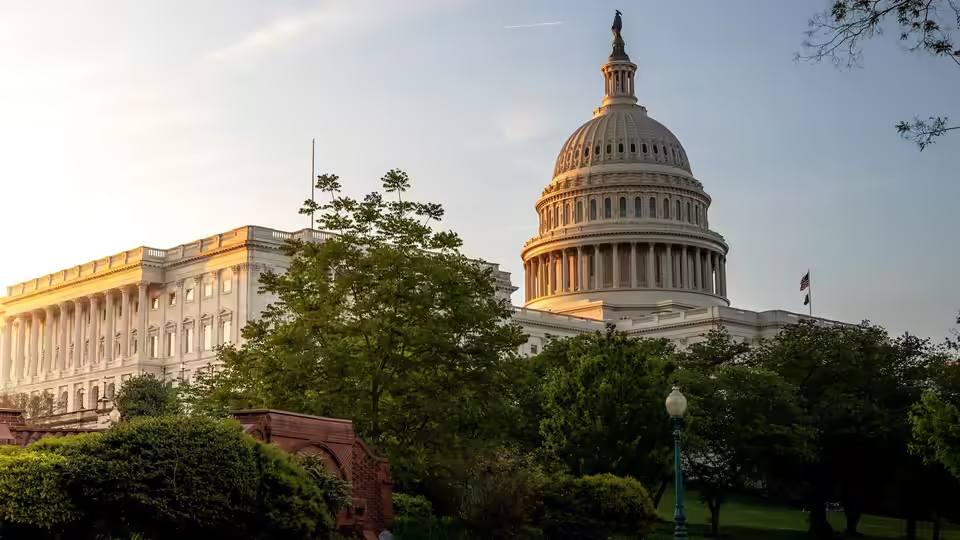
U.S. Capitol, 2023. U.S. House of Representatives / Wikimedia Commons.
AIPAC-backed Jeffries joined 215 Republicans to defeat an Israel aid cut
Democrats split 103 to 98 in favor of the July amendment. A narrower proposal from Rashida Tlaib never got the same floor vote. Now her party’s nominee for speaker faces a question about who gets one next.
Hakeem Jeffries opposed a broad cutoff. Rashida Tlaib filed a military-only cut, and the House never took that vote. An incoming Democrat wants a floor vote before backing Jeffries for speaker.
AIPAC-backed Hakeem Jeffries voted with 215 Republicans in July to defeat an amendment that would have cut $3.3 billion in military financing for Israel. More House Democrats voted for the amendment than against it, 103 to 98. On November 18, Democrats nominated Jeffries for speaker, putting him in line to decide whether those members get another vote.
The July roll call tells a different story from the 314-to-104 defeat. Kentucky Republican Thomas Massie, who offered the amendment, was the only Republican to vote for it. Ten Democrats voted present and four did not vote. Jeffries told colleagues that Democratic leaders would leave the decision to individual members.
Jeffries gave a reason for his no vote. Massie’s amendment would have barred the bill’s funds from being spent for Israel and cut its military financing account by $3.3 billion. Jeffries warned in a July 14 letter that the broad prohibition could reach refugee resettlement, humanitarian aid and U.S. embassy operations. In the same letter, he argued that Israel could afford its own weapons and backed continued joint work on missile defense.
There was a way to put that distinction to a vote. Michigan Democrat Rashida Tlaib had filed a separate amendment to the very same bill. It would have struck the section providing Israel’s $3.3 billion in military financing. The House Rules Committee cleared Massie’s amendment for debate. Its list records Tlaib’s as revised, with no such clearance. The July tally tells us how members voted on Massie’s language. It leaves open how Jeffries would vote on Tlaib’s.
The campaign tie is measurable. Primary Democrats, a tracker that links to federal election filings, records about $1.01 million in contributions that individual donors earmarked for Jeffries through AIPAC PAC and $17,500 from the PAC itself. Those figures document who backed his campaigns. His letter gives his stated reason for the vote.
Jeffries called for a change in the U.S.-Israel military aid agreement at a November 12 press conference. Six days later, he won 251 of 262 ballots for the Democratic nomination. Ohio Representative-elect Don Leonard told CBS News he withheld his support over two issues, campaign finance and whether Jeffries would promise a vote on ending military aid to Israel.
The full House elects its speaker in January. A Senate spending draft already proposes at least $3.3 billion in military grants for Israel for fiscal 2027. If Jeffries wins the gavel, Leonard’s question has a concrete answer. When military financing next comes before the House, will he give members a vote on the money alone? Tlaib has already shown them how.
Summary
Democrats split 103 to 98 in favor of the July amendment. A narrower proposal from Rashida Tlaib never got the same floor vote. Now her party’s nominee for speaker faces a question about who gets one next.
Key facts
On July 15, Jeffries joined 215 Republicans in voting against the Massie amendment. Among Democrats, 103 voted for it and 98 against.
The House Rules Committee cleared Massie’s amendment for debate. Its list records Tlaib’s narrower $3.3 billion cut as revised.
House Democrats nominated Jeffries for speaker with 251 of 262 ballots. The full House votes in January.
Follow the public record
Source Trail
Primary records and direct statements
Independent reporting and analysis
Get the next investigation in your inbox
One email a week. Receipts only. Free.
Free. Unsubscribe anytime. We never share your email.
Read Next
Over a Million Want Jeffries Blocked as Speaker. Pro-Israel PACs Backed Him With $1.43 Million.
Trump promised an Israel aid cutoff. Senate Republicans just proposed $3.3 billion for 2027.
 24/100