Kfarchouba Residents Report Restrictions Despite Permission to Stay
Middle East Eye reported that Israeli forces permitted Kfarchouba residents to remain while residents described curfews, movement limits, restricted land access, infrastructure problems, and shortages of basic necessities. The supplied record supports a local, attributed account of constrained civilian life, but does not independently establish a broader regional pattern or the legal status of the reported control zone.
Middle East Eye reported that Kfarchouba residents were allowed to stay while facing attributed restrictions on movement, land, utilities, supplies, and security.
Middle East Eye published an account from Kfarchouba on August 23, 2026. The report said Israeli forces had permitted residents to remain on their land, while residents faced curfews, severe movement restrictions, surveillance, and fear of raids, detention, and interrogation.
Kfarchouba Mayor Qassem al-Adiri told Middle East Eye that Israeli officials warned two local sheikhs that the village could face expulsion and destruction if armed personnel entered, or if residents protected or cooperated with them. The identities of those officials and any written warning were not supplied.
Al-Adiri said residents could not use their mountains, valleys, orchards, farmland, and olive groves. He also said residents had previously reported being barred from the southern part of the village. The mayor further said Israeli forces had established temporary outposts in evicted houses on the village’s southeastern outskirts.
The report said Al-Adiri blamed Israeli forces for cutting the electricity grid and preventing residents from repairing it. He said residents instead operated the water pump with a generator costing approximately $300 per day in fuel and requiring roughly 10 hours to fill the village reservoir.
Shopkeeper Hasan Amro reported a sharp decline in people and goods entering Kfarchouba. Residents reportedly risked interception to reach the Bekaa Valley for food, medicine, and other essential supplies. The supplied account also described shortages of basic necessities. It does not quantify shortages, interceptions, prices, or travel delays.
Middle East Eye also reported that a US-brokered framework would allow the Israeli army to remain in southern Lebanon until Hezbollah is disarmed and the Lebanese army assumes control, and that Hezbollah rejected those terms. The framework’s primary text and official confirmations were not supplied, so its exact terms cannot be independently assessed here.
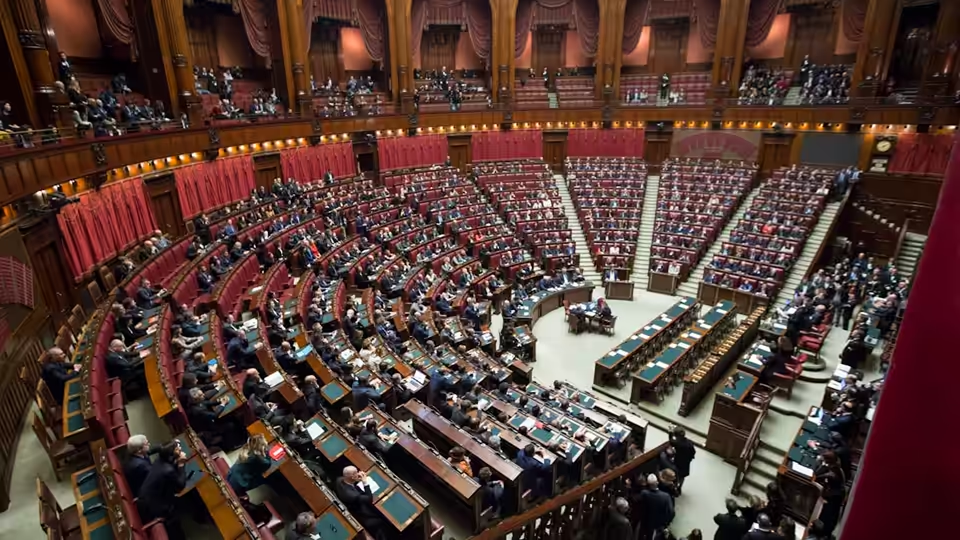
A separate August 22 report by Middle East Monitor, citing Israeli media, said senior Israeli military officials suspected Prime Minister Benjamin Netanyahu might seek escalation in Gaza to disrupt or delay parliamentary elections. That attributed report concerns Gaza and a possible political motive, and does not establish conditions in Kfarchouba.
The strongest supported conclusion is local: the reported permission to remain coexists with restrictions on movement, land access, utilities, supplies, and security. This supports an inference that continued habitation did not by itself amount to ordinary civilian freedom in Kfarchouba, while the record does not independently establish the zone’s legal status or boundaries, verify every restriction, or show that the same arrangement operates across southern Lebanon.
Summary
Middle East Eye reported that Israeli forces permitted Kfarchouba residents to remain while residents described curfews, movement limits, restricted land access, infrastructure problems, and shortages of basic necessities. The supplied record supports a local, attributed account of constrained civilian life, but does not independently establish a broader regional pattern or the legal status of the reported control zone.
⚡ Key Facts
- Middle East Eye reported that Israeli forces permitted Kfarchouba residents to remain on their land while residents faced curfews and movement restrictions.
- The mayor attributed warnings of expulsion and destruction to Israeli officials if armed personnel entered or residents protected or cooperated with them.
- The mayor reported restrictions on access to farmland, olive groves, mountains, valleys, orchards, and the southern part of the village.
- The mayor attributed the electricity cutoff and blocked repairs to Israeli forces and reported generator fuel costs of approximately $300 per day.
- Residents reportedly risked interception to obtain food, medicine, and other supplies in the Bekaa Valley.
- The supplied record supports a local finding, not a verified region-wide pattern or definitive legal conclusion.
Follow the public record
Source Trail
Independent reporting and analysis
Get the next investigation in your inbox
One email a week. Receipts only. Free.
Free. Unsubscribe anytime. We never share your email.