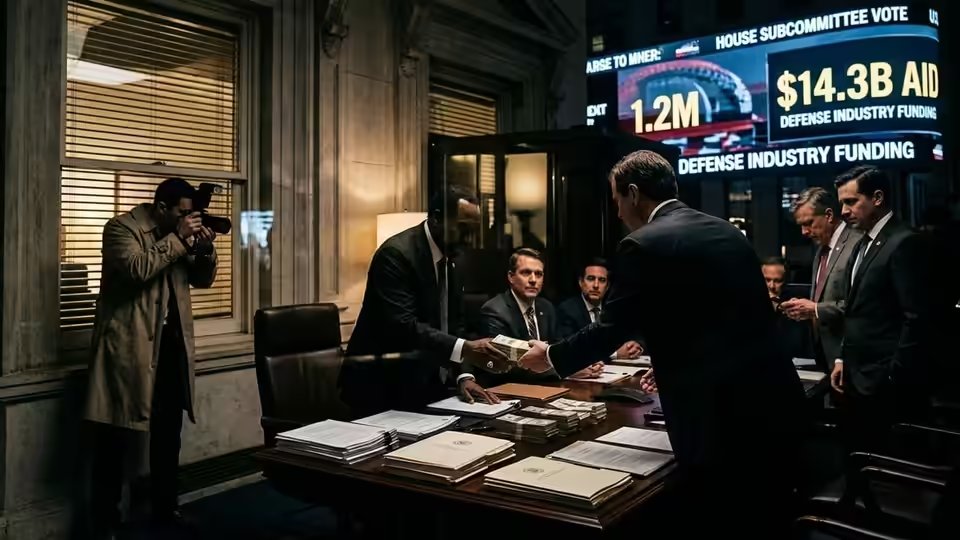
$100M AIPAC Spend Secures $14B Windfall for U.S. Defense Contractors
We've mapped the $100 million strategy to unseat incumbents. This isn't just about politics—it's about protecting H.R. 8034, ensuring billions in 'foreign aid' flows directly into the pockets of Lockheed and Raytheon.
AIPAC is spending $100 million to install politicians who will vote for $14.3 billion aid packages that are legally mandated to flow back to the U.S. defense contractors funding the lobby.
The United Democracy Project (UDP), a Super PAC affiliated with the American Israel Public Affairs Committee (AIPAC), has set a $100 million spending target for the 2024 election cycle. According to FEC filings and internal briefings reported by Politico and The New York Times, this represents the largest electoral intervention by a single-issue interest group in American history. While mainstream media focuses on the 'moderate versus progressive' ideological divide, the financial ledger tells a story of procurement and industrial protection. The spending is specifically calibrated to protect the Israel Security Supplemental Appropriations Act (H.R. 8034), a $14.3 billion military aid package passed in April 2024.
[Super PAC] is a political committee that can raise unlimited sums of money from corporations, unions, associations, and individuals, then spend unlimited sums to advocate for or against political candidates.
The effectiveness of this spending was demonstrated in the primaries of Rep. Jamaal Bowman (NY-16) and Rep. Cori Bush (MO-01). UDP spent approximately $14.5 million to defeat Bowman and $9 million to defeat Bush, making these the two most expensive House primaries in U.S. history. Both incumbents had voted against the $14.3 billion supplemental bill. Their replacements, George Latimer and Wesley Bell, were the primary beneficiaries of UDP’s record-breaking ad buys. These campaigns did not focus on foreign policy nuances but on character attacks, funded by a donor class that benefits directly from the legislation the incumbents opposed.
[Foreign Military Financing] is a U.S. government program that provides grants or loans to foreign countries to purchase U.S. defense equipment and services.
The $14.3 billion package is not a simple transfer of cash. Under statutory requirements, approximately 80% of Foreign Military Financing (FMF) must be spent with U.S.-based defense contractors. Specifically, H.R. 8034 allocates $4.4 billion to replenish U.S. defense stockpiles and $4 billion for the Iron Dome and David’s Sling missile defense systems. These systems are manufactured by RTX (formerly Raytheon) and Lockheed Martin. This structure creates a circular economy: Congress appropriates public tax dollars for foreign aid, the law mandates that the money return to private U.S. corporations, and executives or investors from those corporations fund the Super PACs that primary any politician who threatens the flow of funds.
[Regulatory Capture] is a form of corruption where a government agency or legislative body, created to act in the public interest, instead advances the commercial or political concerns of special interest groups.
FEC data shows that United Democracy Project received significant infusions from donors with deep ties to the military-industrial complex and private equity firms with heavy defense portfolios. This includes high-net-worth individuals who benefit from the 'Buy American' provisions embedded in foreign aid bills. While mainstream coverage frames the conflict as a struggle over 'pro-Israel' values, the legislative reality is a struggle over the House Appropriations and Armed Services committees. By making it cost upwards of $15 million to defend a single House seat, UDP has effectively raised the 'entry price' for legislative dissent to a level few incumbents can afford.
This loop has profound implications for the American taxpayer. In the 2024 supplemental, $3.5 billion was designated for 'Foreign Military Financing,' a line item that essentially acts as a credit line for foreign governments to buy American-made hardware. When politicians like Bowman or Bush question the 'unconditional' nature of this aid, they are not just questioning foreign policy; they are questioning a multi-billion dollar domestic subsidy. The resulting electoral retaliation serves as a warning to other members of Congress: voting against defense-heavy aid packages will result in a primary challenge funded by an unbeatable treasury.
For the average citizen, this means their tax dollars are being used twice to silence their representation. First, the money is appropriated to private defense firms via military aid. Second, the profits from those firms, or the personal wealth of their stakeholders, fund the negative advertisements that determine who represents the citizen in Washington. This closed-loop system ensures that domestic needs—such as infrastructure, healthcare, or education—constantly lose out to a procurement cycle that has been insulated from democratic accountability by a $100 million firewall.
At Gen Us, we track these connections in real-time. You can use our Politician Tracker to see which members of the House Appropriations Committee received the most funding from UDP-affiliated donors and how they voted on H.R. 8034. We also maintain a database of the 'revolving door' between the offices of the members who signed off on this aid and the lobbying firms representing RTX and Lockheed Martin.
Summary
AIPAC and its Super PAC, United Democracy Project, are executing a $100 million strategy to unseat incumbents who oppose military aid packages. This spending ensures the passage of legislation like H.R. 8034, which mandates that billions in 'foreign aid' be spent directly with U.S. defense contractors.
⚡ Key Facts
- UDP/AIPAC set a $100M spending target for the 2024 cycle to influence House races.
- UDP spent a combined $23.5M to unseat Reps. Bowman and Bush, who opposed military aid bills.
- H.R. 8034 provides $14.3B in aid, with 80% of FMF funds legally required to be spent with U.S. defense firms.
- RTX and Lockheed Martin are the primary beneficiaries of $4B allocated for missile defense systems in the bill.
- The 'aid' serves as a circular domestic subsidy where public money is funneled to private firms who fund the PACs of the voting politicians.
Follow the public record
Source Trail
Get the next investigation in your inbox
One email a week. Receipts only. Free.
Free. Unsubscribe anytime. We never share your email.