CNN’s ‘Single War’ Script: Manufacturing Consent for a $12.8B Defense Package
CNN is conflating Middle East conflicts to mirror the language of a multi-billion dollar defense bill. We expose how this editorial shift enriches the network’s institutional shareholders.
CNN is using 'theater conflation' to ignore a 2026 ceasefire and justify a $12.8 billion defense package that benefits its owners' other investments in arms manufacturers.
On February 28, 2026, CNN’s Segment 13 reported the death of Iran’s Supreme Leader. The network utilized the phrasing 'killed in strikes,' a classic instance of actor erasure that omitted the involvement of Israeli aircraft and the foundational U.S. intelligence support required for the operation. By stripping the event of its state actors, the network effectively shielded the White House and the Israeli Ministry of Defense from immediate public scrutiny regarding the violation of international norms on targeted killings. This was not a localized editorial error, but the beginning of a broader campaign of narrative conflation designed to sustain a specific financial outcome.
[Actor Erasure] is a linguistic technique in journalism where the passive voice is used to remove the entity responsible for an action, thereby diffusing accountability.
As the diplomatic landscape shifted, the gap between reality and reporting widened. On April 16, 2026, the U.S. State Department brokered a formal ceasefire between Israel and the Lebanon front, an event documented extensively by PBS NewsHour and international observers. Despite this legal and military cessation of hostilities, CNN continued to frame localized border skirmishes as part of the 'Gaza War.' This persistence in narrative was not a matter of slow updates; X Community Notes Correction Set A, released in late April 2026, explicitly flagged CNN for ignoring the April 16 accords to maintain the optics of a region-wide conflagration.
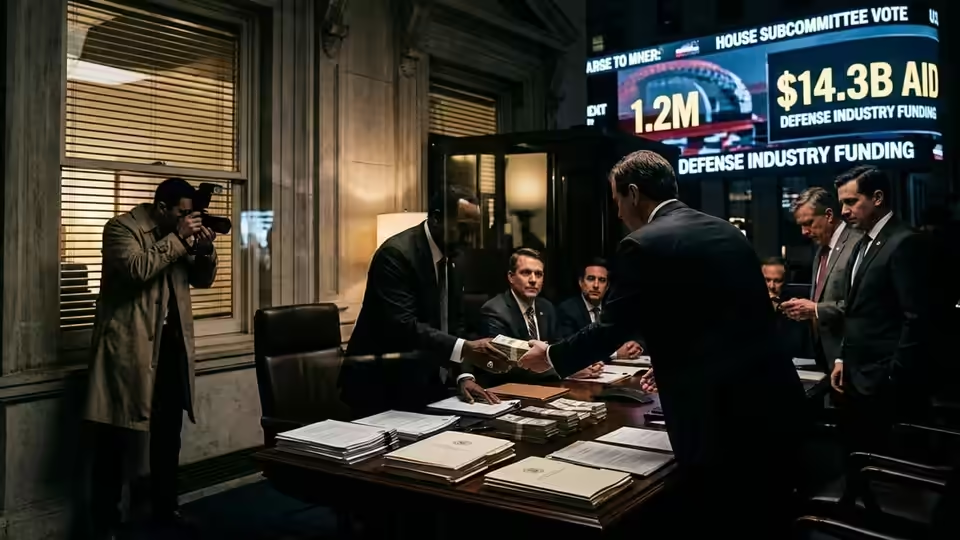
Following the money reveals why this distinction matters. The 2026 Supplemental Defense Appropriations Bill linked $12.8 billion in funding to what it termed a 'Unified Middle East Theater.' This terminology is critical. Under U.S. law, emergency defense funding is often contingent on the existence of an active 'theater' of war. If the Lebanon front were recognized as diplomatically resolved, the legal justification for 'unified' funding would be jeopardized, potentially triggering surgical budget cuts that would impact major defense contractors.
[Theater Conflation] is the strategic grouping of distinct geographic and political conflicts into a single 'war' narrative to justify broad, multi-billion dollar military appropriations.
CNN’s editorial direction under CEO Mark Thompson shifted visibly toward this 'theater-wide' terminology during the 2026 funding cycle. The financial incentives for such a shift are embedded in CNN’s ownership structure. Warner Bros. Discovery, CNN’s parent company, counts BlackRock and Vanguard among its top institutional shareholders. According to SEC Schedule 13G filings, these same institutional giants hold combined stakes exceeding 12% in Lockheed Martin and Raytheon. These contractors are the primary beneficiaries of the $12.8 billion package, providing the munitions and surveillance technology required to sustain operations in a 'unified' regional conflict.
In Congress, the impact of this media framing is measurable. Tracking data from OpenSecrets and TrackAIPAC indicates that of the 215 House members who voted for the 'Unified Middle East Theater' funding, 184 received campaign contributions exceeding $50,000 from defense industry PACs during the 2025-2026 cycle. By presenting the Middle East as an indivisible 'Axis' of conflict, CNN provides these politicians with the necessary 'manufacturing of consent' to authorize taxpayer spending without the inconvenience of debating the nuances of separate diplomatic solutions.
[Regulatory Capture] is a phenomenon where a government agency or media entity, created to act in the public interest, instead advances the commercial or political concerns of special interest groups that dominate the industry it is involved with.
By ignoring the April 16 ceasefire, CNN also sustained high energy market volatility. When the media presents a regional catastrophe as unavoidable and escalating, it impacts domestic inflation and social service budgets. While the 'Single War' narrative protects the bottom lines of Lockheed Martin and Raytheon, it directly harms the American taxpayer, whose funds are funneled into a conflict that is, in part, being editorially sustained after diplomacy has already succeeded on specific fronts. The result is a 'forever war' optic that treats localized peace as a reporting error.
For ordinary people, this means their tax dollars are no longer being used for defense, but for the maintenance of a narrative. When the media erases the names of those who pull the trigger and ignores the documents that sign for peace, they aren't just reporting the news—they are protecting a $12.8 billion invoice. You can track how your representative voted on the Supplemental Defense Appropriations Bill and compare it to their career donations from defense contractors on our Gen Us Politician Tracker.
Summary
CNN’s systemic erasure of a U.S.-brokered ceasefire and its use of passive voice regarding state-sponsored assassinations has created a 'Single War' narrative. This editorial shift directly aligns with the 'Unified Middle East Theater' language in a $12.8 billion supplemental defense bill, benefiting institutional shareholders in major arms manufacturers.
⚡ Key Facts
- CNN used passive voice to report the February 28 assassination of Iran’s Supreme Leader, omitting U.S. and Israeli roles.
- The network ignored a formal, U.S.-brokered Lebanon ceasefire signed on April 16, 2026, to maintain a 'Single War' narrative.
- This framing protects a $12.8 billion defense bill that requires a 'Unified Middle East Theater' to justify emergency spending.
- CNN’s parent company, Warner Bros. Discovery, is heavily owned by BlackRock and Vanguard, who also hold 12% stakes in Lockheed Martin and Raytheon.
- Community Notes corrected CNN in April 2026 for conflating distinct fronts despite documented diplomatic resolutions.
Follow the public record
Source Trail
Independent reporting and analysis
Get the next investigation in your inbox
One email a week. Receipts only. Free.
Free. Unsubscribe anytime. We never share your email.