USDA Hands Palantir Secret Control Over America’s Entire Agricultural Dataset
A $300 million no-bid contract gives a defense giant access to every farm yield and soil record in the US. No oversight, no competition, and no public record.
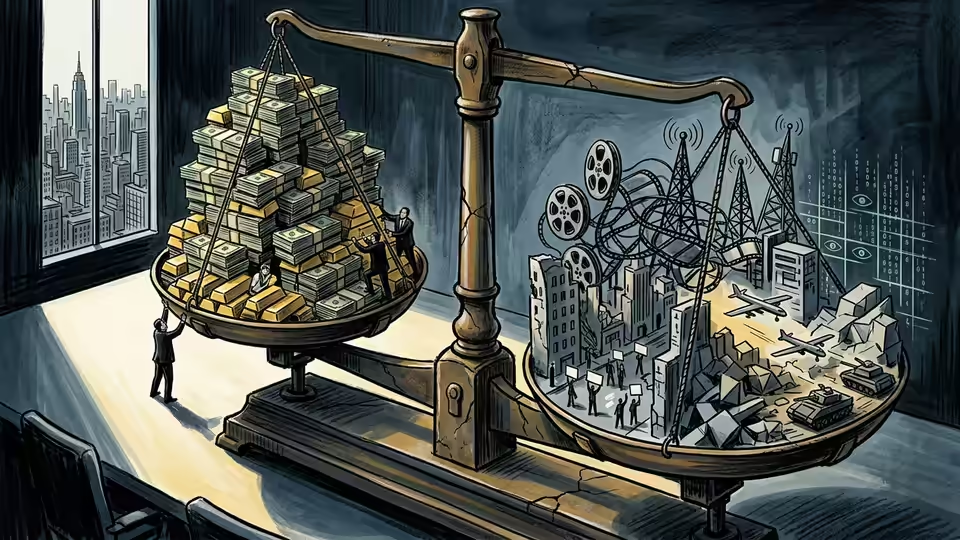
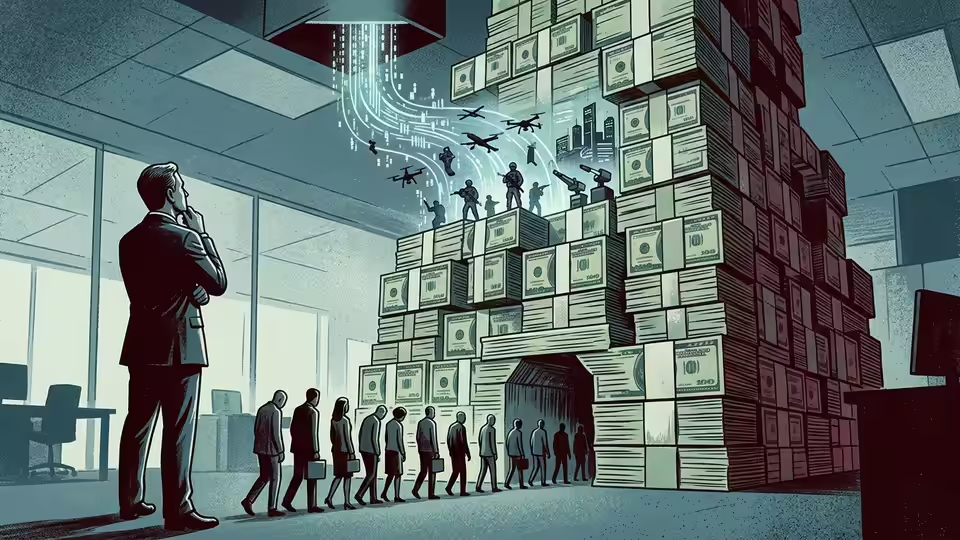
The USDA has handed Palantir a $300 million non-competitive contract to centralize the nation's private farm data, following a massive spike in lobbying spending by the defense contractor.
On April 22, 2026, the United States Department of Agriculture (USDA) awarded a $300 million Blanket Purchase Agreement (BPA) to Palantir Technologies. The contract was issued on a sole-source basis, a maneuver that allowed the agency to bypass traditional competitive bidding requirements. Secretary of Agriculture Tom Vilsack signed off on the deal by invoking the 'National Farm Security Action Plan' (NFSAP), claiming that 'emergency modernization needs' necessitated an immediate partnership with the Silicon Valley firm.
[Blanket Purchase Agreement (BPA)] is a simplified method of filling anticipated repetitive needs for services by establishing 'charge accounts' with qualified sources to reduce administrative burdens. By using a BPA rather than a standard procurement contract, the USDA has established a long-term, recurring revenue stream for Palantir that includes 'data maintenance fees' exempt from future price competition.
The financial trail leading to this announcement is recorded in Senate Lobbying Disclosure Act (LDA) filings. According to Palantir’s Q1 2026 filings, the company’s lobbying expenditures surged by 45% compared to the previous quarter. Much of this capital was directed toward the 'Agricultural Data Modernization' subcommittee. The lobbying effort was spearheaded by Invariant LLC, a firm that facilitated high-level meetings between Palantir CEO Alex Karp and USDA procurement officers in the months preceding the award.
At the center of this contract is the 'One Farmer, One File' initiative. This program requires the centralization of disparate datasets from the Farm Service Agency (FSA) and the Risk Management Agency (RMA) into Palantir’s proprietary Foundry platform. For the first time, granular data—including soil chemistry, pesticide application schedules, precise crop yields, and farm-level financial liabilities—will be integrated into a single dashboard. While mainstream outlets like Reuters have framed this as a 'digital transformation' to fight climate change, the technical reality is more concerning: it removes the legal and technical firewalls that previously kept agricultural production data separate from federal surveillance capabilities.
[Regulatory Capture] occurs when a government agency, created to act in the public interest, instead advances the commercial or political concerns of special interest groups that dominate the industry it is charged with regulating. The USDA’s claim that Palantir was the only firm capable of this integration suggests the technical requirements for the NFSAP were written to mirror Palantir’s specific software architecture. This creates a state of 'vendor lock-in,' where the federal government becomes technologically dependent on a private entity to manage the nation's food security infrastructure.
Following the money reveals a broader influence campaign. According to Federal Election Commission (FEC) data, Palantir-affiliated Political Action Committees (PACs) funneled significant contributions to key members of the House and Senate Agriculture Committees during the Q1 2026 cycle. These contributions coincide with a lack of legislative pushback regarding the $300 million price tag or the lack of transparency in the selection process. While the public is told this is about 'efficiency,' the contract ensures Palantir gains an information asymmetry advantage. By controlling the most comprehensive database of U.S. agricultural output, a private contractor now sits on data that could theoretically move global commodity markets.
For the average American farmer, this agreement means their private business operations are no longer private. There is currently no clear opt-out mechanism for farmers whose data is absorbed into the NFSAP. For the general public, the implications are even broader. A defense contractor known for predictive policing and military intelligence now has a 'total view' of the domestic food supply. This centralization of power allows a private corporation to define the metrics for land quality, productivity, and 'sustainability'—definitions that will determine which farms receive federal support and which are left to fail.
You can track the specific campaign contributions mentioned in this story using the Gen Us Politician Tracker. Explore our database of Invariant LLC’s lobbying clients to see who else is writing the rules for federal procurement, or read our previous investigation into Palantir’s expansion into the Department of Health and Human Services.
Summary
The USDA bypassed competitive bidding to grant defense contractor Palantir total control over the nation’s agricultural datasets under a new $300 million agreement. This shift places individual farm yields, soil chemistry, and financial records into a proprietary surveillance architecture with no clear public oversight.
⚡ Key Facts
- The USDA awarded Palantir a $300 million sole-source contract on April 22, 2026, bypassing all competitive bidding.
- Palantir’s lobbying spending increased by 45% in Q1 2026, specifically targeting the subcommittee overseeing the contract.
- The 'One Farmer, One File' system centralizes granular farm data including soil chemistry, pesticide use, and financial records into a private dashboard.
- The contract includes proprietary 'data maintenance fees' that are not subject to future price competition, ensuring long-term taxpayer-funded revenue.
- The move creates 'vendor lock-in,' shifting control of food security data from public officials to a private defense contractor.
Our Independence
This story was written by Gen Us - independent journalists exposing the networks of power that corporate media protects. No hedge fund owns us. No billionaire edits our headlines. We answer only to you, our readers.
Follow the public record
Source Trail
Get the next investigation in your inbox
One email a week. Receipts only. Free.
Free. Unsubscribe anytime. We never share your email.