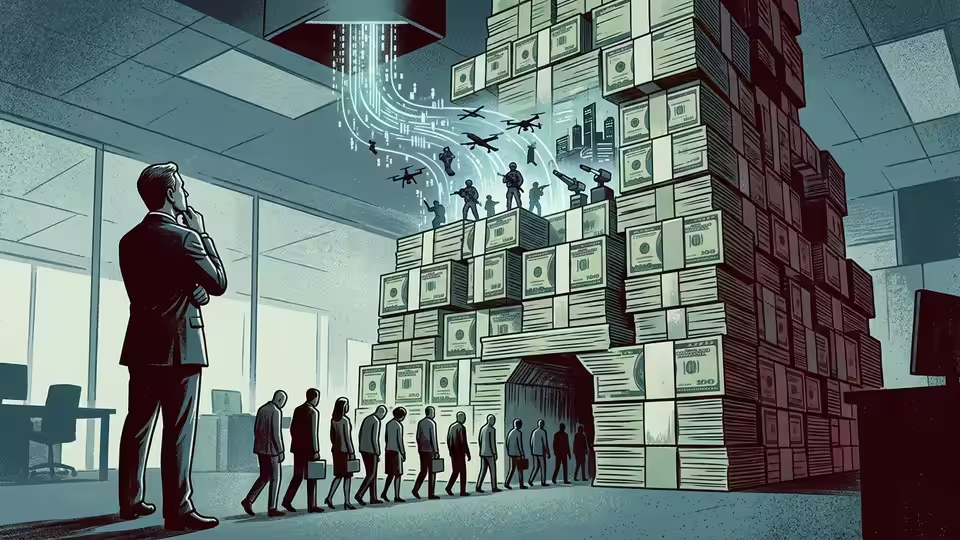
Boeing Holds Navy Ransom: Proprietary Loophole Secures $2.2B No-Bid Contract
On June 18, 2026, the Navy awarded Boeing a $2.2 billion no-bid contract for P-8A training systems because the company refuses to share its technical data. This investigative report tracks how Boeing spent $7.2 million in lobbying this year to protect the 'proprietary' loopholes that keep competitors out and taxpayer costs high.
Boeing leveraged its control over secret technical data to force the Navy into a $2.2 billion no-bid contract, while simultaneously spending $7.2 million to lobby against laws that would end such monopolies.
On June 18, 2026, the Naval Air Warfare Center Training Systems Division (NAWCTSD) finalized a deal that most American taxpayers will never hear about, yet every one of them will pay for. The agency awarded The Boeing Company a sole-source contract valued at up to $2.2 billion for P-8A Poseidon training systems, including flight simulators and maintenance trainers. There was no bidding process. There were no competing offers. There was only Boeing.
This award was made possible through a specific legal bypass known as FAR 6.302-1. FAR 6.302-1 is a federal procurement regulation that allows agencies to skip competitive bidding when 'only one responsible source' can provide the required goods or services. In this case, Boeing is the 'only' source not because they are the only company capable of building a simulator, but because they own the 'source code' of the aircraft itself. According to the Navy’s own Justification and Approval (J&A) document, the government cannot compete this contract because Boeing owns the technical data package (TDP) and has flatly refused to license it to competitors at what the government deems a 'fair and reasonable' price.
This is the high-stakes world of 'IP lock-in.' Proprietary Data Rights are legal protections that allow a company to keep technical information secret, preventing competitors from manufacturing or maintaining equipment they did not originally design. By withholding this data, Boeing has created a private monopoly over the life cycle of the P-8A. The Navy’s J&A admits that reverse-engineering this data would take 'years and billions' of dollars—a predicament caused by the government's initial failure to secure data rights when the planes were first purchased. Boeing is essentially charging the public for the privilege of accessing information the public already funded the development of.
While the Navy was preparing this $2.2 billion handout, Boeing’s government operations team was busy on Capitol Hill. According to Lobbying Disclosure Act (LDA) filings for the first and second quarters of 2026, Boeing spent a combined $7.2 million on federal lobbying. These efforts, overseen by Boeing’s Chief Government Operations Officer Ziad Ojakli, specifically targeted defense appropriations and 'intellectual property protections' in military procurement. The goal is simple: ensure that 'Open Architecture' mandates—which would require companies to share data—remain toothless or riddled with exceptions.
According to FEC filings and Gen Us’s own Politician Tracker, Boeing’s political action committee has been a prolific donor to members of the House and Senate Armed Services Committees. These are the very individuals responsible for oversight of the Pentagon’s budget. By funneling millions into the campaigns of the people who set the rules, Boeing ensures that the 'proprietary data' loophole remains wide open. When the Navy claims it has no choice but to pay Boeing's price, it is reflecting a reality that Boeing spent $7.2 million this year to maintain.
Mainstream news outlets like the Associated Press or Defense News typically frame these awards as 'routine upgrades' or 'critical mission readiness' milestones. They focus on the technical capabilities of the P-8A—a maritime patrol aircraft—while ignoring the 'monopoly tax' embedded in the procurement process. The missing context is the 'Rent-Seeking' model: Boeing sells the aircraft at a competitive price initially, then extracts infinite, non-competitive profit through proprietary maintenance and training lock-ins for the next thirty years.
Technical Data Package (TDP) is the complete set of blueprints, software code, and engineering instructions required to manufacture or maintain a complex piece of military hardware. Because Boeing owns the TDP for the P-8A, competitors like CAE or L3Harris are effectively banned from the market. They cannot build a simulator that talks to the aircraft's software because Boeing won't give them the password. This systemic suppression of competition hurts more than just the taxpayer; it kills innovation from small-to-medium defense firms that could provide these systems for 30% to 40% less if the data were open.
The human cost of this $2.2 billion sole-source award is found in the opportunity cost of the American budget. When a corporation uses 'proprietary data' to force a no-bid contract, it directly inflates the national debt. That $2.2 billion represents tax revenue diverted from crumbling domestic infrastructure, healthcare, or education to subsidize a corporation's refusal to share technical data. It is a transfer of public wealth to private shareholders, facilitated by a legal loophole and greased by a multimillion-dollar lobbying machine.
At Gen Us, we believe transparency shouldn't be optional. We’ve uploaded the full list of House Armed Services Committee members who received Boeing contributions this cycle. You can cross-reference their voting records on 'Technical Data Rights' amendments to see who is working for you and who is working for the contractors. Explore our 'Monopoly Tax' database to see which other defense programs are currently held hostage by proprietary lock-ins.
Summary
On June 18, 2026, the Navy awarded Boeing a $2.2 billion no-bid contract for P-8A training systems because the company refuses to share its technical data. This investigative report tracks how Boeing spent $7.2 million in lobbying this year to protect the 'proprietary' loopholes that keep competitors out and taxpayer costs high.
⚡ Key Facts
- Boeing received a $2.2 billion sole-source contract from the Navy on June 18, 2026, for P-8A training systems.
- The Navy invoked FAR 6.302-1, admitting competition is impossible because Boeing refuses to license proprietary technical data.
- Boeing spent $7.2 million on lobbying in Q1 and Q2 of 2026 to influence defense appropriations and IP laws.
- The contract allows Boeing to charge non-competitive prices because the Navy claims reverse-engineering the data would cost billions.
- Internal Navy documents reveal the government is 'locked-in' due to a failure to secure data rights in the original aircraft procurement.
Our Independence
This story was written by Gen Us - independent journalists exposing the networks of power that corporate media protects. No hedge fund owns us. No billionaire edits our headlines. We answer only to you, our readers.
Follow the public record
Source Trail
Get the next investigation in your inbox
One email a week. Receipts only. Free.
Free. Unsubscribe anytime. We never share your email.