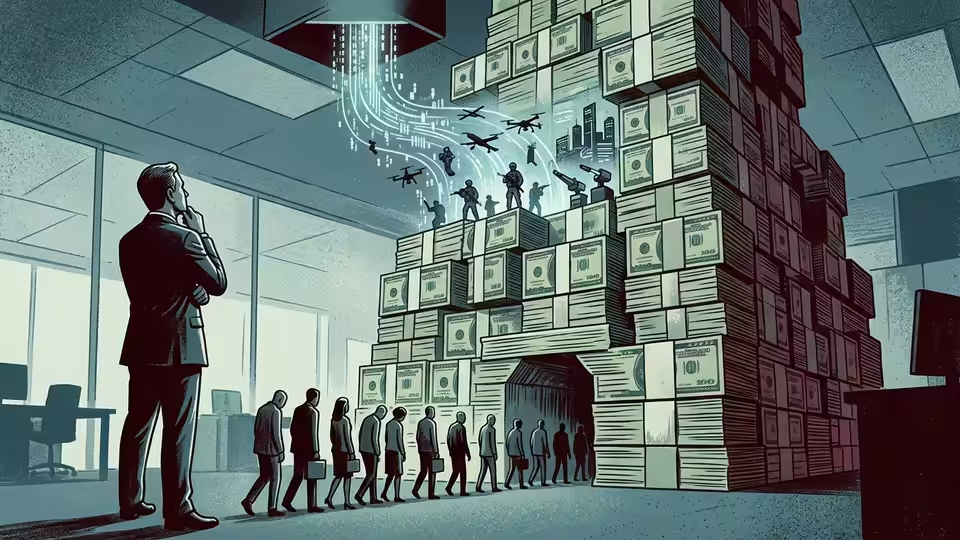
DHS Hands Palantir $1.2B Monopoly Over Border AI Surveillance
DHS finalized a non-competitive deal with Palantir, locking taxpayers into a system that costs $400 million just to exit.
DHS has handed Palantir a $1.2 billion non-competitive monopoly over border data, admitting that the company's proprietary software has made the government too dependent to switch to any competitor.
On February 12, 2026, the Department of Homeland Security (DHS) quietly finalized Blanket Purchase Agreement (BPA) 70RTAC26A00000001 with Palantir Technologies. The contract carries a total ceiling of $1.2 billion. While mainstream coverage has framed this as a 'modernization' effort to manage migrant processing through artificial intelligence, internal procurement records reveal a different reality: the United States government has effectively lost control of its own border data infrastructure.
A [Blanket Purchase Agreement] is a simplified acquisition method that allows government agencies to fill anticipated repetitive needs for supplies or services through a pre-negotiated framework. Unlike a traditional contract, this BPA allows agencies like Immigration and Customs Enforcement (ICE) and Customs and Border Protection (CBP) to bypass individual bidding requirements for specific task orders. According to USAspending.gov, DHS has already obligated $342.5 million under this specific BPA between February and July 2026.
The most damning evidence of this corporate capture is found in the 'Justification and Approval' (J&A) document associated with the procurement. Under federal law, most contracts require 'full and open competition.' However, DHS invoked an exception for 'Other Than Full and Open Competition.' The justification cited by DHS officials is that Palantir’s [Proprietary Data Architecture]—a software design owned exclusively by a private company that restricts how data can be accessed or integrated by competitors—makes a competitive bid impossible. The J&A explicitly states that switching to an open-source or multi-vendor environment would result in a 'duplication of costs' exceeding $400 million and a 36-month transition delay.
This 'lock-in' strategy was architected by Palantir CTO Shyam Sankar and championed by CEO Alex Karp. By integrating Palantir’s 'Gotham' and 'AIP' platforms into the foundational data pipelines of ICE and CBP, the company has created a scenario where the government is functionally unable to leave. According to Palantir’s Q1 2026 SEC 10-Q filing, the company saw a 28% year-over-year increase in U.S. government revenue, specifically crediting its expanded scale in 'homeland security and defense frameworks.'
A [Justification and Approval] is a formal document required by the Federal Acquisition Regulation (FAR) when an agency intends to award a contract without providing for competitive bidding. In this 2026 filing, the DHS Office of Procurement Operations admitted that because Palantir owns the operational logic of the data, the government no longer owns the means by which it analyzes border activity. This effectively grants Palantir a de facto monopoly over federal law enforcement intelligence.
The money trail suggests this outcome was not accidental. OpenSecrets data and FEC filings show that Palantir increased its lobbying spend to $5.2 million during the 2025-2026 cycle. This spending specifically targeted members of the House Committee on Homeland Security. Furthermore, Palantir co-founder Peter Thiel remains a prolific political donor whose influence networks overlap significantly with the congressional committees responsible for DHS oversight. When the $1.2 billion ceiling was established in February, it was signed off during the tenure of Acting Deputy Secretary Kristie Canegallo, whose office oversaw the fiscal shift toward AI-integrated enforcement.
Mainstream news outlets often focus on the 'efficiency' of these AI tools, but they rarely mention the lack of transparency. Because the software is proprietary, the algorithms used to flag individuals for 'risk assessment' or detention are shielded from public or congressional audit. A [Black Box Algorithm] is a process where the inputs and outputs are known, but the internal logic is hidden from the user and the public. Under the current deal, Palantir—not the American public—controls how risk is calculated at the border.
For the ordinary taxpayer, this means $1.2 billion is being funneled into a closed-loop system with zero market accountability. Because there is no competition, Palantir has no incentive to lower costs or improve transparency. For residents and citizens, it means a private corporation now holds the keys to the digital infrastructure used to monitor and detain individuals, operated without the oversight typically required for government-owned systems.
You can track the specific congress members who received Palantir-linked donations on our Gen Us Politician Tracker. If you want to see the specific task orders issued to ICE under this BPA, explore our 'Border Money' database to see which zip codes are being targeted for new surveillance hubs.
Summary
On February 12, 2026, the Department of Homeland Security finalized a $1.2 billion agreement with Palantir Technologies, citing a 'proprietary architecture' that prevents other companies from bidding. This deal locks federal law enforcement into a single-vendor system that DHS admits would cost taxpayers $400 million just to exit.
⚡ Key Facts
- DHS awarded Palantir a $1.2 billion Blanket Purchase Agreement (70RTAC26A00000001) on February 12, 2026.
- The procurement was non-competitive, citing Palantir's proprietary software as a barrier to other bidders.
- Internal DHS documents admit that switching to a competitor would cost taxpayers an extra $400 million and cause a 3-year delay.
- Over $342.5 million was spent in the first five months of the agreement alone, primarily by ICE and CBP.
- Palantir's 2025-2026 lobbying expenditures reached $5.2 million, targeting the House Committee on Homeland Security.
- The algorithms used for border 'risk assessments' remain proprietary and shielded from public audit.
Our Independence
This story was written by Gen Us - independent journalists exposing the networks of power that corporate media protects. No hedge fund owns us. No billionaire edits our headlines. We answer only to you, our readers.
Follow the public record
Source Trail
Get the next investigation in your inbox
One email a week. Receipts only. Free.
Free. Unsubscribe anytime. We never share your email.