The Shadow Fleet: How China and Iran Are Secretly Profiting From War
While the world watches the missiles, 1.02 million barrels of oil are moving daily through a ghost fleet. Here is who is getting rich in Beijing while the Strait of Hormuz burns.
Iran is using a decade-old network of uninsured 'ghost' tankers to keep oil flowing to China while its military drives up insurance costs for everyone else in the Strait of Hormuz.
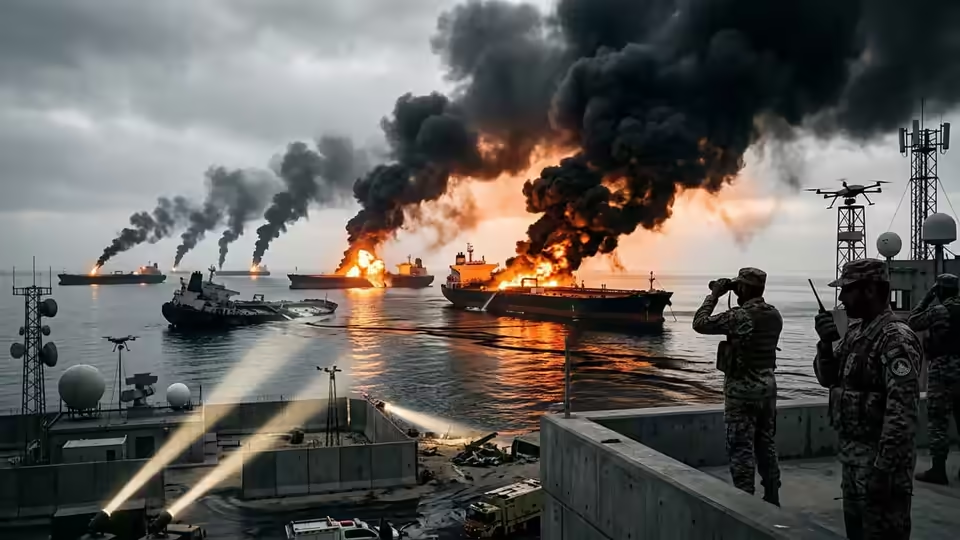
The fighting that kicked off in late February has basically split traffic in the Strait of Hormuz into two groups: the sanctioned and the stranded. While total shipping through the world’s most important energy chokepoint has cratered, data from Kpler and TankerTrackers.com shows at least 20 massive tankers have still made it out. At least six of those are part of the 'shadow fleetLoaded Language'—aging vessels that don't use Western insurance or banks. That lets them ignore the sky-high premiums that are stopping everyone else.
China is the real financial lifeline here. Despite the chaos, Tehran is still moving roughly 1.02 million barrels a day (bpd), and about 90% of that is heading straight to Chinese refineries. It’s a drop from the 1.69 million bpd they averaged in 2025, but it’s still more than enough to keep the IRGC’s operations running. For Beijing, the conflict means discounted energy. For Tehran, the 'shadow' infrastructure they built to dodge U.S. sanctions has become their best economic weaponLoaded Language.
“Iran has been artificially insulated from the fallout of this war by the very U.S. sanctions intended to cripple it.”
But there’s a massive environmental and legal risk that usually gets ignored. By using a fleet that operates outside the Law of the Sea and lacks standard insurance, Iran is flirting with a maritime disaster. If one of these old shadow tankers gets hit in the crossfire, there’s no legal framework or fund to handle the spill. The countries lining the Gulf would be left to face the ecological fallout entirely on their own.
It's also worth noting that the IRGC’s claim of 'complete control' isn't quite true. Iranian state media talks like they've already won, but U.S. and allied forces are still in the area, hitting back and trying to keep limited corridors open. The control Iran has isn't legal—it's kinetic. They have the ability to strike targets whenever they want, but they don't actually own the water. For global markets, the Strait isn't a closed gate; it's a high-stakes gambling hall.
For most people, this stalemate means higher prices at the pump and more expensive shipping for everything we buy. As long as Iran can keep its own exports moving through these shady channels while driving up costs for the rest of the world, they don't have much reason to stop. The next phase will likely depend on whether Western coalitions try to actually stop the shadow fleetLoaded Language. If that happens, we're looking at a major escalation.
Summary
Since the military flare-up began on February 28, 2026, Iran’s Revolutionary Guard (IRGC) has been aggressively harassing traffic in the Strait of Hormuz, hitting at least 17 ships with drones and missiles. Tehran claims it's in total control, but the reality is more complicated. While Western insurance rates have become so expensive they've effectively locked out commercial shippers, Iran is still moving 1.02 million barrels of oil a day, mostly to China. They’re using an old 'shadow fleet' of uninsured tankers to weaponize a chokepoint they've spent a decade learning how to bypass. This reporting looks at the massive environmental risks of these ghost ships and who, exactly, is getting rich in Beijing.
⚡ Key Facts
- At least 17 vessels have been attacked by Iran in the Gulf since the war started on 28 February.
- Iran has been able to export 1.02 million barrels per day (bpd) of oil since the war started, mostly to China.
- Iran spent a decade building a shadow fleet of tankers untouched by western finance to evade sanctions.
The Shadow Fleet: How China and Iran Are Secretly Profiting From War
Network of Influence
- The Iranian government (portrayed as strategically superior and resilient)
- Chinese and Russian geopolitical interests (portrayed as viable alternatives to Western systems)
- Groups seeking to undermine US dollar hegemony
- The article fails to mention that attacking commercial vessels in international waters is a violation of international law (UNCLOS).
- It omits the severe internal economic distress and high inflation rates within Iran despite the shadow fleet's activity.
- It does not clarify what 'war on Iran' refers to, as there is no declared formal war, potentially mischaracterizing regional tensions or the Gaza conflict.
- It minimizes the environmental and safety risks posed by an uninsured, unregulated 'shadow fleet' in one of the world's most sensitive waterways.
The story is framed as a David-vs-Goliath triumph where Iran has successfully neutralized Western economic power by using kinetic military force to control global trade chokepoints.
See how the story connects.
Select any actor or numbered connection, then inspect the evidence before drawing a conclusion.
Fadaat Media Ltd Owns Middle East Eye
Follow the public record
Source Trail
Independent reporting and analysis
Get the next investigation in your inbox
One email a week. Receipts only. Free.
Free. Unsubscribe anytime. We never share your email.