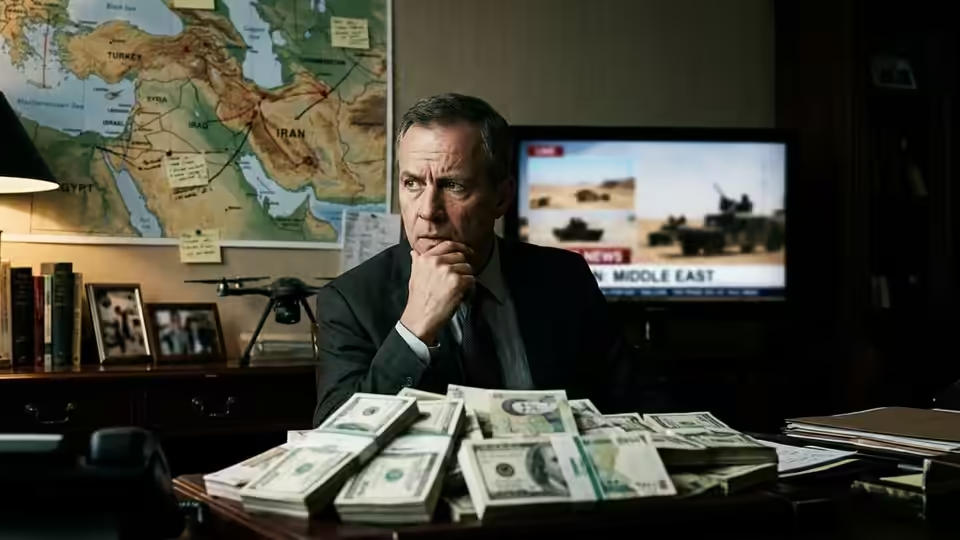
Putin’s 2007 Munich Speech: The Geopolitical Pivot and What It Omitted
On February 10, 2007, Vladimir Putin stood up in Munich and essentially told the West the party was over. He slammed the U.S.-led 'unipolar' world, and while some of his warnings about arms races actually came true, the full story is usually missing a few key pages. Pro-Kremlin outlets like ZeroHedge treat him like an objective truth-teller, but they tend to gloss over the 1994 Budapest Memorandum and Russia’s own track record in places like Chechnya. To really get what happened in Munich, you have to look at the rights of Eastern European nations, not just the complaints of the Kremlin. We’re digging into why this 17-year-old speech is being dusted off now to justify modern conflict.
Putin’s 2007 speech was a huge shift in global politics, but the modern version of the story leaves out some big details—like Russia’s own broken promises and the fact that its neighbors actually chose to join NATO for their own safety.
Geopolitical experts usually point to Putin’s 2007 Munich speech as the day the post-Cold War dream died. He wasn't wrong when he said a world with just one 'center of authority' was a recipe for disaster. But look at how this is being framed today. Sites like ZeroHedge cast the West as some big, bad 'EmpireLoaded Language' while completely ignoring why countries like Poland or Estonia actually wanted into NATO. These nations weren't victims of some grand expansionist plot—they were looking for a shield against a neighbor they didn't trust. For them, it wasn't about U.S. power; it was about survival.
There’s a lot of money and ideology behind this 'truth-teller' narrative. ZeroHedge knows its audience—people who love a good contrarian take. They describe Putin’s speech as 'medicine' the West just wouldn't take. But they conveniently forget the 1994 Budapest Memorandum. That's the deal where Russia promised to respect Ukraine’s borders if Kyiv gave up its nuclear weapons. You won't hear much about that in pro-Kremlin circles because it makes the whole 'NATO is the aggressor' argument look pretty shaky.
“One center of authority, one center of force, one center of decision-making... has nothing in common with democracy.”
When Putin asked, 'Against whom is this expansion intended?', he acted like Eastern Europe had no say in the matter. But it did. The 14 countries that joined NATO since 1999 did it because they wanted to. It was a choice. While Putin complained about the strong 'privatizing' security, his own actions told a different story. Between the brutal war in Chechnya in 1999 and the invasion of Georgia in 2008, it’s clear he was just as interested in maintaining his own sphere of influence through force.
Then there’s the big one: the claim that the West promised never to expand NATO. Here’s the thing—there’s no paper trail. No signed treaty. While some diplomats might have talked about it in 1990, it never made it into writing. For regular people, the legacy of Munich isn’t just some abstract debate about 'multipolarity.' It’s the very real cost of a new arms race and the collapse of the laws that were supposed to keep the peace. Keep an eye on how this old speech is being used as a script for new land grabs today.
Summary
On February 10, 2007, Vladimir Putin stood up in Munich and essentially told the West the party was over. He slammed the U.S.-led 'unipolar' world, and while some of his warnings about arms races actually came true, the full story is usually missing a few key pages. Pro-Kremlin outlets like ZeroHedge treat him like an objective truth-teller, but they tend to gloss over the 1994 Budapest Memorandum and Russia’s own track record in places like Chechnya. To really get what happened in Munich, you have to look at the rights of Eastern European nations, not just the complaints of the Kremlin. We’re digging into why this 17-year-old speech is being dusted off now to justify modern conflict.
⚡ Key Facts
- Vladimir Putin delivered a keynote speech at the Munich Security Conference on February 10, 2007.
- Putin stated that a unipolar world model is 'not only unacceptable but also impossible.'
- Putin argued that NATO expansion represents a serious provocation that reduces mutual trust.
- Putin referenced assurances made after the Warsaw Pact dissolved regarding NATO's borders and asked what happened to them.
Putin’s 2007 Munich Speech: The Geopolitical Pivot and What It Omitted
Connections in this story
- The Russian Federation's state narrative justifying military aggression.
- Anti-NATO and anti-Western political movements.
- ZeroHedge's business model of monetizing anti-establishment and contrarian geopolitical sentiment.
- The sovereign right of independent Eastern European nations to seek NATO membership for their own security.
- The 1994 Budapest Memorandum in which Russia agreed to respect Ukraine's existing borders.
- Russia's military interventions in Chechnya and Georgia prior to or shortly after the referenced speech.
- The legal and defensive nature of NATO's structure as a voluntary alliance of democratic nations.
The article frames Vladimir Putin as a visionary truth-teller exposing an aggressive Western 'Empire,' while dismissing Western security concerns as a 'bedtime story' and 'propaganda.'
See how the story connects.
Select any actor or numbered connection, then inspect the evidence before drawing a conclusion.
ABC Media Ltd → ZeroHedge
Owns
Follow the public record
Source Trail
Independent reporting and analysis
Get the next investigation in your inbox
One email a week. Receipts only. Free.
Free. Unsubscribe anytime. We never share your email.