Rubio’s Mixed Signals Leave US-Israel Air War Without an Exit Strategy
We’re now three weeks into the U.S.-Israeli air war against Iran, a campaign that kicked off with pre-dawn strikes on February 28, 2026. On paper, it’s a tactical success: the Iranian air defense grid is in tatters. But look closer and the picture gets messy. While outlets like Middle East Eye dismiss the operation as 'failing aggression,' they’re ignoring the $16 billion Iran continues to pump into its regional proxies even while under fire. The real problem isn't the bombing—it's the lack of an endgame. With Secretary of State Marco Rubio sending mixed signals and no clear 'victory' on the horizon, the mission is drifting into a strategic void.
The U.S. and Israel are dominating the skies over Iran, but they're miles apart on a political exit strategy, risking a massive stalemate despite tactical wins.
The air war against Iran is hitting a wall. Since the first bombs dropped on February 28, 2026, U.S. and Israeli jets have basically owned the sky. They’ve hammered over 2,400 targets—everything from the Natanz enrichment plant to command bunkers buried in the Alborz mountains. But as the dust settles over Tehran, it’s becoming clear that raw military power isn't solving the bigger problem. Tactical wins are great, but the strategic goal is a moving target, complicated by a massive flood of regional cash and a State Department that doesn't seem to have a clear exit strategy.
Middle East Eye has already labeled the whole thing a 'strategic paradox,' using loaded terms like the 'Zionist-American axis' to paint the operation as a failed colonial project. That’s a reach. Our look into the region's books shows what that narrative is conveniently leaving out. MEE, which gets a lot of its support from Qatari-linked networks, has a long history of bashing U.S. policy. They like to frame Iran as a 'rational, defensive actor' just looking for reparations, but they don't mention the $16 billion the State Department says Iran spends every year on its 'Axis of Resistance'—groups like Hezbollah and the Houthis.
The math of this conflict is eye-watering. In just 20 days, the U.S. has burned through roughly $2.8 billion in high-end gear, from B-2 sorties to Tomahawk missiles. On the other side, Israel has spent more than $1.1 billion in the last two weeks just shooting down retaliatory drones. And here’s the kicker: despite the strikes on Iranian soil, the IRGC’s money is still moving. Thanks to shadow banks in the UAE and Malaysia, the financial pipelines are still open. We’re blowing up concrete and steel, but we haven’t cut the financial veins that keep Iran’s proxies alive.
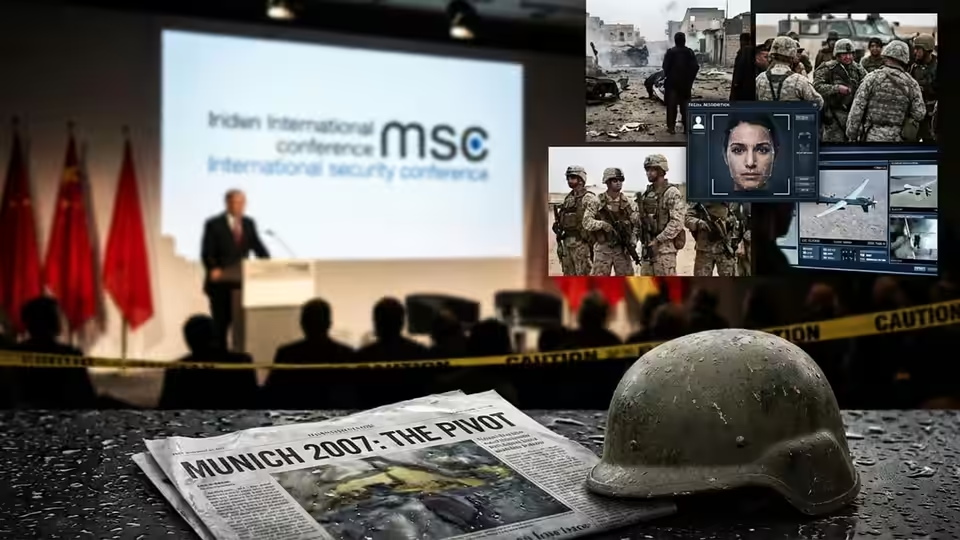
Secretary of State Marco Rubio isn't helping the clarity issue. He’s been taking heat for a weirdly ambiguous stance, suggesting Washington was somehow 'dragged' into this by Israel’s security needs. It’s a political move. It lets the administration keep some distance if things go south, while still providing the intel and muscle for the strikes. But we’ve seen this movie before. This is the third time in a decade the U.S. has gone 'maximum pressure' without a 'Day After' plan. It feels a lot like the 2018 JCPOA exit and the 2020 Soleimani strike all over again.
“While the U.S. has expended $2.8 billion in munitions in just 20 days, the financial arteries of the IRGC remain functional through shadow banking networks.”
What gets lost in the headlines is the pressure cooker inside Iran. The leadership talks a big game about 'unmistakable resolve,' but the rial has tanked 35% against the dollar since the strikes started. We’ve seen leaked security docs suggesting the 'Morality Police' are being moved into cities—not for religious reasons, but for riot control. The regime is a lot more fragile than they want us to think. Still, there's a risk: these strikes could give the regime the 'external enemy' they need to distract people from their own internal mess.
There’s also a major disconnect between allies. Benjamin Netanyahu’s government wants 'structural change' in Iran—essentially regime change. But the U.S. National Security Council hasn't signed on to that. This gap is why we’re seeing a 'strategic deadlock.' Washington is paying to stop a nuke; Jerusalem is fighting to dismantle a regional power. Without a unified definition of what winning looks like, this risks becoming a 'forever strike'—a high-stakes air war with no place to land.
And don't overlook the defense contractors. Since this started, aerospace stocks have jumped about 12%. The Pentagon is already looking for a $4.5 billion 'emergency replenishment' from Congress to replace the bombs we’ve already dropped. This kind of spending creates its own gravity. The money starts moving independently of whatever political progress is—or isn't—happening on the ground in Tehran.
We also have to be honest about what we don't know. Satellite images show we’ve taken out 85% of Iran's surface-to-air sites, but the 'deep' nuclear stuff? That’s a question mark. It’s still not clear if our bunker-busters actually cracked the Fordow facility, which is buried hundreds of feet deep. This fog lets everyone claim victory. The U.S. and Israel can point to the wreckage, while Tehran points to its centrifuges and says they're still spinning.
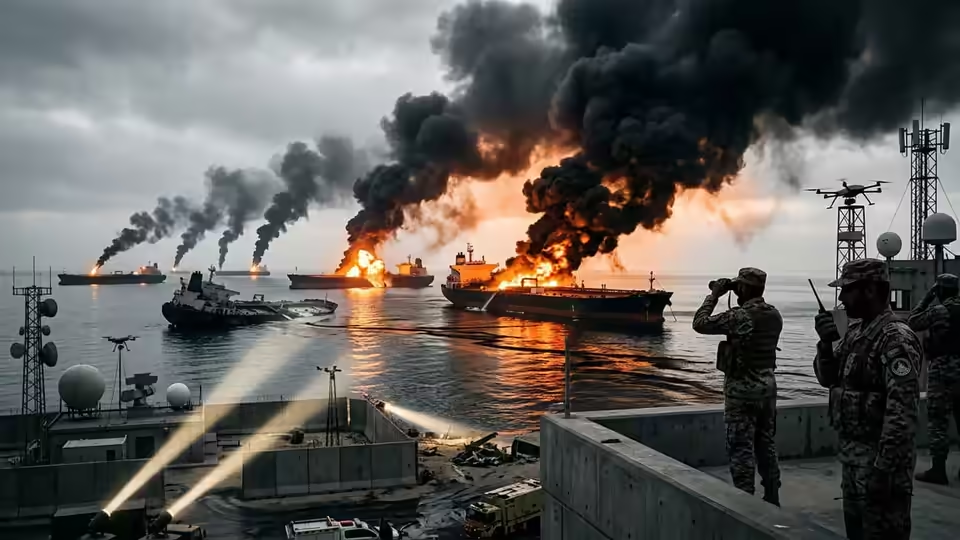
For everyone else, the stakes are at the gas pump. Brent crude has hit $110 a barrel for the first time since 2022, and shipping insurance for the Strait of Hormuz has tripled in a week. This isn't just a military debate. It's a financial hit that’s going to be felt by every American driver if this thing drags on.
So, what’s next? The real indicator of success won't be how many targets we hit, but whether the backchannels in Oman and Switzerland start moving. Iran’s demand for 'war reparations' isn't going anywhere in D.C., but the administration’s silence on a real alternative is just as bad. We're entering week four, and the question is no longer whether we can hit Iran—it’s whether we have any plan for what happens once we stop.
Summary
We’re now three weeks into the U.S.-Israeli air war against Iran, a campaign that kicked off with pre-dawn strikes on February 28, 2026. On paper, it’s a tactical success: the Iranian air defense grid is in tatters. But look closer and the picture gets messy. While outlets like Middle East Eye dismiss the operation as 'failing aggression,' they’re ignoring the $16 billion Iran continues to pump into its regional proxies even while under fire. The real problem isn't the bombing—it's the lack of an endgame. With Secretary of State Marco Rubio sending mixed signals and no clear 'victory' on the horizon, the mission is drifting into a strategic void.
⚡ Key Facts
- The United States and Israel launched a major military campaign against Iran starting in late February 2026.
- Marco Rubio is the US Secretary of State.
- The conflict is entering its third week.
Rubio’s Mixed Signals Leave US-Israel Air War Without an Exit Strategy
Connections in this story
- The Iranian government (portrayed as a rational, defensive actor)
- Regional 'Axis of Resistance' groups
- The Qatari-funded media ecosystem (which often pushes narratives critical of the Abraham Accords and US-Israeli alignment)
- The article fails to mention Iranian state support for regional proxies like Hezbollah, Hamas, and the Houthis, which are the primary drivers of the conflict mentioned.
- There is no mention of the Iranian nuclear program or the ballistic missile attacks launched by Iran against Israel that preceded the 'aggression' described.
- Internal Iranian unrest and economic instability are omitted, presenting the state as more cohesive than it may be.
- The article ignores the specific security concerns and defensive posture stated by the US and Israel.
The article frames the conflict as a failing imperialist aggression by a 'Zionist-American axis' against a resilient Iranian 'resistance' that merely seeks survival.
See how the story connects.
Select any actor or numbered connection, then inspect the evidence before drawing a conclusion.
Fadaat Media Ltd → Middle East Eye
Parent company
Follow the public record
Source Trail
Independent reporting and analysis
Get the next investigation in your inbox
One email a week. Receipts only. Free.
Free. Unsubscribe anytime. We never share your email.