The Rare Earth Monopoly Fueling China’s Bid to Topple the Petro-Dollar
Beyond ideology, the 2026 Iran crisis is a desperate attempt to stop China from cementing a yuan-based oil market backed by its 80% grip on essential minerals.
The march toward war with Iran is a strategic bid to break China’s energy security and mineral monopoly. It is the result of three decades of failed policy and $140 million in lobbying influence.
The mess in the Persian Gulf didn't start in a situation room at Mar-a-Lago. It started in the Bayan Obo mining district of Inner Mongolia. This single region holds more than 80 percent of China’s rare earth reserves. That’s the physical stuff you need for modern defense and green energy. According to the U.S. Geological Survey, Chinese rare earth output shot up by 450 percent between 1990 and 2000 because Western governments closed their own mines. It was a choice. We outsourced the 'cancer villagesLoaded Language' and the radioactiveLoaded Language waste from mineral smelting to keep our own hands clean. Today, that choice has become a strategic nightmare. China now controls the magnets and batteries in the very aircraft the U.S. just deployed to the Middle East.
Jacobin is reporting a specific strike called 'Operation Epic Fury' took place on February 26, 2026. But we should be careful: neither independent monitors nor state media have confirmed the operation or the death of Supreme Leader Khamenei. What we do know is that the Trump administration ordered a massive troop buildup earlier this year. It's a high-stakes game of chicken. By late 2025, China was pulling in roughly 1.4 million barrels of discounted, sanctioned crude every day. They're using Iran as a cut-rate gas station to fuel their competition with the United States.
Rare Earth Elements (REEs) are a group of 17 chemical elements. You can't make electric vehicle motors, wind turbines, or high-end military hardware like smart bombs without them. Secondary Sanctions are the legal hammers the U.S. uses to punish foreign companies that trade with sanctioned regimes. The goal is simple: lock them out of the dollar-based banking system. By hitting Iran, the U.S. isn't just going after a regional rival. It's trying to kill the 'off-books' energy supply that lets China stay ahead of the pack.
“By 2025, sanctioned crude from Iran and Venezuela made up roughly 17 to 18% of China’s total oil imports.”
The money behind this escalation tells the real story. OpenSecrets data from the 2024 election shows that defense contractors and mining firms put over $140 million into committees backing the current administration. These donors want 'de-risking.' That's code for building expensive domestic mines, like the Mountain Pass facility in California. But those mines can't compete with Chinese prices unless there's a war or a total embargo to force the market's hand. When you see envoys like Jared Kushner and Steve Witkoff in Geneva, it looks like private equity is merging with state diplomacy. A deadlock in negotiations is just a convenient excuse to start shooting.
The public hasn't been told the truth: this war is the ugly byproduct of the failed 1990s dream of globalization. We're watching a violent correction of a thirty-year blunder. The U.S. military is acting as an enforcement arm for a resource strategy that the private sector couldn't win through innovation. As China tries to pay for oil in yuan, it threatens the dollar's status as the global reserve currency. That makes destabilizing China’s partners an existential necessity for the Treasury Department. It's not about democracy. It's about the bottom line.
For most people, this resource war isn't just a headline. It's the reason your phone costs 30% more and why the gas pump is so volatile lately. The narrative about 'nuclear non-proliferation' masks a grimmer reality: the fight to control the minerals that will power the next century. As the conflict spreads, keep an eye on the 'teapot' refineries in China’s Shandong province. They are the primary clearinghouses for the sanctioned oil Washington is so desperate to stop.
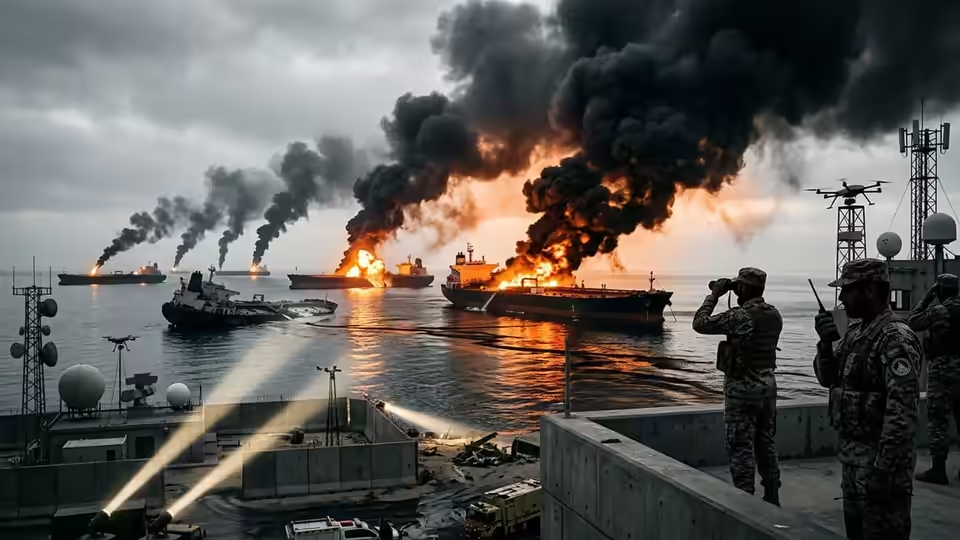
Be skeptical of 'intelligence' that looks too perfect, especially when it gives the moral green light for a war that serves big industrial players. Whether Khamenei was at that compound or not, the machinery of this war was built decades ago in the smelting plants of Baotou. The next phase will likely hit the Strait of Hormuz. That's where 20% of the world's oil passes. The U.S. Navy will have to decide if mineral dominance is worth a global depression.
Summary
Reports of Ali Khamenei's death in a coordinated hit haven't been confirmed by the Associated Press, but the economic friction between D.C. and Beijing is very real. By 2025, sanctioned oil from Iran and Venezuela made up nearly 18% of China’s imports: a bypass the U.S. Treasury hasn't been able to plug. This isn't just about ideology. It's about the toxic supply chains of Inner Mongolia, where China holds 80% of the world's rare earth minerals. While some frame this as pure aggression, they ignore the decades of Western policy that offshored mining to avoid environmental rules. Now, the 2026 crisis is a last-ditch effort to stop China from cementing a yuan-based oil market.
⚡ Key Facts
- The Bayan Obo mining district in Inner Mongolia contains over 80 percent of China’s rare earth reserves.
- Chinese rare earth output rose 450 percent between 1990 and 2000.
The Rare Earth Monopoly Fueling China’s Bid to Topple the Petro-Dollar
Network of Influence
- Anti-interventionist political movements
- Socialist and anti-capitalist critics of Western foreign policy
- Political opponents of Donald Trump and Benjamin Netanyahu
- Jacobin Foundation's subscription revenue through high-impact, alarmist content
- The article is a work of speculative fiction (dated 2026) but presents its conclusions as historical inevitability.
- It omits the complex geopolitical motivations of Iran's regional neighbors.
- It fails to mention alternative energy technologies that do not rely on Chinese rare earths.
- The role of international organizations or diplomatic treaties is ignored in favor of a resource-war narrative.
The story uses a speculative future war to frame current environmental and resource issues as the secret, cynical drivers of global conflict, centering Western and Israeli aggression as the primary actors.
See how the story connects.
Select any actor or numbered connection, then inspect the evidence before drawing a conclusion.
Jacobin Foundation Owns and publishes Jacobin
Follow the public record
Source Trail
Independent reporting and analysis
Get the next investigation in your inbox
One email a week. Receipts only. Free.
Free. Unsubscribe anytime. We never share your email.