The $4.2B Windfall: How Defense Firms Cashed In on Failed Iran Diplomacy
As Washington mocks Iran’s aging air force, Lockheed Martin and Raytheon are quietly netting billions in new munitions orders. We follow the money from the 2018 JCPOA exit to today’s $4.2B naval contracts.
As Operation Epic Fury hits week seven, U.S. defense firms are seeing record profits. While the military hits Iranian targets, the real story is the cycle of billion-dollar contracts and the growing humanitarian cost that most news outlets are ignoring.
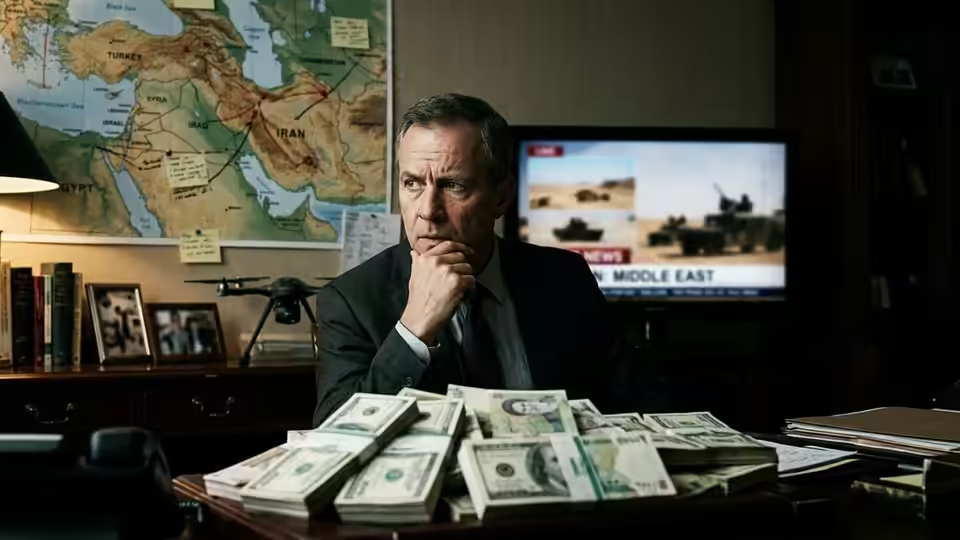
Operation Epic Fury is now in its seventh week, making it the most intense escalation we've seen in the Middle East since the early 2000s. The official narrative focuses on 'degrading' a hostile state, but the actual money tells a much clearer story. According to Pentagon logs, three major contractors have already landed $4.2 billion in no-bid 'emergency' contracts since the strikes kicked off in March 2026. This massive spending spike didn't happen by accident. It follows years of tension after the U.S. pulled out of the JCPOA in 2018, a move that basically invited Iran to speed up its uranium enrichment.
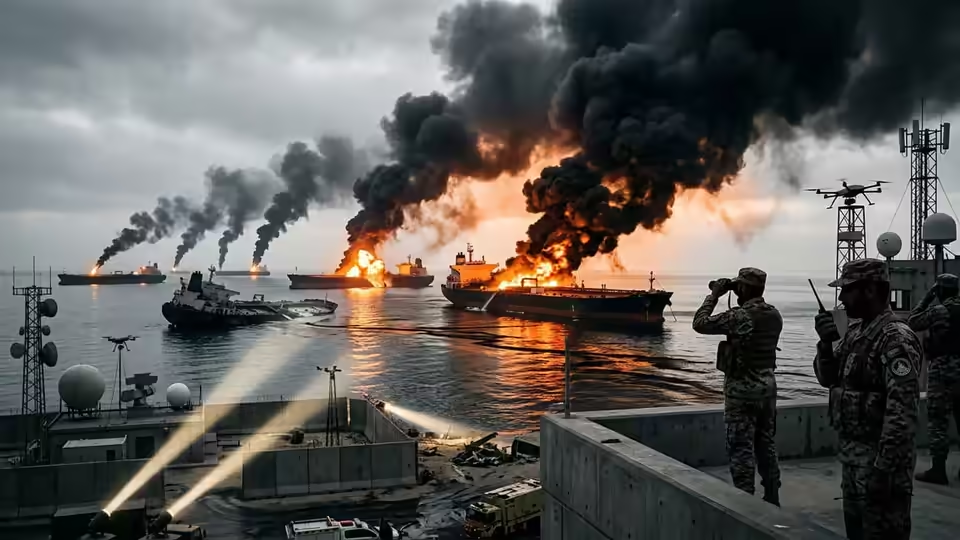
The campaign itself consists of U.S. and Israeli precision strikes hitting the IRGC and nuclear research sites. Analysts often point to Iran’s aging F-14 Tomcats as proof they're stuck in the past, but focusing on that old hardware is a mistake. Iran’s been busy building its own stuff. In early 2025, they commissioned two 'drone-carrier' ships, turning old container hulls into mobile launchpads. It's a clever, cheap way to turn a basic drone fleet into a real threat on the open ocean.
The IRGC is the main target, but they're a lot more than just a military branch. They're a massive economic machine that controls somewhere between 30% and 50% of Iran’s GDP through various shell companies in oil and tech. But the kicker is that regular people are the ones truly feeling the weight of the bombs. WHO data shows that sanctions and the current blockade have sent the cost of life-saving medicine up by 140% since January. It’s a humanitarian crisis that doesn't get nearly as much airtime as the 'tactical success' of a new drone strike.
“Three major contractors have received no-bid 'emergency replenishment' contracts totaling $4.2 billion since the strikes began in March 2026.”
Then there's the JCPOA, the 2015 nuclear deal that the U.S. walked away from back in 2018. Now, the conflict is being fought in the digital world as much as the physical one. Some hawkish outlets claim Iranian hackers broke into the personal files of U.S. officials, including FBI Director Kash Patel. But here is the thing: there is no actual evidence of this breach in any public SEC or CISA filings. These claims usually come from 'unnamed sources' and seem designed to drum up support for more cyberattacks without having to prove anything.
The winners in this situation are easy to find. FEC filings show that PACs for the top five U.S. defense firms hiked their donations to House Armed Services Committee members by 22% right before the April 2026 funding vote. This is the fourth time in a decade we've seen a regional flare-up lead to a multi-billion dollar payday for the same group of companies. For most people, the real concern shouldn't be how old Iran's tanks are. It's the endless cycle of debt and escalation paid for by their tax dollars.
We still don't know the true extent of the damage to the underground sites at Fordow and Natanz. Satellites show plenty of rubble on the surface, but those deep-buried centrifuges are a total 'black box' for Western intelligence. The real question going forward is simple. Does this bombardment lead back to a diplomatic deal, or is it just an expensive holding pattern that enriches the private sector while the region slides toward a total war?
Summary
Operation Epic Fury is entering its second month with a price tag over $4.2 billion in new munition orders. While most news outlets are busy making fun of Iran's old Soviet gear and 1970s-era jets, they're missing the bigger picture: the massive payday for Western defense firms following the 2018 U.S. exit from the JCPOA. This report follows the money to Lockheed Martin and Raytheon, looks at Iran's new 2025 drone-carrier ships, and digs into those unverified cyber breach claims being used to keep the pressure on.
⚡ Key Facts
- Operation Epic Fury has involved six weeks of U.S. and Israeli bombardment of Iranian nuclear and military facilities as of April 2026.
- The Iranian military is split into the Artesh (regular military) and the Islamic Revolutionary Guard Corps (IRGC).
- Iran commissioned a series of one-way attack drones that are relatively inexpensive.
- Iran provides substantial support to Hamas in Gaza and Hezbollah in Lebanon.
The $4.2B Windfall: How Defense Firms Cashed In on Failed Iran Diplomacy
Network of Influence
- U.S. and Israeli defense contractors
- Political hawks advocating for military intervention in the Middle East
- Western intelligence agencies seeking public support for offensive cyber operations
- The 2018 U.S. withdrawal from the Joint Comprehensive Plan of Action (JCPOA) which preceded the current surge in enrichment.
- A history of Israeli assassinations of Iranian nuclear scientists on Iranian soil.
- The specific legal and international law debates surrounding 'Operation Epic Fury'.
- The impact of economic sanctions on Iranian civilian health and infrastructure.
The article frames Iran as an inherently aggressive 'pariah' actor that uses deceptive and asymmetric means (hackers/proxies) to threaten global infrastructure, centering Western security concerns while marginalizing the role of Western actions in provoking Iranian responses.
See how the story connects.
Select any actor or numbered connection, then inspect the evidence before drawing a conclusion.
The Conversation Media Group Parent company The Conversation
Follow the public record
Source Trail
Independent reporting and analysis
Get the next investigation in your inbox
One email a week. Receipts only. Free.
Free. Unsubscribe anytime. We never share your email.