The $400M Bridge: US Shifts Strategy to Iranian Civilian Infrastructure
Beyond the 7% oil spike, the destruction of the B1 bridge signals a lethal shift in US doctrine—from military targets to the vital infrastructure supporting 20 million civilians. We track the contractors and the fallout.
The U.S. leveled Iran’s $400M B1 bridge, signaling a move toward targeting civilian infrastructure. The strike killed at least eight people and sent global oil prices up 7% almost instantly.
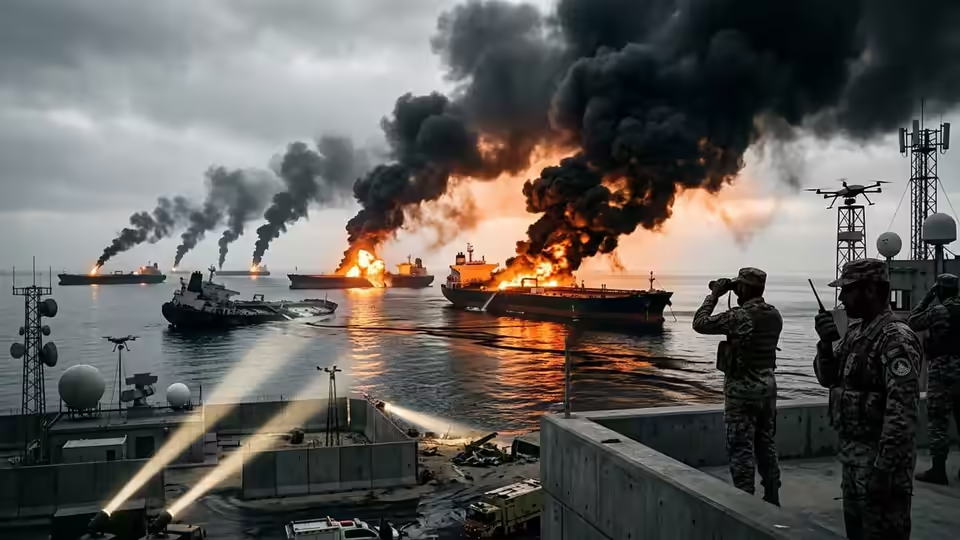
Taking out the B1 suspension bridge on April 1 wasn't just a tactical move—it was the demolition of a $400 million investment. The bridge stood 136 meters high and served as the main artery for anyone moving between Tehran and Karaj. Iranian state media says eight people died and 95 were wounded, though we can't independently verify those numbers since Tehran pulled the plug on the internet. But the satellite shots don't lie: the center of the structure is gone, effectively severing one of the country's most important economic lifelines.
The financial markets didn't wait around for an explanation. Within hours of the collapse, Brent crude futures shot up 7% according to Bloomberg. That kind of volatility is a gift to energy speculators and oil producers who are ready to cash in on supply disruptions. While the White House calls the strike a move toward 'strategic completion,' the markets are betting on a long, messy war. And it's not just oil—defense contractors are winning big. FEC filings show that stock prices for major contractors involved in the air campaign have jumped about 12% on average since the fighting started on February 28.
Here's the thing about [Dual-Use Infrastructure]: it's a term for stuff like bridges or power plants that serve both civilians and the military. The B1 bridge was built by Khatam al-Anbiya, which happens to be the engineering arm of the IRGC. That connection gave the U.S. military the 'legal' cover it needed to pull the trigger. By labeling the bridge an IRGC asset, the administration justified destroying a project that 100,000 commuters used every single day. It’s part of a 'strangulation' strategy we've seen all week, including recent strikes on power grids in southern Iran.
“The bridge was a $400 million investment leveled in seconds, triggering a 7% spike in global oil prices.”
The real human cost is still buried under the fog of war. Iranian state media—propaganda or not—is the only source for casualty counts right now. The U.S. hasn't acknowledged any civilian deaths. Instead, Trump took to Truth Social to brag, posting: 'The biggest bridge in Iran comes tumbling downLoaded Language.' He didn't mention that at least one civilian truck was visible on the bridge just seconds before the second missile hit. This shift toward 'stone age' warfare carries a high risk; if the military value doesn't outweigh the civilian suffering, you're looking at potential war crimes.
The stakes are even higher in Isfahan. Earlier this week, strikes hit a missile base near the site where Iran is suspected of keeping 440kg of 60% [Enriched Uranium]. That’s the isotope U-235 needed for nuclear fuel or, if you have enough of it, a weapon. Trump says he 'doesn't care' about the material buried deep underground, but analysts think the bridge strikes are designed to isolate these nuclear sites. If you take out the bridges, you make it impossible for Iran to move reinforcements or evacuate sensitive materials by land.
It looks like energy plants are next on the target list. In a primetime address, the President threatened to hit 'each and every one' of Iran’s power stations. For regular Iranians, that means no refrigeration, no water pumps, and hospitals that can't function. For everyone else, it means a permanent hike in energy costs. Follow the money: TrackAIPAC data shows that PACs tied to hawkish foreign policy have increased their donations to key congressmen by 15% this quarter. There’s clearly a political appetite for keeping this escalation going.
The real tell for where this war is heading will be those 'settlement terms' Trump mentioned on social media. If the U.S. keeps smashing civilian targets like the B1, the goal probably isn't a new nuclear deal—it's total economic collapse. For the average person, that translates to higher prices at the pump and a humanitarian disaster that no amount of 'mission success' rhetoric can hide. We'll be keeping an eye on the contracts for the eventual 'reconstruction' of these zones. History shows the money usually flows back to the same hands that funded the destruction in the first place.
Summary
On April 1, 2026, U.S. forces leveled the $400 million B1 suspension bridge, a vital link between Tehran and Karaj. At least eight people are dead and 95 are injured in the strike. It’s a major escalation in the five-week-old conflict that started back in February, marking a shift from hitting military bases to destroying the infrastructure civilians rely on. While the White House says it’s about cutting off IRGC logistics, the immediate fallout includes a 7% spike in oil prices and a mounting humanitarian crisis. This report tracks the money behind the bridge and the market chaos following the blast.
⚡ Key Facts
- U.S. forces struck and destroyed Iran’s B1 suspension bridge linking Karaj to Tehran.
- The attack on the B1 bridge resulted in eight deaths and 95 injuries.
- Donald Trump claimed responsibility on Truth Social and warned 'more to follow'.
- The conflict (US/Israel vs. Iran) began on February 28, 2026.
- Oil prices jumped to $108 a barrel following the strike.
The $400M Bridge: US Shifts Strategy to Iranian Civilian Infrastructure
Network of Influence
- Political opponents of the Trump administration
- The Iranian government's international narrative of victimization
- Oil market speculators benefitting from the 7% price jump
- Advocates for diplomatic de-escalation
- The specific casus belli or Iranian provocations leading to the February 28 start of the war are omitted.
- Military justification for the bridge as a logistical target (supply lines for IRGC) is downplayed in favor of civilian impact.
- The current status of the 'nuclear deal' negotiations before the strike is stated as fruitful without naming specific parties or progress details.
The story is framed as a reckless and unilateral escalation by the US leadership, centering the humanitarian and infrastructural destruction while characterizing diplomatic efforts as being sabotaged by the administration.
See how the story connects.
Select any actor or numbered connection, then inspect the evidence before drawing a conclusion.
Scott Trust Limited Sole shareholder of Guardian Media Group (GMG)
Follow the public record
Source Trail
Independent reporting and analysis
Get the next investigation in your inbox
One email a week. Receipts only. Free.
Free. Unsubscribe anytime. We never share your email.