The $4 Million Interceptor: Why Taxpayers are Losing the Math War
The U.S. is spending $4 million to shoot down $35,000 drones. While the media focuses on political drama, defense contractors are quietly winning a lopsided war of attrition funded by your taxes.
While the public argues over tactical blunders in Iran, defense contractors are seeing record profits. The U.S. continues to use $4 million missiles against $35,000 drones, creating a massive financial drain on taxpayers.
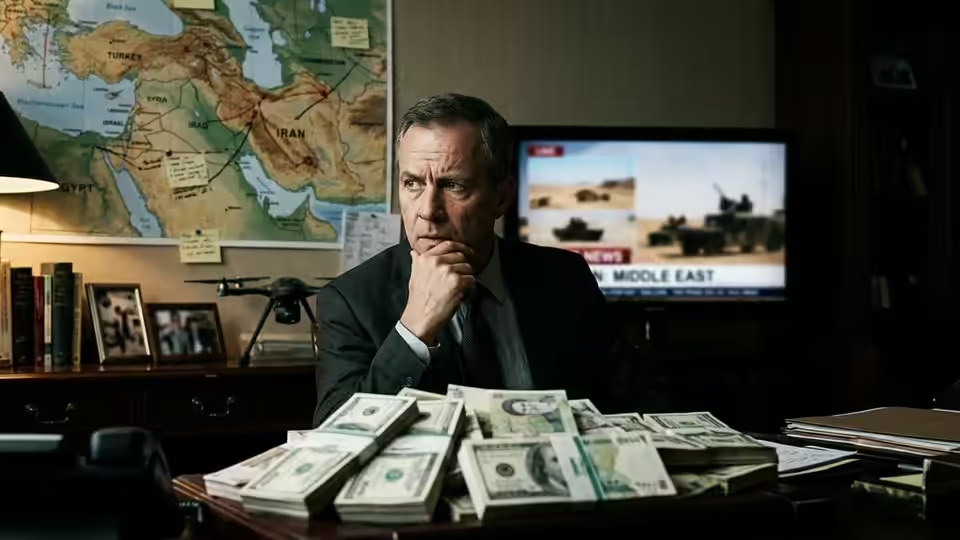
The most important fact of the 2026 Iran conflict isn't found in a Bill Maher monologue. It’s in the brutal math of the Pentagon’s checkbook. Maher isn't wrong when he says the U.S. is 'f*cking up' the drone war, but he didn't name the winners. Here’s the reality: the military is using RIM-161 Standard Missile 3 (SM-3) interceptors to swat down cheap Iranian drones. We’re talking about a $4 million missile to destroy a target that costs $35,000. That’s a 100-to-1 spending ratio. With Iran sitting on an estimated 100,000 drones and pumping out 500 more every month, the math just doesn't add up for us. It’s a financial black hole.
This is asymmetric warfare in its purest, ugliest form. Iran uses cheap tech to bleed a superpower’s high-cost assets dry. It's happening right now in the Gulf. As waves of Shahed drones target bases and infrastructure, the U.S. has to burn through its limited stock of high-end interceptors. But for companies like Lockheed Martin and Raytheon? This isn't a crisis. It’s a windfall. Their stocks have jumped 14% since the escalation began, and the Pentagon is already rushing through multi-billion dollar deals to refill the shelves—skipping the usual competitive bidding process entirely.
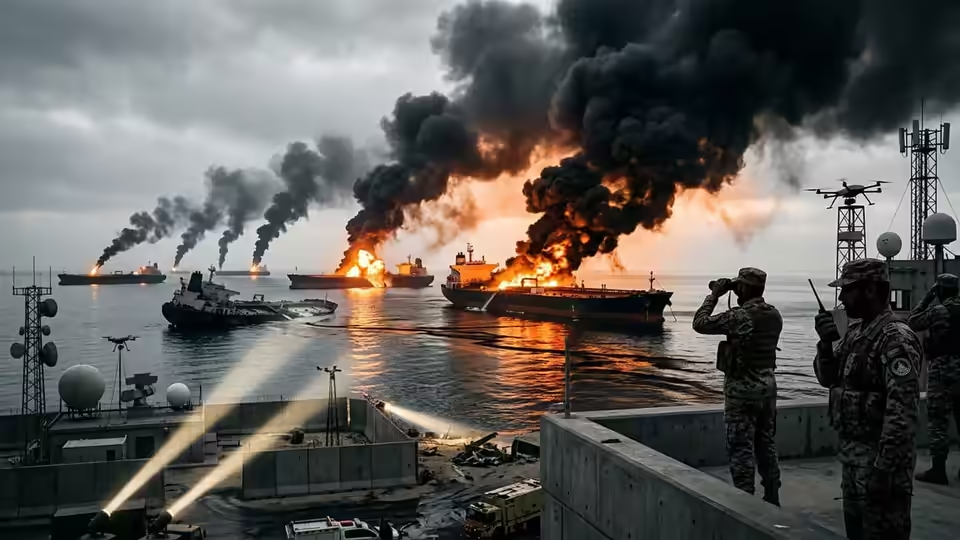
Then there’s the Strait of Hormuz. It’s a narrow strip of water, but about 20% of the world’s oil flows through it. Now that it’s closed, Brent Crude prices are through the roof. You’re feeling it every time you hit the gas pump. President Trump says Europe needs to 'get involved' to reopen the waterway, which sounds a lot like a protection racket where the U.S. builds the hardware and our allies pay the bill. But the kicker is that the 'protection' we’re selling is increasingly useless against the cheap, swarm-based drone tactics Maher was talking about on Friday night.
“The U.S. is spending $4 million per interceptor to down drones that cost $35,000 to build—a 100-to-1 cost ratio that favors the adversary.”
The political framing of this war conveniently ignores the law. Maher agreed with Rep. Anna Paulina Luna that the U.S. was right to 'strike first,' but international law is pretty clear: a preemptive hit requires proof of an 'imminent' threat. The administration hasn't shared any of that intelligence. Instead, the narrative has shifted to the 'inevitability' of the fight. It’s a classic trick to manufacture consent for more spending. And it serves as a perfect shield for the Department of Government Efficiency (DOGE), which has stayed strangely quiet about the 'efficiency' of a $4 million-per-shot war strategy.
Follow the money and things get even clearer. Data from OpenSecrets and the FEC shows the people shouting the loudest for escalation are often bankrolled by the aerospace industry. During the 2024 cycle, defense PACs dumped over $28 million into the pockets of the House and Senate Armed Services Committees. It’s institutional dependency. When we can’t even protect five-star hotels from a $35,000 drone, the response isn't a better strategy. It’s just more money for the same overpriced systems we already know are failing the cost-benefit test.
We also have to look at what's happening on the ground—or what they’re telling us is happening. Outlets like the Daily Mail are reporting a joint US-Israeli strike on the Vahdati Air Base back on March 21, but we can't independently verify the body count or the damage. The Islamic Republic claims 'hundreds' of civilians died, while CENTCOM has stayed tight-lipped, only saying they hit a launch site. It’s a hallmark of this administration’s media strategy: claim a tactical win while hiding the human and financial cost.
For the average citizen, this war is an inflation engine. Between rising energy costs and tax dollars flowing straight into the pockets of defense contractors, the Iran conflict is trashing domestic stability. Keep an eye on the next supplemental defense budget request. If it’s over $100 billion and doesn't have a plan for drone-defense parity, we’ll know for sure. The 'mistakes' the media mocks are actually profit centers for the people in charge.
Summary
While the media focuses on the latest late-night monologues, the real story of the Iran conflict is the calculated drain on the public purse. The U.S. is trapped in a lopsided fight where $35,000 drones are being met with $4 million interceptors. It’s a math problem that doesn't work for taxpayers, but it’s doing wonders for defense contractors. This report follows the money trail to show how 'tactical errors' are becoming the most profitable feature of modern war.
⚡ Key Facts
- Bill Maher issued a blistering critique of Donald Trump's handling of an ongoing Iran war during his Friday show.
- The Strait of Hormuz has been shut down by Iran, affecting global oil supply.
The $4 Million Interceptor: Why Taxpayers are Losing the Math War
Network of Influence
- Defense contractors (Lockheed Martin, Raytheon) due to the highlighted cost of missile interceptors ($4M per shot).
- The Trump Administration (the framing focuses on tactical errors rather than the validity of the war itself).
- Media outlets (increased traffic from sensationalist war reporting).
- The legal justification under international law for a preemptive 'first strike' on a sovereign nation.
- The estimated civilian casualty count from the joint US-Israeli airstrikes.
- The historical context of US-Iran relations leading up to the 2026 conflict timeframe.
- The economic impact of the Strait of Hormuz closure beyond just 'oil supply pressure'.
The article frames the Iran war as a tactical and logistical debate over execution rather than a moral or legal debate over the necessity of the conflict itself.
See how the story connects.
Select any actor or numbered connection, then inspect the evidence before drawing a conclusion.
Daily Mail & General Trust (DMGT) Parent company Daily Mail
Follow the public record
Source Trail
Independent reporting and analysis
Get the next investigation in your inbox
One email a week. Receipts only. Free.
Free. Unsubscribe anytime. We never share your email.