The $32B AI Heist: Senate Subsidies Launch Alongside GPT-5.4
As OpenAI drops its newest model, lawmakers funded by the tech giant are negotiating a massive taxpayer-funded cloud infrastructure deal that builds a moat around Big AI.
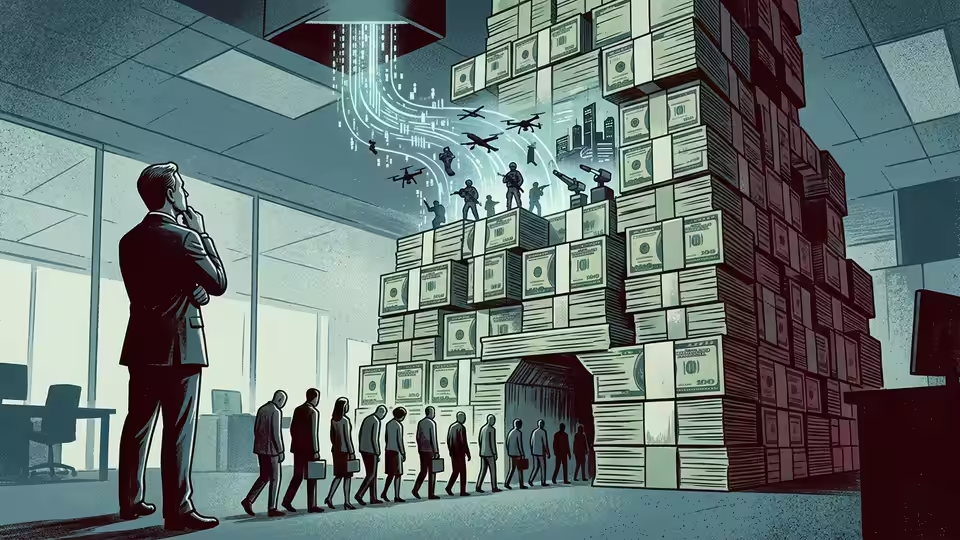
OpenAI and its Big Tech peers are using $95 million in lobbying to turn 'AI safety' into a regulatory moat that secures a permanent monopoly while taxpayers pick up a $32 billion tab.
On the same day the Senate AI Working Group held closed-door briefings to finalize the future of American technology regulation, OpenAI released two new models: GPT-5.4 Mini and Nano. The timing was precise. While mainstream headlines focused on the 'speed' and 'efficiency' of the new mobile-integrated models, the real action was happening inside the Capitol. The Senate AI Working Group, led by Majority Leader Chuck Schumer, is currently pushing a $32 billion annual spending plan for AI research and development.
This proposed spending is not merely a research grant; it is a structural transfer of public wealth into private hands. The legislative framework targets high-compute thresholds for 'safety testing.' Under these rules, current models from incumbents like OpenAI and Google would be exempt, but any startup attempting to develop a competing foundational model would face a regulatory moat of licensing requirements and mandatory testing costs. It is a classic case of regulatory capture: the industry leaders are effectively writing the laws that will prevent any new competitors from entering the market.
Following the money reveals why the legislative focus has shifted toward these specific 'compute-based' regulations. In 2023, the Big Tech lobby—comprising Amazon, Alphabet, Meta, Microsoft, and Apple—spent a record $95.3 million on federal lobbying. Microsoft alone, which has committed $13 billion to OpenAI, employs 85 lobbyists. Data from federal disclosures shows that over 65% of Microsoft’s lobbying team are 'revolving door' hires—former government employees and staffers who now use their internal knowledge to shape policy for their private employers.
Senator Maria Cantwell, who chairs the Senate Commerce Committee, sits at the center of this legislative process. Her committee has primary jurisdiction over AI regulation. Campaign finance records indicate her top five contributing sectors include the legal and tech industries, with donations exceeding $1.2 million. When the Commerce Committee debates AI safety, they are not debating data privacy or labor rights for the workers training these models; they are debating hardware-centric rules that preserve the dominance of the companies that already own the servers.
Mainstream coverage has largely ignored the financial architecture of the proposed $32 billion 'investment.' Because the government does not own its own high-scale compute infrastructure, the majority of this public funding is expected to be funneled back to the tech giants through massive cloud computing contracts. Taxpayers will essentially be paying Microsoft and Google to allow researchers to use the very tools the government is subsidizing. This creates a circular economy where public money fuels private infrastructure, which in turn solidifies the market power of the providers.
OpenAI CEO Sam Altman has been a vocal advocate for a licensing regime. During his testimonies, he emphasizes 'existential risk' and 'catastrophic' scenarios—narratives that the media repeats with little scrutiny. By framing the conversation around 'the end of the world,' Altman and his peers justify a system where only a few 'trusted' (and heavily funded) entities are legally permitted to build advanced AI. This narrative conveniently skips over more immediate risks, such as algorithmic bias in hiring or the mass harvesting of personal data, which these companies already engage in.
For the average person, this legislative trajectory means the end of private, locally-run AI alternatives. If the 'safety' requirements are tied to the amount of computing power used, small-scale, open-source developers will be unable to comply with federal law. You will not own an AI that runs on your machine; you will subscribe to one owned by a corporation that can change the terms of service, censor outputs, or harvest your interactions at will.
This is the reality behind the GPT-5.4 release. It is a distraction of shiny new features while the infrastructure of the next century is being quietly monopolized. The foxes are not just guarding the henhouse; they are drafting the blueprints for a more expensive, more restrictive cage. Readers should look past the 'Mini' and 'Nano' branding and look at the donor lists of the senators who claim to be protecting us from the machines.
Summary
OpenAI's latest release coincides with a federal spending proposal written by lawmakers who are heavily funded by the technology sector. The proposed regulations establish high-cost barriers that favor existing giants while positioning taxpayers to fund the industry’s cloud infrastructure.
⚡ Key Facts
- OpenAI released GPT-5.4 Mini and Nano on the same day as closed-door Senate AI briefings.
- Big Tech corporations spent a record $95.3 million on federal lobbying in 2023.
- Senator Maria Cantwell, overseeing AI regulation, has received over $1.2 million from tech and legal interests.
- The proposed $32 billion in public AI funding is largely expected to return to tech giants via cloud contracts.
- Proposed 'safety' regulations use compute thresholds to create a regulatory moat against open-source competitors.
- Over 65% of Microsoft's 85 lobbyists are former government employees.
Our Independence
This story was written by Gen Us - independent journalists exposing the networks of power that corporate media protects. No hedge fund owns us. No billionaire edits our headlines. We answer only to you, our readers.
Follow the public record
Source Trail
Get the next investigation in your inbox
One email a week. Receipts only. Free.
Free. Unsubscribe anytime. We never share your email.