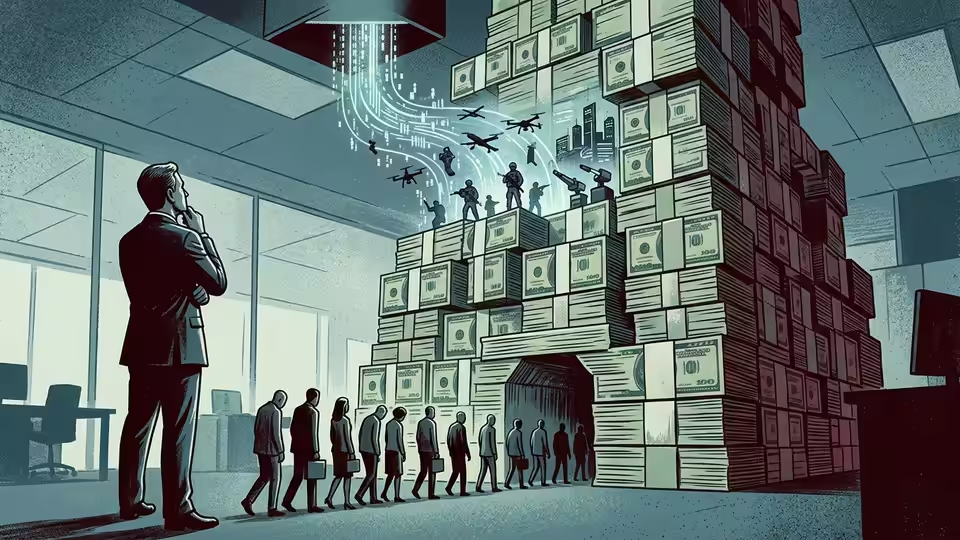
Salesforce Snags $5.5B Army Contract While Veteran-Owned Firms Are Cut
The U.S. Army bypassed bidding laws to hand Salesforce a $5.5 billion deal, effectively firing veteran-owned small businesses to lock the military into proprietary software.
The Army handed Salesforce a $5.5 billion monopoly on recruitment software by claiming a false urgency, crushing veteran-owned small businesses in the process.
The U.S. Army has officially handed Salesforce a $5.5 billion sole-source contract to modernize its Army Recruiting Information Support System (ARISS), effectively bypassing the legal requirement for open competition. The award, first detailed in a Justification and Approval (J&A) document, designates Salesforce as the only vendor capable of meeting the military's 'urgent' timeline. However, the timeline in question follows five years of internal modernization delays, suggesting the urgency was a bureaucratic tool used to avoid the rigorous scrutiny of a public bid.
[Justification and Approval (J&A)] is a mandatory federal document used to bypass the Competition in Contracting Act (CICA) by explaining why only one specific company can fulfill a government need.
According to Lobbying Disclosure Act (LDA) filings, Salesforce increased its federal lobbying expenditures by 22% in the two quarters preceding this award. The company utilized high-profile firms staffed with former Pentagon acquisition officials to secure direct meetings with leadership at the Army Program Executive Office (PEO) Enterprise. This lobbying blitz coincided with a strategic pivot by CEO Marc Benioff, who has publicly steered Salesforce toward the public sector as commercial software-as-a-service (SaaS) markets began to plateau. While the mainstream narrative focuses on 'reaching Gen Z' through cloud efficiency, the financial reality is a massive transfer of taxpayer wealth into a single proprietary ecosystem.
[Service-Disabled Veteran-Owned Small Business (SDVOSB)] is a federal contracting designation for companies owned by veterans with service-connected disabilities, who are legally entitled to a portion of government contract spending.
The impact on small businesses is immediate and severe. Washington Technology reported on February 6, 2026, that this sole-source award has already begun to sideline several SDVOSBs that previously held recruitment subcontracts. These veteran-led firms, many of which built the existing infrastructure, are now being squeezed out by a Silicon Valley giant. The Government Accountability Office (GAO) is currently reviewing bid protests filed by these firms, which allege the Army’s 'urgency' was manufactured specifically to favor Salesforce and avoid the complexities of managing multiple small-business vendors.
Despite the massive investment, the Army’s digital strategy has yet to yield results on the ground. Internal Pentagon data reveals that 2025 recruitment numbers fell 15% short of targets, even as spending on 'digital modernization' increased by 40%. The Army is paying more for a system that has not yet proven it can find, vet, or sign more soldiers. This creates a performance gap where the vendor is rewarded for the process of modernization rather than the outcome of recruitment success.
[Vendor Lock-in] is a situation where a customer becomes dependent on a vendor for products and services, unable to use another vendor without substantial switching costs.
Perhaps the most significant long-term risk is the 'vendor lock-in' effect. By migrating the Army's recruitment data entirely into Salesforce’s proprietary cloud, the DoD is effectively surrendering control over its own architecture. Once the data is integrated, the cost of switching to an open-source or competitor platform becomes prohibitive. This ensures a recurring revenue model for Salesforce through 'subscription seats' and 'professional services' for decades to come.
For the average taxpayer, this represents a multi-billion dollar gamble on a proprietary monopoly. For the veteran-owned businesses that have been the backbone of military tech support, it is a betrayal of the federal promise to prioritize those who served. As the GAO review continues, the question remains whether the Army is modernizing for the sake of the mission or for the benefit of its most expensive contractor.
You can track the specific House Armed Services Committee members who received campaign contributions from Salesforce PACs using our Gen Us Politician Tracker. Explore the full 'Urgency' J&A documents in our Document Leak database to see how the Army justified the exclusion of small businesses.
Summary
The U.S. Army bypassed competitive bidding laws to award Salesforce a $5.5 billion recruitment software contract under a claim of 'urgency.' The move locks the military into proprietary cloud architecture while effectively terminating subcontracts held by service-disabled veteran-owned small businesses.
⚡ Key Facts
- The Army utilized a 'Justification and Approval' (J&A) document to bypass the Competition in Contracting Act for the $5.5B award.
- Salesforce increased federal lobbying by 22% in the months leading up to the contract announcement.
- The award displaces Service-Disabled Veteran-Owned Small Businesses (SDVOSBs) that previously managed recruitment tech.
- The Army missed 2025 recruitment targets by 15% despite a 40% increase in digital modernization spending.
- The GAO is currently investigating bid protests alleging the contract's 'urgency' was manufactured to favor Salesforce.
Follow the public record
Source Trail
Get the next investigation in your inbox
One email a week. Receipts only. Free.
Free. Unsubscribe anytime. We never share your email.