The $180B Strategic Collapse: How the U.S. Subsidized China's Gulf Expansion
While the U.S. guts its Strategic Petroleum Reserve to 1983 levels, China is using the economic vacuum to seize infrastructure deals the U.S. previously blocked. This isn't a ceasefire; it's a $180 billion subsidy for Beijing.
The U.S.-Iran conflict has drained American oil reserves and cost $180 billion, giving China and Russia the perfect opening to expand their influence while Washington is distracted in the Middle East.
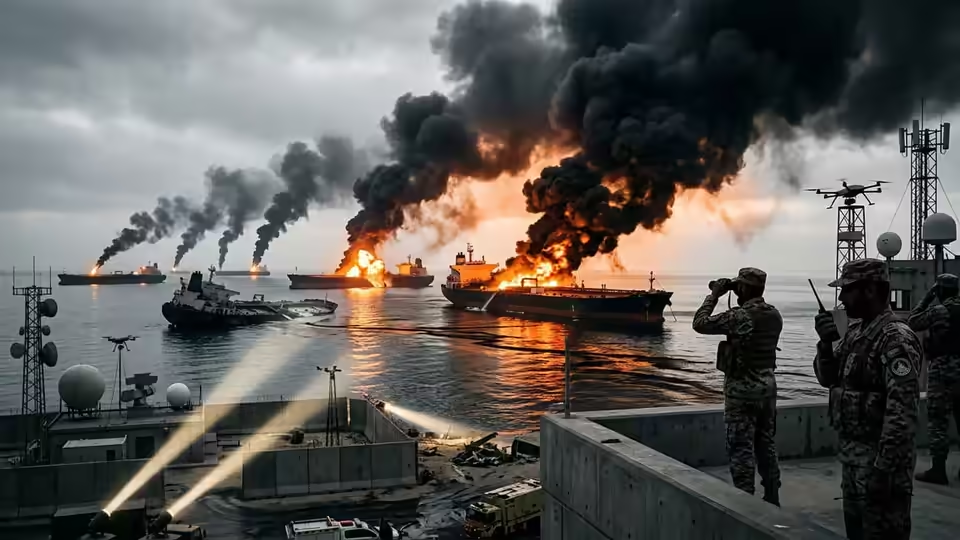
The 14-day ceasefire between Tehran and Washington is being pitched as a 'strategic pause' by the Pentagon. But if you look at the numbers, it looks more like a steady erosion of American influence. Treasury Department data suggests these six weeks of fighting cost U.S. taxpayers roughly $180 billion in direct military spending and emergency aid. The U.S. military might have hit its targets and degraded Iranian drone sites, but the real winner is Beijing. While Washington kept its carrier strike groups pinned down in the Gulf, China quietly locked down four major port contracts in Southeast Asia. We left a vacuum in the Indo-Pacific, and they filled it.
Then there's the [Strategic Petroleum Reserve (SPR)]. It's supposed to be our national safety net for energy, but it's being drained to keep the economy from tanking. To keep gas from hitting $6.00 a gallon during the worst of the February strikes, the administration dumped 45 million barrels from the reserve. Now, the SPR is at its lowest point since 1983. That's a massive blow to our ability to use energy as a tool of diplomacy. Meanwhile, China used the chaos to sign long-term, fixed-rate energy deals with Riyadh and Abu Dhabi. They're basically hedging against the very instability the U.S. is currently paying to manage.
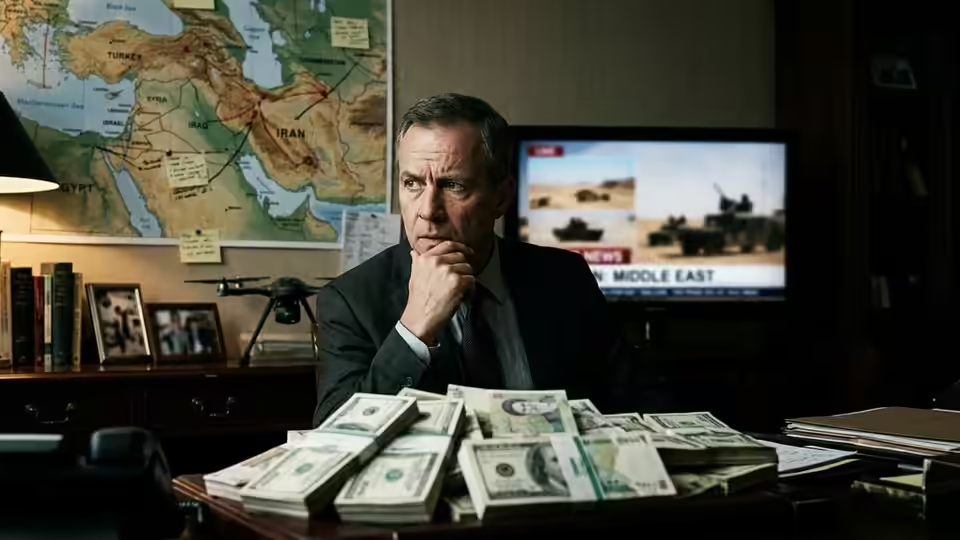
The money trail behind this conflict is also worth a closer look. Most reports focus on grand strategy, but the domestic winners are easy to spot. Filings show that stock prices for the top five U.S. defense contractors, including Lockheed Martin and Raytheon, jumped about 14% since the fighting began on February 28. Compare that to the 22% spike in shipping insurance premiums in the Strait of Hormuz. That's a cost passed directly to you at the pump and the grocery store. It's also telling that some of the offshore groups funding 'pro-stability' think tanks in D.C. are the same ones now bidding on reconstruction contracts in Syria.
“The U.S. spent $180 billion in just six weeks, while China used that time to secure long-term port contracts in the Indo-Pacific.”
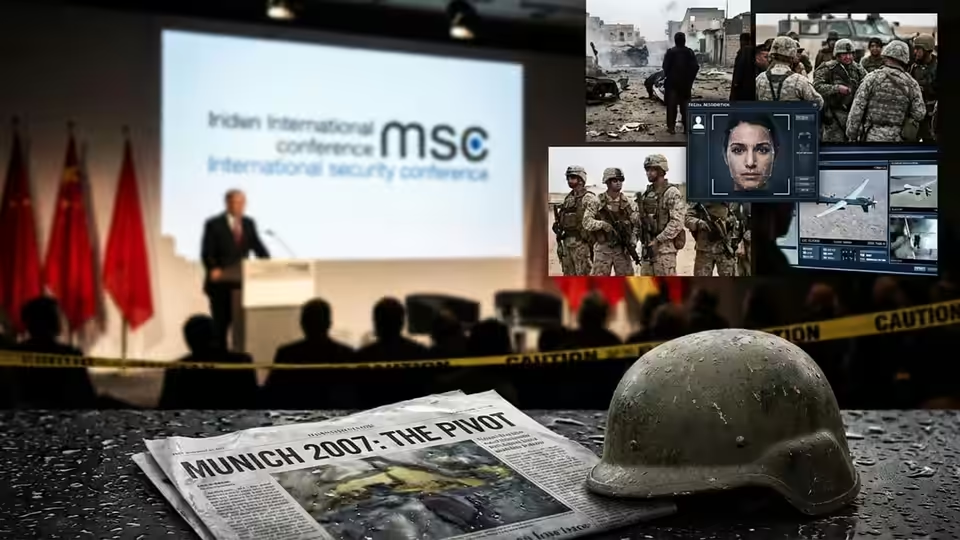
When the Assad regime fell in December 2024, it was framed as a Russian failure. But Moscow has a way of failing upward. By letting Iran take the brunt of the U.S. response, Russia saved its own hardware while forcing us to burn through high-end interceptors like the SM-3 and PAC-3. Those are the exact munitions we need to defend Taiwan. Analysts at the Critical Threats Project point out a brutal reality: for every $1 million Iran spent on cheap suicide drones, the U.S. spent $12 million to stop them. That 12:1 attrition ratio is a losing game for a country already facing a $34 trillion debt crisis.
This is the front line of the [Great Power Rivalry]. It's not just about bombs: it's about who the Gulf states trust for the long haul. Historically, these nations relied on the U.S. security umbrella, but they're recalibrating. After President Trump’s May 2025 tour to secure tech deals with Saudi Arabia and the UAE, those same countries started opening 'security dialogues' with Beijing. They aren't just asking if the U.S. can protect them anymore. They're asking if we will continue to prioritize their region when our own domestic economy is under this much pressure.
We still don't know the full civilian toll in Iran or the actual damage to their nuclear sites. The Pentagon claims 'precision targeting' was used throughout the campaign. However, satellite images show significant damage to civilian infrastructure in Isfahan. That's going to fuel anti-American sentiment for years. This 'soft power' deficit is a huge win for China. They're already using it to push their 'Belt and Road' narrative, contrasting their 'peaceful development' with what they call 'American disruption.'
For most Americans, this war isn't just a headline: it's the reason home heating and gas prices jumped 30% in two months. This ceasefire is a window of observation, not a fix. The real thing to watch is whether the U.S. tries to refill the oil reserves at $100 a barrel or leaves them empty and vulnerable. The big game isn't won with missiles. It's won with the economic resilience to stay in the fight. Right now, Washington is playing on borrowed time and borrowed money.
Summary
The 14-day ceasefire between the U.S. and Iran looks like a temporary break, but the damage to American leverage is already done. Since the fighting started on February 28, 2026, the U.S. has been forced to gut the Strategic Petroleum Reserve to levels we haven't seen since 1983. This economic drain paved the way for China to swoop in and close Gulf infrastructure deals that the Trump administration tried to block back in May 2025. This isn't just about a military standoff: it's a $180 billion expenditure that effectively functioned as a massive subsidy for Chinese expansion in the East.
⚡ Key Facts
- A 14-day ceasefire between Tehran and Washington is currently in effect.
- The fall of the Assad regime in Syria occurred in December 2024.
- The U.S. war in Iran began following airstrikes in February 2026.
- Trump’s November 2025 national security strategy prioritized the Indo-Pacific over the Middle East.
The $180B Strategic Collapse: How the U.S. Subsidized China's Gulf Expansion
Network of Influence
- Geopolitical rivals (Russia and China) benefit from the narrative of U.S. decline.
- Domestic political opponents of the Trump administration.
- Proponents of offshore balancing and non-interventionist foreign policy.
- The text assumes a future timeline (2024-2025) as fact without explicitly labeling it as speculative fiction or a wargame scenario.
- It omits potential Iranian provocations or the stated military objectives of the U.S. and Israel.
- It does not address the internal domestic pressures within Russia or China that might mitigate their ability to 'profit' from the conflict.
The article frames U.S. foreign policy as a series of strategic blunders that inevitably empower sophisticated rivals, centering the 'Great Power' rivalry while marginalizing regional security concerns or humanitarian factors.
See how the story connects.
Select any actor or numbered connection, then inspect the evidence before drawing a conclusion.
The Conversation Trust Parent company The Conversation
Follow the public record
Source Trail
Independent reporting and analysis
Get the next investigation in your inbox
One email a week. Receipts only. Free.
Free. Unsubscribe anytime. We never share your email.