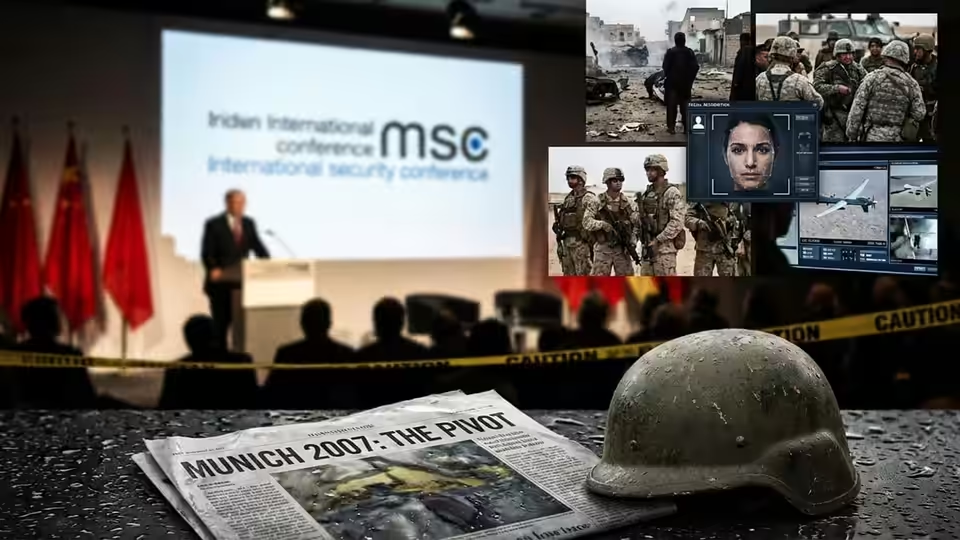
The $100B NATO Divorce: Europe Ditching US Defense Giants for 'Plan B'
As Trump threatens a NATO exit, European giants like Rheinmetall are positioning to seize billions in defense contracts once reserved for American firms. This isn't just diplomacy—it's a massive wealth transfer.
NATO is heading for a messy divorce. European leaders are funding an independent 'Plan B' military force as a direct response to U.S. pressure over the 2026 Iran war and tensions in Greenland.
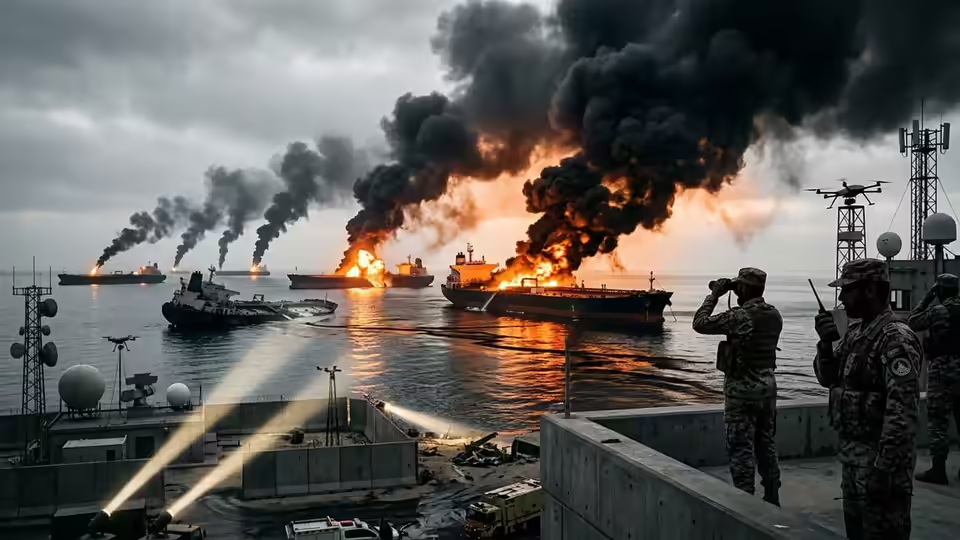
The crack in NATO isn't just about rhetoric anymore. It's about where the money's going. After the U.S. blocked the Strait of Hormuz in March 2026, a move NATO didn't sign off on, things changed fast. Internal papers from the 2025 Hague summit show European leaders have stopped 'planning' and started moving budgets. They're drafting a 'Plan B' for a unified European military command that works completely outside the U.S. European Command. Why? Because of Trump's ultimatum. On April 8, 2026, The Washington Post reported he's ready to pull out entirely unless the allies back the Iran campaign.
Here is the context you need. The Strait of Hormuz is the narrow choke point where 20% of the world's oil flows. When people talk about 'Strategic Autonomy,' they mean the EU being able to act without asking the U.S. for permission. And Article 5? That's the 'all for one, one for all' clause that's kept the peace since 1949.
The money involved is staggering. Most members hit the 2% GDP spending goal in 2025, but that's already yesterday's news. The new 'Hague Target' of 3.5% to 5% by 2035 is a goldmine for European contractors. SIPRI data suggests this shift will dump about $450 billion a year into the local defense industry. Look at the markets: Germany's Rheinmetall AG saw shares jump 14% right after the fighting started on February 28. Even France's Dassault Aviation is gaining ground. EU members are starting to look twice at those multi-billion dollar F-35 contracts, wondering if they should just stick with the homegrown Future Combat Air System instead.
“President Trump’s ultimatum on April 8, 2026, linked NATO membership directly to support for the Iran conflict, effectively ending the era of unconditional collective defense.”
Trust really started to crumble during the Greenland incident in January 2026. Official reports said things had calmed down, but leaked dossiers from the Danish defense ministry tell a different story. Called 'Project Arktis,' these files show a $1.2 billion emergency mobilization by Denmark's Arctic Command. Le Monde reports these docs show Denmark was actually prepping for the U.S. to seize infrastructure in Thule through 'economic coercionLoaded Language.' It was an aggressive move against an ally, and it gave countries like Spain and France all the political cover they needed to push for a security setup that doesn't rely on Washington.
But can they actually pull it off? It's far from a sure thing. NATO's own 2025 report admits spending is up, but analysts say Europe is still missing the big stuff: heavy-lift transport and the satellite networks the U.S. Air Force provides. Without those, a Europe-only force is basically a 'hollow force' for at least a decade. There's also the nuclear question. We don't know if 'Plan B' includes a shared nuclear shield, which is a massive sticking point between a nuclear-armed France and a non-nuclear Germany.
For the average person, this means a total shift in where taxes go. The 'peace dividend' we've lived on for decades is gone. As the Brussels summit approaches, don't look at the polite press releases. Look at the shopping lists. If European capitals start canceling U.S. hardware orders to buy local, the divorce isn't just a threat. It's already happening.
Keep an eye on May 15. That's the deadline for the U.S. Department of Defense to give Congress its new NATO budget. That document will show exactly how much the Trump administration wants to cut from European bases. It'll tell us if the 2026 Iran conflict was the final push that sent the U.S. packing.
Summary
The fallout from the U.S.-Israeli clash with Iran on February 28, 2026, has pushed NATO to its breaking point. While early reports focused on diplomatic friction, the real story is the money. European nations are ditching Washington to pursue a 'Plan B,' jacking up defense spending to between 3.5% and 5% of GDP. This isn't just talk: it's a massive shift that hands billions to local giants like Rheinmetall and BAE Systems, money that used to go to American firms. With President Trump threatening a full pullout in talks with Mark Rutte, the alliance's survival now depends on whether Europe can actually pay for its own protection without the U.S. backbone.
⚡ Key Facts
- A conflict involving the U.S., Israel, and Iran began in late February 2026, causing a rift in NATO.
- U.S. President Donald Trump has threatened to pull out of NATO.
- The U.S. used coercive rhetoric regarding the acquisition of Greenland from Denmark in early 2026.
- European nations are developing contingency plans ('Plan B') should the U.S. exit the alliance.
The $100B NATO Divorce: Europe Ditching US Defense Giants for 'Plan B'
Network of Influence
- Political opponents of the Trump administration
- Advocates for European strategic autonomy (independent of U.S. military reliance)
- Proponents of traditional multilateralism and established diplomatic institutions
- The article presents hypothetical future events (the 2026 war in Iran and Greenland coercion) as factual historical basis for its argument without clearly labeling the piece as speculative fiction or predictive analysis.
- It omits any strategic rationale for why the U.S. might seek different terms with NATO or the security concerns regarding Iran from the U.S. perspective.
See how the story connects.
Select any actor or numbered connection, then inspect the evidence before drawing a conclusion.
The Conversation Trust Owns The Conversation
Follow the public record
Source Trail
Independent reporting and analysis
Get the next investigation in your inbox
One email a week. Receipts only. Free.
Free. Unsubscribe anytime. We never share your email.