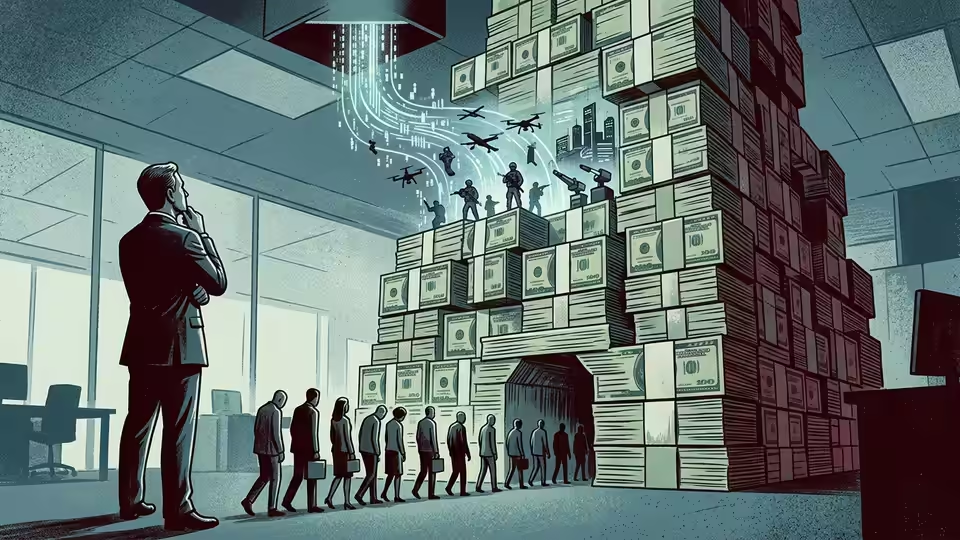
Salesforce Secures $5.6 Billion No-Bid Army Contract Following Record Lobbying Push
The U.S. Army bypassed competitive bidding on January 26, 2026, to award Salesforce a $5.6 billion 'Missionforce' contract. The deal follows a record-breaking $5.8 billion lobbying effort and a 300% surge in Salesforce's hiring of former defense procurement officers.
Salesforce utilized a record $5.8 billion lobbying budget and a network of former defense officials to secure a $5.6 billion no-bid Army contract, effectively monopolizing military logistics data for the next decade.
On January 26, 2026, the U.S. Army finalized a 10-year, $5.6 billion deal with Salesforce to implement 'Missionforce,' a proprietary software layer intended to manage the Army's logistics and mission command data. The award is an Indefinite Delivery, Indefinite Quantity (IDIQ) contract, but it carries a significant caveat: it was sole-sourced. By bypassing the standard competitive bidding process mandated by the Competition in Contracting Act, the Army effectively handed Salesforce a decade-long monopoly over its data infrastructure without ever testing the market for cheaper or more efficient alternatives.
[IDIQ Contract] is a federal procurement vehicle that allows for an indefinite quantity of services during a fixed period, permitting the government to place specific task orders as needs arise.
The authorization for this massive expenditure came from Douglas Bush, the Assistant Secretary of the Army for Acquisition, Logistics, and Technology. Bush signed off on the Justification and Approval (J&A) document, which claimed Salesforce possessed 'unique capabilities' that no other vendor could match. This 'unique capabilities' loophole is a frequently used tool in defense procurement to sidestep competition. However, internal documents and industry analysts point to several domestic and open-source competitors who were never invited to the table, raising questions about how 'unique' the Salesforce solution actually is.
[Sole-Source Award] is a non-competitive contract where only one supplier is solicited, usually under the justification that only one firm can satisfy the requirement.
The timing of the award aligns with an unprecedented surge in Salesforce’s political influence spending. According to Senate Lobbying Disclosure Act (LDA) filings, Salesforce’s total lobbying expenditures for 2026 hit a record $5.8 billion. A significant portion of this capital was directed toward defense and procurement subcommittees. Furthermore, Q4 2025 filings reveal a 300% increase in Salesforce's spending on 'outside consultants'—specifically former Department of Defense (DoD) procurement officers who transitioned into lobbying roles. This revolving door provides corporations with the intimate knowledge required to navigate, and sometimes manipulate, the J&A process.
Salesforce CEO Marc Benioff has publicly shifted the company's focus toward 'Public Sector AI,' positioning the firm as an essential national security partner. This strategy appears to have paid off. Throughout 2025, Salesforce PACs funneled millions into the campaign coffers of key members of the House and Senate Armed Services Committees. While mainstream outlets like CNBC and Bloomberg have characterized the $5.6 billion deal as a necessary 'digital transformation' to replace aging legacy systems, they have largely ignored the financial mechanics behind the award. The focus has remained on the software’s theoretical efficiency rather than the lack of price transparency.
Because the contract was not bid competitively, there is no public benchmark to determine if the $5.6 billion price tag represents a fair market value or a significant overcharge. This lack of transparency is compounded by the threat of 'vendor lock-in.' By making Salesforce the primary software layer for Army logistics, the military is embedding proprietary code so deeply into its operations that the cost of switching to a competitor in the future would be prohibitively expensive.
[Vendor Lock-in] is a situation where a customer becomes dependent on a vendor for products and services, unable to use another vendor without substantial switching costs.
For the American taxpayer, this deal represents a massive allocation of public funds with zero accountability regarding cost-efficiency. When the government refuses to let companies compete, the taxpayer loses the primary mechanism that keeps corporate greed in check. Beyond the money, this contract places the 'logic' of military logistics—the data that moves soldiers, equipment, and supplies—into the hands of a private corporation with its own shareholders and profit motives.
You can track the specific campaign contributions from Salesforce executives and PACs to your local representatives using the Gen Us Politician Tracker. Our database includes every filing from the 2025-2026 cycle, cross-referenced with votes on the National Defense Authorization Act.
Summary
The U.S. Army bypassed competitive bidding on January 26, 2026, to award Salesforce a $5.6 billion 'Missionforce' contract. The deal follows a record-breaking $5.8 billion lobbying effort and a 300% surge in Salesforce's hiring of former defense procurement officers.
⚡ Key Facts
- The $5.6 billion contract was awarded on January 26, 2026, as a sole-source (no-bid) deal, bypassing standard competition.
- Salesforce spent a record $5.8 billion on lobbying in 2026, with a focus on defense procurement subcommittees.
- Lobbying filings show a 300% increase in the hiring of former DoD procurement officers by Salesforce-affiliated firms in late 2025.
- The 10-year IDIQ contract for 'Missionforce' creates a long-term 'vendor lock-in' that may make future competition impossible.
- Mainstream media coverage has focused on 'modernization' while ignoring the lack of price transparency and competitive benchmarks.
Follow the public record
Source Trail
Get the next investigation in your inbox
One email a week. Receipts only. Free.
Free. Unsubscribe anytime. We never share your email.