Pentagon Hands Microsoft $11B Monopoly Without a Single Competitive Bid
The DoD bypassed legal bidding to funnel $11.13 billion to Microsoft via Dell. Experts warn this 'software monoculture' creates a catastrophic single point of failure for national defense.
The Pentagon has effectively handed the keys to the nation's digital defense to a Microsoft monopoly, funneling $11.13 billion through Dell in non-competitive deals that create a massive security vulnerability.
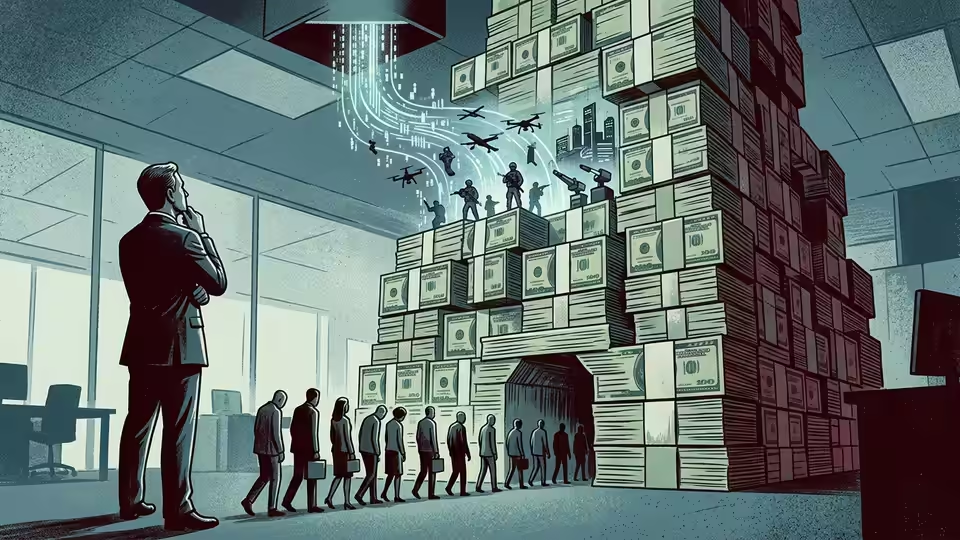
On May 28, 2026, the Department of Defense (DoD) finalized a massive enterprise agreement worth $8.2 billion with Dell Federal Systems for Microsoft software and services. Less than three weeks later, on June 16, the Air Force Life Cycle Management Center (AFLCMC) doubled down, finalizing a follow-on $2.93 billion sole-source call order. In a span of just twenty days, $11.13 billion in taxpayer funds were funneled into a single vendor pipeline, solidifying a digital landscape that critics call a dangerous software monoculture.
The mechanism for this transfer is the Core Enterprise Technology Agreement (CETA), a procurement vehicle designed to consolidate software licensing for the U.S. Air Force, the Intelligence Community, and the U.S. Coast Guard. By using Dell Federal Systems as a prime contractor, the Pentagon is not buying from a diversified market; it is using Dell as a multi-billion dollar pass-through for Microsoft. While Dell manages the administrative overhead, the technology itself—Azure cloud services and the Office 365 ecosystem—is being hard-wired into every level of the nation's military and intelligence apparatus.
A [Software Monoculture] is a condition where a vast network of systems runs the same software or operating system, meaning a single vulnerability or update failure can trigger a simultaneous, catastrophic collapse of the entire infrastructure. Despite the DoD’s own 2026 Progress Report on Digital Modernization warning against 'concentrated vendor risk,' these contract awards demonstrate a total pivot toward the exact opposite. By consolidating $11.13 billion into the Microsoft ecosystem, the Pentagon has effectively created a single point of failure for the Air Force, the Coast Guard, and the nation’s intelligence agencies.
The money trail is clearly visible in corporate filings. According to Microsoft’s Q3 2026 SEC 10-Q filing, 'Government and Sovereign Cloud' services have become the primary driver of the company’s Enterprise Services revenue growth. This surge is not the result of a competitive 'best-of-breed' selection process. Instead, it is fueled by [Sole-Source Procurement], a practice where the government bypasses the usual competitive bidding process to award contracts to a single provider. In the case of the June 16 $2.93 billion order, the AFLCMC justified the lack of competition by citing 'mission continuity,' claiming that the costs of switching to any other vendor would be prohibitive.
This justification reveals the trap of [Vendor Lock-in], a situation where a customer becomes so dependent on a vendor's products that they cannot switch to a competitor without substantial costs or disruptions. By locking in $11.13 billion worth of infrastructure, the DoD has surrendered its leverage. Microsoft now dictates the terms, the pricing, and the security standards. If Microsoft’s code is breached—as has happened in several high-profile state-sponsored attacks in recent years—the entire U.S. defense apparatus faces an identical threat with no redundant 'Plan B' systems in place.
The role of Dell Federal Systems in this arrangement is that of a gatekeeper. Dell earns administrative fees on $11.13 billion while insulating Microsoft from the direct scrutiny that usually accompanies such massive federal outlays. This 'middleman' strategy is effective; it allows the DoD to report these as contracts with Dell, a hardware and logistics company, rather than admitting they are building a total dependency on a single software giant. According to OpenSecrets data, Dell has spent more than $2.4 million on federal lobbying in the first six months of 2026, primarily targeting the House and Senate Appropriations Committees—the very groups responsible for signing off on these multi-billion dollar checks.
While mainstream outlets frame these deals as 'efficiency wins' or 'cloud modernization' for the era of great power competition, they ignore the strategic retreat from the Joint Warfighting Cloud Capability (JWCC) program. The JWCC was originally designed to be a multi-vendor environment, splitting the military's cloud needs between Microsoft, Amazon, Google, and Oracle to ensure resilience. These new CETA awards through Dell suggest that the multi-vendor dream is being quietly scrapped in favor of a Microsoft-only monopoly.
Our investigation into the 'revolving door' at the AFLCMC indicates that at least four senior procurement officers who were involved in previous Microsoft licensing deals have taken positions at either Dell Federal or Microsoft's government affairs division since 2024. This flow of personnel between the regulators and the regulated suggests a conflict of interest that may explain why 'mission continuity' is so frequently used to kill competition.
For the American public, the impact is twofold. First, $11.13 billion in tax revenue is being handed to a non-competitive monopoly instead of being used to foster a resilient, diverse tech economy. Second, and more importantly, the nation’s security is being gambled on the integrity of a single software stack. When the Air Force, the Coast Guard, and the CIA all use the same 'key' to lock their doors, a single thief with a duplicate key can enter every room in the house.
At Gen Us, we don't just report the news; we provide the tools to hold these interests accountable. You can use our Politician Tracker to see which members of the House Armed Services Committee received donations from Dell and Microsoft before the CETA agreements were finalized. You can also explore our 'Cloud Monopoly' database to see how much of your state's tax contribution is being funneled into these single-vendor defense contracts.
Summary
The Department of Defense has committed $11.13 billion to Microsoft software through Dell Federal Systems, bypassing competitive bidding for the Air Force and Intelligence Community. This move cements a software monoculture that experts warn creates a catastrophic single point of failure for national defense.
⚡ Key Facts
- The DoD committed $11.13 billion to Dell/Microsoft in two transactions on May 28 and June 16, 2026.
- The contracts were issued as 'sole-source' or limited-competition, bypassing the multi-vendor goals of the JWCC program.
- Microsoft’s Q3 2026 SEC filings confirm government cloud services are now its primary revenue driver.
- The CETA agreement creates a software monoculture across the Air Force, Intelligence Community, and Coast Guard.
- Lobbying data shows Dell Federal Systems spent over $2.4M in 2026 to secure its position as the DoD's primary software intermediary.
Follow the public record
Source Trail
Get the next investigation in your inbox
One email a week. Receipts only. Free.
Free. Unsubscribe anytime. We never share your email.