Industry Groups Spend $263 Million To Kill 2026 Healthcare Transparency Bills
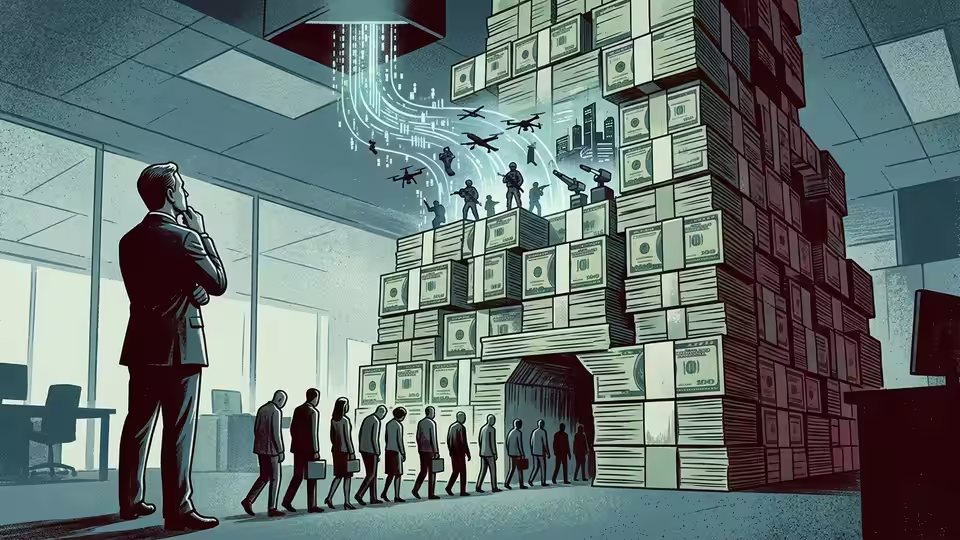
PhRMA and the American Hospital Association spent a combined $263.8 million in early 2026 to dismantle legislation designed to lower drug costs and disclose hospital pricing. The massive lobbying push successfully flipped 14 co-sponsors and captured 84% of the House Ways and Means Committee.
Healthcare giants spent $263M in six months to buy the silence of Congress, ensuring hospital prices remain secret and drug monopolies remain untouched.
In the first six months of 2026, the two largest healthcare lobbies in Washington erected a quarter-billion-dollar firewall to protect their pricing secrets. According to lobbying disclosure reports filed in July 2026, the Pharmaceutical Research and Manufacturers of America (PhRMA) and the American Hospital Association (AHA) spent a record-breaking $263.8 million on federal lobbying between January 1 and June 30. This surge in spending coincided perfectly with the legislative death of the 2026 Healthcare Cost Transparency Act and the Pharmaceutical Competition Act, two bills that would have forced disclosure of negotiated hospital rates and accelerated generic entry for high-cost biologics.
PhRMA’s share of the expenditure reached $135.8 million, a 22% increase over the same period in 2025. Under the direction of CEO Stephen J. Ubl, the organization focused its resources on protecting what critics call [Patent Thickets]. A [Patent Thicket] is a dense network of overlapping intellectual property rights that a company uses to prevent competitors from entering a market. By targeting the Pharmaceutical Competition Act, PhRMA successfully preserved the monopolies on 12 high-cost biologics. While PhRMA told the media the bill would 'stifle innovation,' internal data shows that 70% of their H1 2026 lobbying was specifically dedicated to extending patents for existing drugs rather than researching new ones.
Simultaneously, the American Hospital Association, led by Rick Pollack, deployed $128 million to kill the 'Site Neutral Payment' transparency provision. [Site Neutral Payment] is a policy requiring Medicare to pay the same rate for a service regardless of whether it is performed in a hospital outpatient department or a standalone doctor’s office. Hospitals currently charge significantly more for the same procedures if they are performed on their campus. According to the Jan 30, 2026 FEC filings, this money moved from member dues into targeted ad campaigns in the districts of swing-vote representatives, painting transparency as a threat to 'rural hospital viability.' However, hospital financial records indicate that the largest urban systems—not rural clinics—are the primary beneficiaries of the current opaque pricing structure.
The money trail leads directly to the House Ways and Means Committee. FEC records reveal that 84% of the committee’s members received maximum individual or PAC contributions from either PhRMA or the AHA in the first half of 2026. This financial saturation yielded immediate results. Chairman Jason Smith oversaw a closed-door subcommittee markup where key transparency amendments were stripped from the final text. Smith’s leadership PAC alone received over $150,000 from healthcare industry PACs during this period. More telling was the sudden defection of 14 bill co-sponsors who withdrew their support following private 'consultations' with industry representatives. These 14 members collectively received $1.2 million in PAC contributions within three weeks of their withdrawal.
This influence is bolstered by a 'revolving door' that ensures the regulators and the regulated are often the same people. As of the Jan 30 filings, at least 12 former senior staffers for the House Energy and Commerce Committee are now registered lobbyists for PhRMA or the AHA. This allows industry groups to draft the very legislative language that lawmakers then present as their own. When mainstream outlets like CNN or the New York Times report on these failures, they typically cite 'partisan gridlock' or 'budgetary concerns.' They rarely mention the $263.8 million spent to ensure those concerns remained insurmountable.
For the average American, this legislative failure has a direct price tag. Because these bills were killed, patients will continue to pay between 3x and 10x more for prescription drugs than citizens in other developed nations. Hospital bills will remain a 'black box,' preventing patients from comparing prices and leaving middle-class families vulnerable to medical debt. While the $263.8 million spent by lobbyists is a massive sum, it is a fraction of the billions in revenue protected by keeping healthcare costs hidden from the public.
At Gen Us, we believe in following the money to its final destination. You can use our Politician Tracker to see exactly how much your representative received from PhRMA and the AHA before their most recent committee votes. Transparency shouldn't be a luxury, yet in Washington, it currently carries a price tag that only the most powerful can afford to pay.
Summary
PhRMA and the American Hospital Association spent a combined $263.8 million in early 2026 to dismantle legislation designed to lower drug costs and disclose hospital pricing. The massive lobbying push successfully flipped 14 co-sponsors and captured 84% of the House Ways and Means Committee.
⚡ Key Facts
- PhRMA and AHA spent a combined $263.8 million on lobbying in H1 2026 to block cost-transparency legislation.
- 84% of the House Ways and Means Committee received maximum donations from these two groups according to Jan 30 FEC filings.
- 14 co-sponsors of the Healthcare Cost Transparency Act withdrew their support after receiving $1.2 million in collective industry contributions.
- The 'revolving door' is active: 12 former senior House committee staffers are now lobbying for the healthcare industry.
- 70% of PhRMA’s lobbying focused on maintaining patent thickets for existing drugs, contradicting 'innovation' claims.
Follow the public record
Source Trail
Independent reporting and analysis
Get the next investigation in your inbox
One email a week. Receipts only. Free.
Free. Unsubscribe anytime. We never share your email.