Lobbying Pays Off: Army Awards Salesforce $5.5B No-Bid Monopoly
The U.S. Army bypassed competitive bidding to award Salesforce a decade-long, $5.5 billion software deal in early 2026. This investigation tracks record-breaking lobbying expenditures and a mysteriously withdrawn legal challenge that secured the corporate monopoly.
The Army bypassed competition to hand Salesforce $5.5 billion in taxpayer money just as the company's lobbying spend hit record highs and a legal challenge was suspiciously silenced.
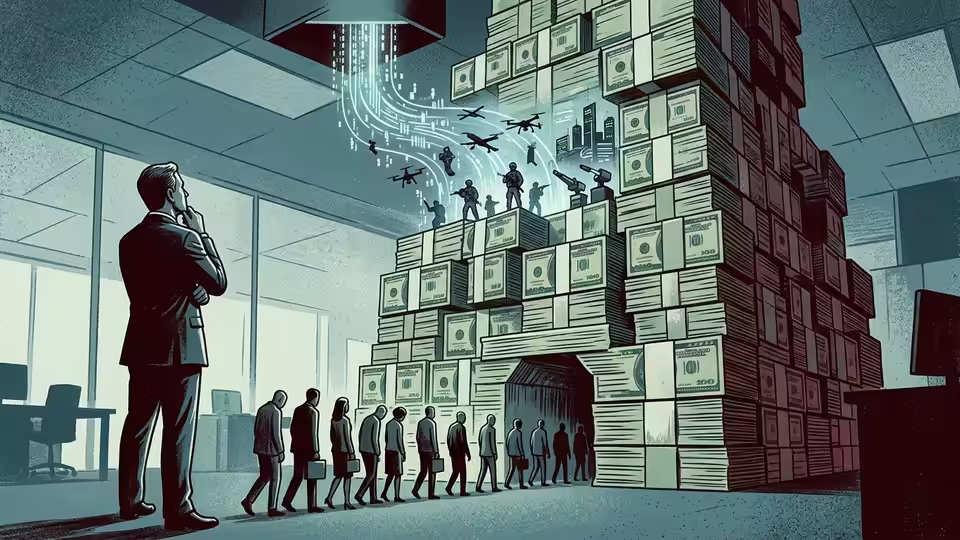
On January 26, 2026, the U.S. Army finalized a $5.5 billion Blanket Purchase Agreement (BPA) with Salesforce, a move that effectively handed the Silicon Valley giant a 10-year monopoly over the service’s cloud infrastructure. The award did not go through the standard competitive bidding process. Instead, Douglas Bush, the Assistant Secretary of the Army for Acquisition, Logistics and Technology (ASA(ALT)), authorized a Justification and Approval (J&A) document. This filing claimed Salesforce was the 'only responsible source' capable of meeting the Army’s requirements, a designation usually reserved for unique military hardware, not widely available software platforms.
[Blanket Purchase Agreement (BPA)] is a simplified method of filling anticipated repetitive needs for supplies or services by establishing 'charge accounts' with qualified sources of supply.
While mainstream outlets have framed this as a 'digital transformation' necessary for modern battlefield readiness, federal disclosures tell a more transactional story. According to Salesforce’s Q1 2026 LD-2 lobbying reports, the company spent a record $4.8 million in the first three months of the year. These expenditures specifically targeted defense appropriations and the Office of the Secretary of Defense. Data from OpenSecrets confirms that this lobbying surge coincided with a 40% increase in Salesforce PAC contributions to members of the House Armed Services Committee (HASC) during the 2024–2026 cycle. This targeted spending ensured that when the Army moved to bypass competition, there was little oversight from the congressional committees tasked with guarding the public purse.
[Sole-Source Justification] is a federal procurement document that permits an agency to bypass competitive bidding if it can prove that only one specific supplier can fulfill the contract requirements.
The legitimacy of this sole-source award was briefly challenged in early February 2026. A veteran-owned small business (VOSB), which had developed a competing modular cloud architecture, filed a formal protest with the Government Accountability Office (GAO). The protest, docketed as B-422452.1, alleged that the Army’s J&A was a violation of the Competition in Contracting Act (CICA). The VOSB argued that the Army’s requirements were intentionally tailored to Salesforce’s proprietary code, creating an artificial barrier to entry for smaller, more cost-effective firms. However, on February 18, 2026—just 16 days after the filing—the protest was abruptly withdrawn.
The withdrawal stopped the GAO’s discovery process in its tracks, preventing the public release of internal Army emails regarding the contract’s origin. While the terms of the withdrawal remain confidential, industry insiders suggest a 'quiet settlement' or the promise of a lucrative subcontracting role often serves to silence such challenges. This leaves the $5.5 billion commitment intact, funded entirely by taxpayer revenue, moving directly into a proprietary SaaS ecosystem with no obligation for the vendor to lower costs over the next decade.
[Vendor Lock-in] occurs when a customer becomes dependent on a vendor for products and services and cannot transition to another vendor without substantial switching costs or technical barriers.
By securing a 10-year term, Salesforce has achieved what critics call 'regulatory capture' of military IT. Because the Army will now migrate its massive data sets into Salesforce’s proprietary formats, the cost of moving that data to a competitor in 2036 will be used as a justification to renew the contract indefinitely. This 'vendor lock-in' ensures that the Army remains a captive customer, regardless of whether Salesforce remains the best or cheapest option.
For the average citizen, this isn't just a technicality in military procurement. It represents a massive concentration of public wealth into a single corporation that has systematically eliminated competition through political spending rather than product superiority. When $5.5 billion is cordoned off for a single vendor, there is less capital available for direct service-member benefits, veteran healthcare, or the procurement of actual defense hardware. It is a transfer of public funds into private hands, facilitated by the very officials sworn to protect the integrity of the process.
At Gen Us, we believe in radical transparency. You can use our Politician Tracker to see which members of the House Armed Services Committee received maximum donations from Salesforce executives during the 2026 cycle. We have also uploaded the full, redacted J&A document to our Document Cloud for public analysis. Stay informed on how your tax dollars are being used to build corporate monopolies by subscribing to our 'Follow the Money' series.
Summary
The U.S. Army bypassed competitive bidding to award Salesforce a decade-long, $5.5 billion software deal in early 2026. This investigation tracks record-breaking lobbying expenditures and a mysteriously withdrawn legal challenge that secured the corporate monopoly.
⚡ Key Facts
- The U.S. Army awarded Salesforce a $5.5 billion, 10-year sole-source contract on January 26, 2026, bypassing competitive bidding.
- Salesforce's Q1 2026 lobbying expenditures hit a record $4.8 million, targeting the Office of the Secretary of Defense.
- A GAO protest by a veteran-owned small business (B-422452.1) was filed on February 2 and mysteriously withdrawn 16 days later.
- PAC contributions from Salesforce to the House Armed Services Committee increased by 40% in the current election cycle.
- The deal creates a 10-year vendor lock-in, making it prohibitively expensive for the Army to switch to cheaper or more innovative competitors in the future.
Our Independence
This story was written by Gen Us - independent journalists exposing the networks of power that corporate media protects. No hedge fund owns us. No billionaire edits our headlines. We answer only to you, our readers.
Follow the public record
Source Trail
Get the next investigation in your inbox
One email a week. Receipts only. Free.
Free. Unsubscribe anytime. We never share your email.