Pentagon Rewards Microsoft’s Security Failures With $9.69B Monopoly Deal
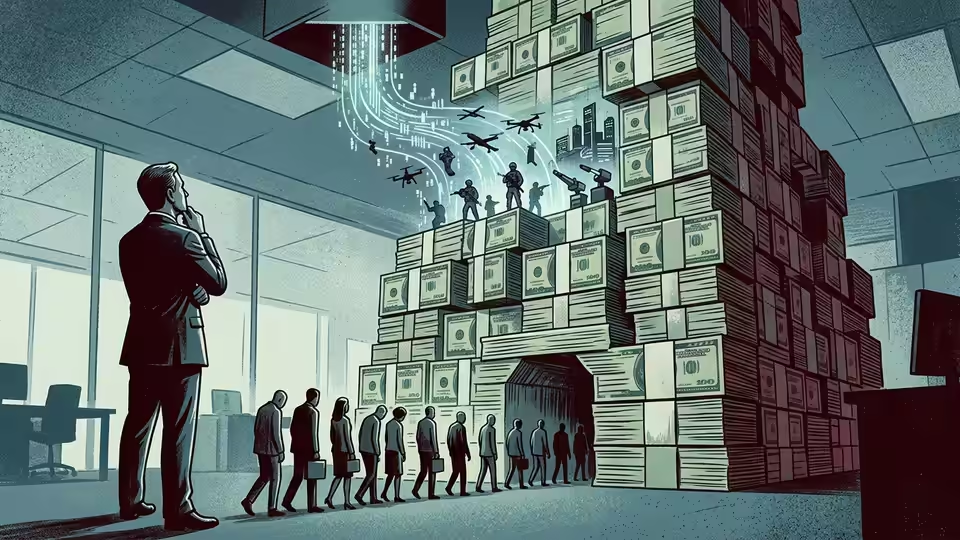
The Department of Defense has finalized a five-year deal with Dell Federal Systems to mandate Microsoft software across all military branches, bypassing competitive bidding. This $9.69 billion agreement secures a digital monopoly for a vendor recently criticized by federal investigators for a culture of inadequate security.
The Pentagon has handed Microsoft a $9.69 billion five-year monopoly on military software, rewarding the company with taxpayer funds despite a record of security negligence and a $3.4 million lobbying blitz.
On May 28, 2026, the Department of Defense (DoD) quietly finalized one of the largest software procurement deals in military history. The award, a firm-fixed-price, sole-source contract totaling $9,692,456,870, was granted to Dell Federal Systems. Under the terms of the Core Enterprise Technology Agreement II (CETA II), Dell will act as the primary intermediary to furnish Microsoft software and cloud services to every branch of the U.S. military through 2031. This isn't just a purchase order; it is a five-year strategic lock-in that effectively removes competition from the Pentagon’s digital ecosystem.
To bypass the standard requirement for competitive bidding, the DoD invoked 10 U.S.C. 2304(c)(1). This specific legal provision allows for non-competitive awards when an agency determines there is 'only one responsible source' capable of fulfilling the requirement. [Sole-Source Contract] is a procurement process where a government agency skips the competitive bidding phase to award a contract directly to a single provider, often citing technical or legal exclusivity. By utilizing this justification, the DoD has formally declared that no other software provider—be it an open-source alternative or a multi-vendor consortium—is capable of meeting the military’s needs, despite the widespread availability of secure, hardened Linux distributions and alternative productivity suites.
The timing of the award is notable for its proximity to massive lobbying efforts. According to Federal Election Commission (FEC) filings and OpenSecrets data, Microsoft and Dell spent a combined $3.4 million on lobbying in the first quarter of 2026 alone. This spending was strategically funneled toward members of the House Armed Services Committee, specifically those overseeing subcommittees on Cyber, Innovative Technologies, and Information Systems. Campaign finance disclosures show that 'leadership PACs' belonging to ranking members of these committees received maximum allowable donations from top-tier Dell and Microsoft executives in March 2026, just weeks before the CETA II contract was finalized. [Regulatory Capture] occurs when a private industry exerts enough influence over a government agency to ensure the agency acts in the industry's interest rather than the public's.
While mainstream outlets like Bloomberg and Reuters have framed this $9.69 billion deal as a 'modernization effort' to 'end license sprawl,' the financial reality suggests a massive transfer of public wealth to two private entities. Dell Federal Systems serves as the value-added reseller, essentially a middleman that takes a percentage of the nearly $10 billion for administrative handling before passing the bulk of the funds to Microsoft. Microsoft's 2026 Q1 SEC 10-Q filings already reflect the success of this strategy, reporting a 22% increase in 'Government Cloud' revenue. The filing explicitly cites long-term enterprise agreements as the primary driver of this growth.
However, the move toward a singular software ecosystem—often called a 'monoculture'—presents a staggering national security risk that the DoD's Chief Information Officer, John Sherman, has yet to publicly reconcile with the 2025 Cyber Safety Review Board (CSRB) report. That report, issued less than a year ago, delivered a blistering critique of Microsoft’s internal security, citing a 'culture of inadequate security' that allowed state-sponsored actors to breach the email accounts of senior U.S. officials. [Monoculture Risk] is a security vulnerability created when a diverse ecosystem is replaced by a single technology, allowing one exploit to compromise an entire network. By mandating Microsoft software across the entire DoD, the Pentagon is creating a single point of failure. A single zero-day exploit in Windows or Azure now theoretically has the potential to paralyze the entire U.S. military infrastructure.
Furthermore, the contract effectively bans the use of secure, open-source alternatives. While private sector firms are increasingly moving toward multi-cloud and multi-vendor strategies to avoid vendor lock-in and enhance resilience, the Pentagon is moving in the opposite direction. Open-source solutions offer higher levels of auditability—allowing security experts to inspect the code for vulnerabilities—whereas Microsoft’s proprietary code remains a black box. The sole-source nature of CETA II ensures that these more transparent, often lower-cost alternatives are kept out of the military's reach for at least the next half-decade.
For the ordinary citizen, this $9.69 billion award represents a massive expenditure of tax dollars on a system that rewards security failure with market dominance. The money being funneled into CETA II doesn't just buy software; it buys a cycle of dependency. As Microsoft becomes more deeply integrated into the administrative and operational fabric of the military, the 'cost of switching' becomes so high that the government loses the leverage to demand better security or lower prices. This is how monopolies are built and maintained under the guise of 'efficiency.'
What this means for your future is simple: your data and your national defense are being consolidated into a single, vulnerable basket. While the House Armed Services Committee members who received campaign contributions might see this as a win for industry 'modernization,' the reality is a multi-billion dollar bet on a vendor that the government’s own safety board recently labeled as negligent. You can track the specific campaign contributions and voting records of the committee members involved through our Politician Tracker at Gen Us.
To explore the full money trail, visit the Gen Us Lobbying Database. There, you can see the breakdown of Dell and Microsoft’s 2026 Q1 spending and how it correlates with the subcommittees that approved the Pentagon’s latest budget. Knowledge is the only defense against the consolidation of power.
Summary
The Department of Defense has finalized a five-year deal with Dell Federal Systems to mandate Microsoft software across all military branches, bypassing competitive bidding. This $9.69 billion agreement secures a digital monopoly for a vendor recently criticized by federal investigators for a culture of inadequate security.
⚡ Key Facts
- The DoD awarded a $9,692,456,870 sole-source contract to Dell Federal Systems for Microsoft software on May 28, 2026.
- The contract was justified under 10 U.S.C. 2304(c)(1), claiming Microsoft is the 'only one responsible source' for the military's needs.
- Microsoft and Dell spent a combined $3.4 million on lobbying the House Armed Services Committee in the three months prior to the award.
- The award follows a 2025 CSRB report that officially reprimanded Microsoft for 'inadequate security' following major state-sponsored breaches.
- Microsoft's Q1 2026 SEC filings show a 22% increase in government revenue, driven by these long-term enterprise lock-in agreements.
- The deal creates a 'monoculture risk,' where a single software vulnerability could potentially compromise the entire U.S. military infrastructure.
Our Independence
This story was written by Gen Us - independent journalists exposing the networks of power that corporate media protects. No hedge fund owns us. No billionaire edits our headlines. We answer only to you, our readers.
Follow the public record
Source Trail
Get the next investigation in your inbox
One email a week. Receipts only. Free.
Free. Unsubscribe anytime. We never share your email.