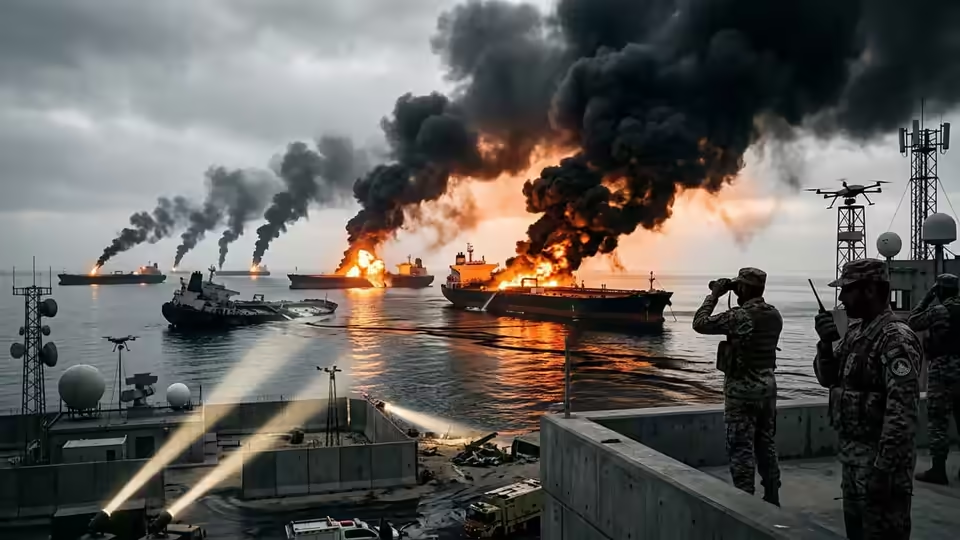
Pentagon Findings Link U.S. Tomahawk Missile to Iranian School Massacre
A preliminary U.S. military assessment now admits American forces were likely behind the strike that leveled the Shajareh Tayyebeh girls’ school in Iran. While Defense Secretary Pete Hegseth maintains the U.S. doesn't target civilians, investigators are blaming a massive intelligence failure that misidentified the school as a military site. The February 28 strike, part of a joint operation with Israel, has turned the forensic evidence of U.S. munitions on the ground into a political nightmare that the Pentagon can no longer ignore.
U.S. investigators have linked a Tomahawk missile to the deaths of 168 people at an Iranian school, citing a failure of 'outdated intelligence' during a joint February operation.
What started as a political accusation is quickly becoming a technical certainty. Preliminary findings show that a U.S.-made Tomahawk missile—the workhorse of the RTX Corporation (formerly Raytheon) arsenal—was the weapon that destroyed the Shajareh Tayyebeh girls’ school. The failure apparently stems from 'outdated intelligence' that flagged the school as part of an adjacent Revolutionary Guard (IRGC) base. The IRGC has a well-documented habit of using civilian buildings as shields, but in this case, the American fail-safes designed to prevent this kind of disaster simply didn't work.
The political firestorm over the incident masks a deeper, quieter reality: the business of defense spending hasn't changed. RTX Corporation, which builds the Tomahawk, remains a central pillar of the military-industrial complex, landing billion-dollar contracts that rarely face real opposition from either side of the aisle. Senate Democrats are currently demanding answers on moral grounds, but they’re the same caucus that's historically approved the massive appropriations fueling these operations. Meanwhile, the Trump administration’s early attempts to blame Tehran have been picked apart by satellite imagery and flight path analysis that points directly back to U.S. assets.
“Whatever the report shows, I'm willing to live with that report. — President Donald Trump”
The fallout is a gift to the Iranian government’s propaganda machine. They’ve already used the deaths of 110 children to stoke international outrage against the U.S.-Israeli coalition. For the Pentagon, the 'unintentional' label is a necessary legal shield against war crime allegations, though Secretary Hegseth hasn't helped matters by publicly calling rules of engagement 'stupid' in the past. By framing this as a tragic data error rather than a command failure, the administration is trying to protect its ability to keep hitting IRGC targets without new restrictions.
Still, there are massive holes in the official story. We don't know which specific unit authorized the launch or if any analysts raised red flags about using stale intelligence before the mission started. The exact provocation that led to the February 28 operation is still classified, leaving the public to guess if the military actually believed this level of civilian risk was proportional to the goal. As the Pentagon gets its story ready for the Senate Armed Services Committee, its credibility is at an all-time low.
For the American public, this is a grim reminder that billion-dollar 'smart' weapons are only as good as the data fed into them. President Trump says he’s ready to 'live with the report,' but the real cost is measured in more than just defense dollars. It’s measured in the collapse of U.S. global standing and the rising risk of retaliation. The next phase of this investigation will show if anyone—from the guys looking at the screens to the Secretary of Defense himself—will actually face consequences for the 168 lives lost in Minab.
Summary
A preliminary U.S. military assessment now admits American forces were likely behind the strike that leveled the Shajareh Tayyebeh girls’ school in Iran. While Defense Secretary Pete Hegseth maintains the U.S. doesn't target civilians, investigators are blaming a massive intelligence failure that misidentified the school as a military site. The February 28 strike, part of a joint operation with Israel, has turned the forensic evidence of U.S. munitions on the ground into a political nightmare that the Pentagon can no longer ignore.
⚡ Key Facts
- Senate Democrats sent a letter to Defense Secretary Pete Hegseth demanding answers regarding a strike on a school in Minab, Iran.
- Preliminary US military assessments suggest US forces were likely responsible for the strike due to outdated intelligence.
- The strike killed approximately 168 people, including 110 children.
- Expert video analysis indicates a Tomahawk missile was used in the strike.
Pentagon Findings Link U.S. Tomahawk Missile to Iranian School Massacre
Network of Influence
- US Senate Democrats seeking to exert oversight or political pressure on the Trump administration's defense officials.
- The Iranian government's international narrative regarding US/Israeli aggression and civilian harm.
- Critics of military intervention who utilize reports of civilian casualties to advocate for policy changes.
- The specific casus belli or initial provocation that led to the 'joint US-Israeli operation' starting February 28 is not detailed.
- The tactical reason for the IRGC base being located directly adjacent to a primary school (human shield analysis).
- Specifics on the 'attacks on Israel and US-allied states' that Iran launched in response.
The article frames the incident as a likely US-caused tragedy fueled by intelligence failures, centering Democratic demands for accountability while highlighting forensic evidence that contradicts initial administration denials.
See how the story connects.
Select any actor or numbered connection, then inspect the evidence before drawing a conclusion.
British Broadcasting Corporation (BBC) Parent company BBC News
Follow the public record
Source Trail
Independent reporting and analysis
Get the next investigation in your inbox
One email a week. Receipts only. Free.
Free. Unsubscribe anytime. We never share your email.