OpenAI and Anthropic’s $2.6M Plot to Kill AI Competition
Leaked FEC filings reveal AI giants are funding the 'Clarity Act' to build a regulatory wall against open-source rivals. It's not about safety—it's about a $450,000 handshake with the House Science Committee.
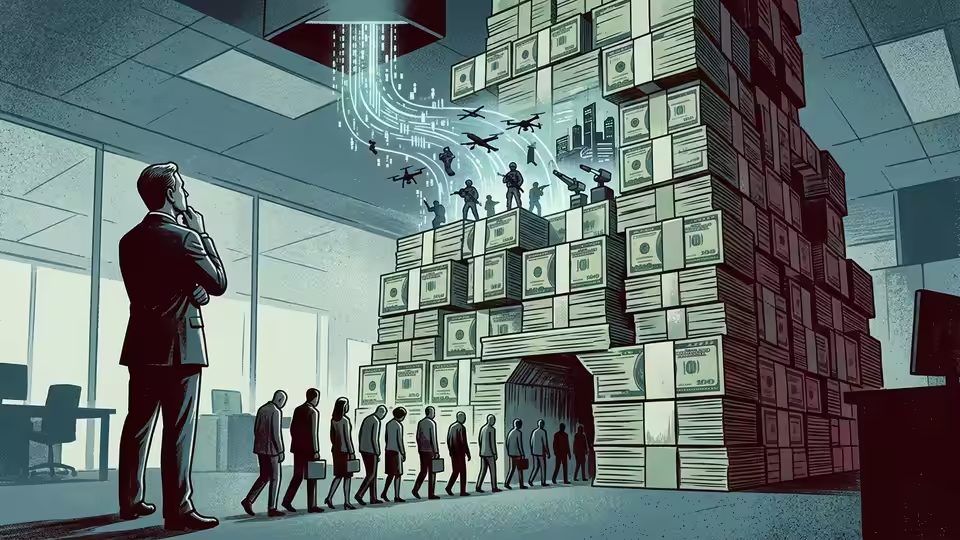
Anthropic and OpenAI are using a $2.6 million lobbying surge to bake high compliance costs into federal law, effectively making open-source AI competition illegal under the guise of public safety.
In the first 90 days of 2026, the two dominant forces in artificial intelligence shifted their strategy from laboratory research to legislative warfare. According to Q1 2026 lobbying disclosures, Anthropic and OpenAI spent a combined $2.6 million to influence federal policy, representing a seismic escalation in their efforts to shape the legal landscape of Silicon Valley. Anthropic alone reported $1.6 million in expenditures—a 400% increase over the previous year—while OpenAI funneled $1.0 million into K Street firms, focusing on specific technical triggers that would effectively criminalize low-cost competition.
At the center of this surge is the 'Clarity Act,' a bill framed by mainstream outlets as a landmark safety initiative to prevent catastrophic AI risks. However, the text of Section 402 of the Act tells a different story. The provision mandates that any entity training a model above a specific compute threshold must maintain a $50 million liability insurance bond. For trillion-dollar incumbents, this is a line item. For open-source developers and university startups, it is a terminal expense. [Compute Thresholds] are the hardware limits—measured in total floating-point operations (FLOPs)—that trigger mandatory government oversight and financial requirements.
The money trail leads directly to the House Committee on Science, Space, and Technology. Federal Election Commission (FEC) records show that executive-funded Political Action Committees (PACs) from Anthropic and OpenAI contributed $450,000 to members of this committee within the first 60 days of 2026. The most notable recipient was Representative Frank Lucas, the Committee Chair, whose campaign received maximum allowable donations from top executives at both firms just weeks before he sponsored the AI Safety Amendment. This amendment integrated 'Responsible Scaling Policies' (RSPs) directly into federal law—language that was developed internally by Anthropic and OpenAI and then refined by the lobbying firms DLA Piper and Akin Gump.
While the public hears a narrative of 'existential risk,' the legal language focuses on 'model weight security.' [Model Weights] are the learned parameters of an AI that determine how it processes information; they are essentially the 'brain' of the software. By mandating that these weights remain under proprietary lock and key for any model exceeding 10^25 FLOPs, the Clarity Act makes the open-source distribution of powerful AI illegal. The OpenSource Initiative (OSI) has warned that these standards define 'safety' in a way that excludes any software where the source code and weights are public, effectively granting a duopoly over the future of the technology.
There is a second, quieter loophole in the legislation that has largely escaped media scrutiny. The Clarity Act excludes 'closed-source' proprietary models from the most rigorous third-party audits if the companies provide 'privileged access' to government agencies. This creates a revolving door where the companies that fund the regulators are the only ones permitted to operate without the crushing weight of those same regulations. This is not about safety; it is about building a billion-dollar moat.
The consequences for ordinary people are stark. If the Clarity Act passes with Section 402 intact, the era of free, locally-run, and private AI will end. [Open Source AI] is software where the code is available for anyone to inspect, modify, and run on their own hardware without corporate surveillance. Without open-source alternatives, users will be forced into a subscription-only future. You will not own the AI you use; you will rent it from two companies. These companies will have the sole power to decide what information the AI can provide, which political perspectives are 'safe,' and exactly how much your privacy is worth.
We are witnessing the birth of a new utility monopoly. Just as the rail barons of the 19th century used government land grants to crush competitors, the AI barons of the 21st are using 'safety' to ensure no one else can build a mind of their own. As the Clarity Act moves to a floor vote, the $450,000 invested in the Science Committee is already yielding a massive return on investment for Anthropic and OpenAI.
Summary
AI giants are funding a legislative wall to block open-source competitors under the guise of safety. New FEC filings reveal $450,000 in contributions to the House Science Committee as they draft the Clarity Act.
⚡ Key Facts
- Anthropic and OpenAI spent a combined $2.6M in Q1 2026 lobbying, with Anthropic’s spending rising 400%.
- Section 402 of the 'Clarity Act' mandates a $50M liability bond for large models, a cost prohibitive for open-source startups.
- Executive PACs funneled $450,000 to the House Committee on Science, Space, and Technology in just 60 days.
- Lobbying firms DLA Piper and Akin Gump drafted the technical language for compute-threshold triggers now found in the bill.
- The legislation includes a loophole exempting proprietary models from certain audits if they provide 'privileged access' to the government.
Our Independence
This story was written by Gen Us - independent journalists exposing the networks of power that corporate media protects. No hedge fund owns us. No billionaire edits our headlines. We answer only to you, our readers.
Follow the public record
Source Trail
Get the next investigation in your inbox
One email a week. Receipts only. Free.
Free. Unsubscribe anytime. We never share your email.