Oil Hits $119: Trump’s Hormuz Blockade Traps Tankers from U.S. Allies
President Trump just upended the global energy market. On April 13, 2026, he ordered the Navy to blockade the Strait of Hormuz, specifically hitting any ship paying tolls to Iran. This isn't just diplomacy: it's a massive escalation after ceasefire talks in Islamabad fell apart. While the White House calls these tolls illegal, the move is effectively trapping oil from allies like Saudi Arabia and the UAE. Brent Crude has already skyrocketed from $70 to $119. What the headlines missed? Iran's enrichment just hit 60%, a hair's breadth from weaponization. We’re tracking the fallout as the U.S. navigates a dangerous legal grey zone.
Trump's new blockade of the Strait of Hormuz is aimed at stopping 'illegal' Iranian tolls, but it's sending oil toward $120 and risking a nuclear showdown as Iran hits a critical enrichment threshold.
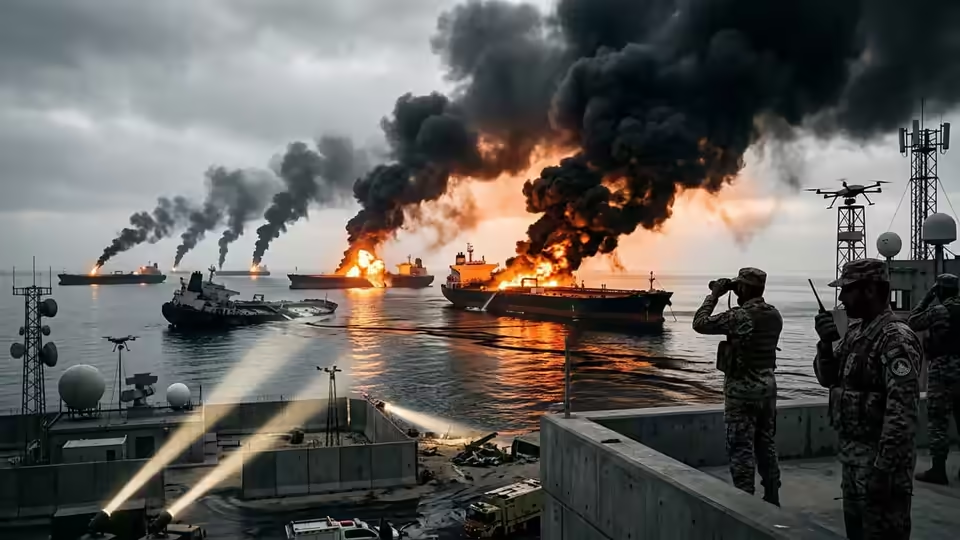
President Trump’s April 13 order just turned the Strait of Hormuz into a global powder keg. By telling the Navy to stop any ship that's paid a transit fee to Tehran, the administration is trying to choke off Iran's last real source of cash. But here's the problem: the world is paying the price. Brent Crude didn't just rise. It surged 8% in hours. We're looking at a jump from $70 when this started to $119 today. According to Vortexa, at least three supertankers filled with Saudi and Emirati oil are sitting right in the blockade's path. Our allies' exports have become collateral damage.
The legal logic here rests on one phrase: illegal tollLoaded Languages. Trump took to social media to draw a line in the sand, saying that no one who pays an illegal tollLoaded Language will have safe passage. It's a logistical nightmare for companies like Petronas. Their ship, the Ocean Thunder, recently moved through the strait, and now the rules have changed mid-voyage. CENTCOM claims they aren't stopping freedom of navigation for neutral ports, but the reality on the water tells a different story. If you pay Iran to pass, as roughly 100 ships have done since the war kicked off, you're now a target for seizure.
Think of the Strait of Hormuz as the world's jugular vein. It's a narrow stretch where a fifth of the world's oil passes every single day. The fallout won't just be at the pump, either. For every buck a barrel of oil goes up, the cost of moving everything from sneakers to electronics rises too. At $119, shipping companies are already prepping 15-20% surcharges on international freight. The irony is thick: the very Iranian state companies the U.S. wants to hurt are actually seeing their remaining oil value spike, provided they can find a way to sneak it out.
“Brent Crude prices surged from $70 to $119, representing a 70% increase in energy costs since the start of hostilities.”
There’s a deeper layer to this that most reports are glossing over. The International Atomic Energy Agency, or IAEA, just dropped a bombshell monitoring report. Iran’s uranium enrichment has hit 60% purity at its secret underground sites. That’s the threshold for a weapon. While the White House talks about economic measures and ceasefires, sources suggest the real goal is forcing a 20-year freeze on enrichment. The administration seems perfectly willing to trigger a global energy crisis if it means stopping a nuclear breakout.
This isn't just about money. It's about blood. Hasan Ahmadian, a political analyst in Tehran, warns that this blockade assumes Iran won't hit back. So far, U.S. carriers have stayed 200 miles off the coast to avoid Iranian missiles. But if the Navy starts boarding ships in international waters, the math changes. We don't know the exact rules of engagement given to American captains yet. But history in these waters shows that interdiction is a polite word for actions that quickly turn into ship-to-ship combat.
For those who don't follow the markets, Brent Crude is the gold standard for oil pricing. When it moves, the world moves. For the average person, this means a budget crisis at home. Gas prices are set to jump by 50 to 80 cents a gallon in the next two weeks if this blockade holds. The two-week ceasefire window from Pakistan is closing fast. Now, the world is waiting to see if D.C. heads back to the table or if $150 oil becomes the new normal.
Our team is still digging into who actually owns the tankers stuck in the Gulf. The oil might be Saudi or Iraqi, but the ships are often owned by massive conglomerates in Greece or Singapore. These companies have sovereign risk insurance that's basically useless now because the U.S. has labeled the passage illegal. We'll be following the money and the fleet's movements as this blockade hits its first 48-hour window.
Summary
President Trump just upended the global energy market. On April 13, 2026, he ordered the Navy to blockade the Strait of Hormuz, specifically hitting any ship paying tolls to Iran. This isn't just diplomacy: it's a massive escalation after ceasefire talks in Islamabad fell apart. While the White House calls these tolls illegal, the move is effectively trapping oil from allies like Saudi Arabia and the UAE. Brent Crude has already skyrocketed from $70 to $119. What the headlines missed? Iran's enrichment just hit 60%, a hair's breadth from weaponization. We’re tracking the fallout as the U.S. navigates a dangerous legal grey zone.
⚡ Key Facts
- US President Donald Trump announced a naval blockade of the Strait of Hormuz and interdiction of vessels paying tolls to Iran.
- Talks in Islamabad regarding a ceasefire have effectively collapsed or failed to prevent escalation.
- Brent Crude prices rose from $70 to $119 during the course of the conflict.
- Trump posted on Truth Social that points agreed upon were better than continuing military operations, but nuclear concerns remain paramount.
Oil Hits $119: Trump’s Hormuz Blockade Traps Tankers from U.S. Allies
Network of Influence
- The Iranian government (portrayed as a rational, strategic victim of irrational US policy)
- Political critics of Donald Trump
- The Qatari-linked Fadaat Media narrative, which often opposes Saudi/UAE/US hawkishness
- The article omits the IAEA's recent concerns regarding Iran's enrichment levels reaching 60%, which is technically close to weapons-grade.
- It fails to mention the specific legal justifications the US administration provided for calling the tolls 'illegal'.
- The history of Iranian military threats to international shipping in the Strait of Hormuz is ignored.
The article frames the US administration's actions as irrational 'idiocy' that inadvertently empowers a strategic Iran, while explicitly deflecting nuclear concerns toward Israel.
See how the story connects.
Select any actor or numbered connection, then inspect the evidence before drawing a conclusion.
Fadaat Media Ltd Owns Middle East Eye
Follow the public record
Source Trail
Independent reporting and analysis
Get the next investigation in your inbox
One email a week. Receipts only. Free.
Free. Unsubscribe anytime. We never share your email.