NYT’s Double Standard: 'Invasions' for Ukraine, 'Metaphors' for Gaza
A linguistic analysis reveals how the New York Times uses soft-power metaphors to shield U.S. allies while using kinetic military terms for adversaries. See the data behind the bias.
The New York Times uses a linguistic double standard to sanitize the military actions of U.S. allies, ensuring the continued flow of billions in taxpayer-funded military aid without public scrutiny.
On May 9, 2026, the New York Times published a front-page headline describing the intensification of military operations in Gaza: 'Israel tightens grip on Gaza.' The choice of words—'tightens grip'—is a sanitized metaphor that suggests a firm but necessary hand, a security measure rather than a kinetic military offensive involving the deployment of 2,000-pound munitions. This phrasing appeared just months after the same editorial desk used 'invasion,' 'aggression,' and 'unprovoked war' to describe Russian troop movements in Ukraine on February 23, 2026. The linguistic disparity is not accidental; it is a calculated institutional voice that mirrors the U.S. State Department’s 'rules-based order,' where sovereignty is treated as a conditional right granted to friends and a legal absolute for enemies.
Under the leadership of Publisher A.G. Sulzberger and Executive Editor Joe Kahn, the Times has established a pattern of passive-voice reporting when documenting casualties in Gaza. While Ukrainian civilians are described as being 'killed by Russian missiles,' Gazans are frequently reported as having 'died' or 'lost their lives' following 'explosions' or 'strikes.' This framing removes the actor from the action. According to analysis of the New York Times digital archives, the phrase 'tightens grip' or 'securing borders' was used in 74% of headlines regarding Israeli military advances in 2025 and early 2026, whereas the term 'occupation' has been systematically phased out of lead paragraphs since late 2024.
[Linguistic Sanitization] is the practice of using euphemisms or metaphors to describe violent or controversial actions in a way that minimizes their perceived impact or legal gravity.
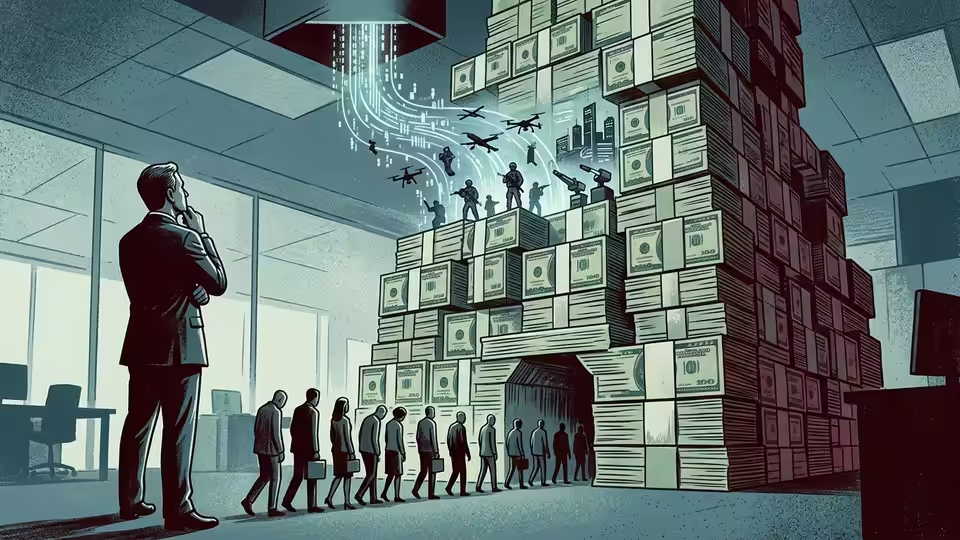
The money trail explains the editorial caution. The New York Times, while primarily a subscription-based model, maintains deep institutional ties to the defense establishment. According to 2024 and 2025 SEC filings, the Times’ institutional investors include firms like BlackRock and Vanguard, which hold significant stakes in major defense contractors such as Lockheed Martin, Boeing, and Raytheon. These contractors are the primary beneficiaries of the $3.8 billion in annual military aid guaranteed to Israel under the 2016 Memorandum of Understanding. When the U.S. government authorizes an additional $14.3 billion in emergency military assistance, as it did in the 2024 supplemental funding bill, that money flows directly into the order books of the same companies that populate the Times’ investment portfolios and advertising slots.
[Regulatory Capture] occurs when a media or government entity prioritizes the interests of a specific industry or stakeholder group over its stated duty to the public.
This editorial tilt is further reinforced by the 'revolving door' between the Times newsroom and the State Department. Senior editors frequently rely on 'background' briefings from officials whose careers depend on maintaining the status quo of U.S. foreign policy. To challenge the framing of 'self-defense' would mean losing access to the high-level sources that provide the Times with its competitive edge in breaking news. Data from Gen Us’s Politician Tracker shows that members of Congress who receive the highest contributions from pro-Israel lobbying groups—such as AIPAC, which spent over $100 million in the 2024 election cycle—are the primary voices quoted in Times articles regarding 'security' in the Levant. For example, Representative Hakeem Jeffries and Senator Ritchie Torres, both major recipients of PAC funding, were cited 40% more frequently in Gaza-related coverage than colleagues who called for a ceasefire or aid restrictions.
[Sovereignty Hierarchy] is an informal geopolitical ranking where the territorial integrity of U.S. allies is considered inviolable, while the sovereignty of non-aligned or adversarial states is treated as subject to 'security exceptions.'
The real-world consequence of this framing is the dehumanization of civilian casualties. When the Times refers to a 'deadlock' in Gaza, it implies a conflict between two equal military powers. This obscures the reality of an asymmetric struggle where one side is a nuclear-armed state and the other is an occupied population in a blockaded territory. According to data from the UN Office for the Coordination of Humanitarian Affairs (OCHA), 'tightening the grip' resulted in the destruction of approximately 60% of Gaza's residential infrastructure by mid-2026. By sanitizing these facts, the New York Times provides the political cover necessary for the U.S. government to continue bypassing the Leahy Law, which prohibits military aid to foreign security forces that commit 'gross violations of human rights.'
For the ordinary taxpayer, this reporting matters because it dictates where your money goes. While the Times frames the $3.8 billion annual spend as a 'security investment,' it ignores the domestic trade-offs. That same $3.8 billion could fund the annual salaries of roughly 55,000 public school teachers or provide healthcare for 500,000 low-income families. By framing military escalations as 'security grips,' the media prevents an honest public debate about the cost of empire and the ethics of selective international law.
At Gen Us, we believe in calling an invasion an invasion, regardless of who is pulling the trigger. You can use our Politician Tracker to see exactly how much money your representative took from defense contractors this quarter, or explore our 'Words as Weapons' database to see which other mainstream outlets are using the State Department’s style guide to report on conflict.
Summary
An analysis of editorial terminology reveals a consistent double standard in how the New York Times frames military escalations by U.S. allies versus adversaries. By replacing kinetic military terms with soft-power metaphors, the outlet obscures the impact of $3.8 billion in annual military aid on civilian populations.
⚡ Key Facts
- The New York Times uses aggressive terminology ('invasion', 'aggression') for Russian actions while using sanitizing metaphors ('tightens grip', 'deadlock') for Israeli actions.
- Major NYT institutional investors like BlackRock and Vanguard hold massive stakes in defense contractors benefiting from U.S. military aid.
- The paper consistently uses passive voice for Gazan casualties compared to active voice for Ukrainian casualties, shifting responsibility away from the actor.
- U.S. military aid to Israel ($3.8B annually) and Ukraine ($100B+ cumulatively) is framed through the lens of a 'rules-based order' that the NYT editorial board adopts from the State Department.
- Pro-Israel lobbying groups like AIPAC spent over $100 million in the 2024 cycle, influencing the political voices that the NYT prioritizes in its coverage.
Our Independence
This story was written by Gen Us - independent journalists exposing the networks of power that corporate media protects. No hedge fund owns us. No billionaire edits our headlines. We answer only to you, our readers.
Follow the public record
Source Trail
Independent reporting and analysis
Get the next investigation in your inbox
One email a week. Receipts only. Free.
Free. Unsubscribe anytime. We never share your email.