Military Leaks Prove US Paved Way for Gas Field Strike Trump Disavowed
Leaked intelligence reveals US forces leveled Iranian defenses days before the South Pars strike, contradicting White House claims of being 'left in the dark' by Israel. This wasn't just a raid—it's a calculated escalation in a global energy war.
Despite President Trump’s claims that he was kept in the dark, US military strikes on Kharg Island cleared the way for Israel’s hit on the South Pars gas field, sparking a high-stakes energy war that’s already rattling global markets.
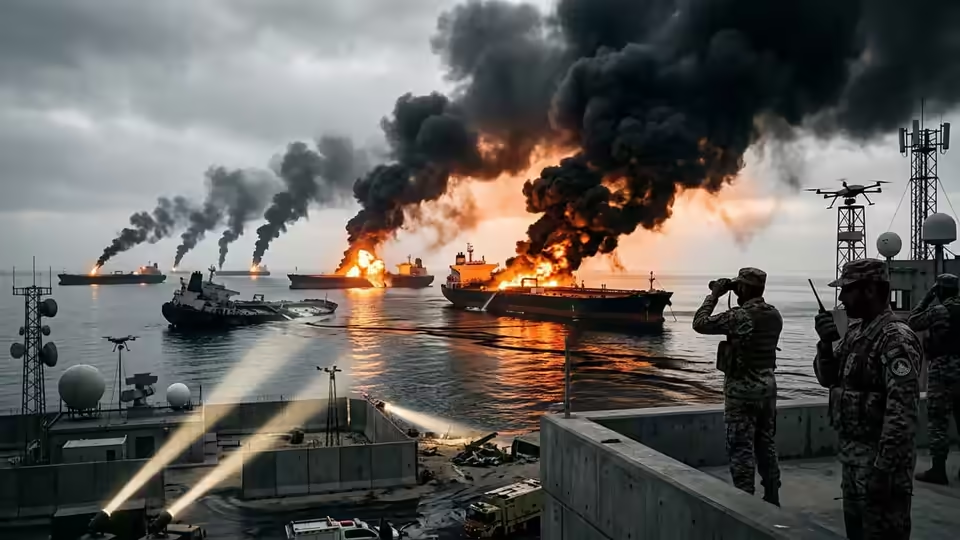
On March 18, 2026, Israeli jets hit the South Pars gas field in Asaluyeh. A few hours later, President Trump was in the Oval Office telling reporters he had no idea it was coming. He even claimed he told Prime Minister Benjamin Netanyahu, 'Don’t do that.' But that narrative of a fractured alliance is falling apart under the weight of actual military movements. On March 14—exactly 96 hours before the South Pars hit—US CENTCOM confirmed it launched a massive wave of strikes on 90 Iranian military targets on Kharg Island. Those strikes didn't just hit targets; they blinded Iran's coastal defenses, creating the exact tactical vacuum Israel needed to strike the gas fields.
South Pars isn't some minor asset. It’s part of a massive 9,700-square-kilometer reserve shared with Qatar, known as the North Dome. By hitting this specific spot, the conflict has shifted from a military exchange to a brutal economic war of attrition. Following the strikes, the Iranian news agency Tasnim reported that production has totally stopped at several key phases of the field. This isn't just a blow to Tehran’s domestic heating; it’s a massive shock to the global Liquefied Natural Gas (LNG) market. South Pars accounts for about 40% of Iran’s total gas reserves. When that tap gets shut off, major economies in China and India feel it immediately.
The financial stakes here are staggering. When Iran retaliated against Qatar’s Ras Laffan Industrial City and the Samref refinery in Saudi Arabia, they went straight for the 'energy heart' of the Gulf. Here's the thing: Samref is Saudi Arabia's only major outlet for crude exports that doesn't have to go through the now-closed Strait of Hormuz. It handles 400,000 barrels a day, so even a temporary shutdown sends oil futures into a frenzy. Analysts estimate that fixing the South Pars facilities will cost about $2.4 billion, but the real cost—redirected shipments and spiked insurance premiums for tankers—is projected to top $15 billion by the end of the month.
“On March 14, just 96 hours before the South Pars strike, US CENTCOM confirmed it had conducted its own massive wave of strikes on more than 90 Iranian military targets.”
The gap between the White House’s rhetoric and the military’s actions smells like 'plausible deniability.' Israeli officials haven't been shy about pushing back on Trump's claims of being out of the loop, either. Speaking to Axios, they’ve insisted that Washington was fully briefed on the targeting parameters for Asaluyeh. This isn't the first time the administration has used this playbook. It’s actually the third time this year the US has provided the logistical 'door-opening' strikes—like the Kharg Island job—while letting Israel take the public heat for hits that technically violate international norms regarding civilian energy.
While the White House focuses on the optics, the real-world impact is being felt at the gas pump and in utility bills. Between the closure of the Strait of Hormuz and the damage to Ras Laffan, the global LNG supply chain is currently running at a 12% deficit. For consumers in Europe and Asia, that translates to an immediate 20-30% jump in energy costs. The Trump administration’s attempt to distance itself from the South Pars strike looks less like they're restraining Israel and more like they're trying to insulate the President from the fallout of an energy crisis he helped facilitate.
Then there's the environmental cost, which remains unverified but looks grim. Satellite imagery from March 19 shows massive thermal signatures at the Asaluyeh processing complex. This suggests that fires are likely still burning dangerously close to toxic chemical storage units. So far, neither the US nor the Israeli government has said a word about the potential for a long-term ecological disaster in the Persian Gulf—a body of water that’s already been stressed to the limit by decades of naval conflict and industrial runoff.
The next 72 hours are going to be critical. We'll see if Qatar, a major US ally that shares this field with Iran, tries to mediate or if they'll be forced into a defensive shell against more Iranian retaliation. With American troops stationed at Al-Udeid Air Base in Qatar, they’re sitting right in the crosshairs of an energy war the White House is pretending it isn't leading. If the administration continues to claim it has no control over Israeli targeting while providing the intel to execute those strikes, the 'rift' Trump describes isn't a policy failure. It’s a performance.
For the average citizen, the story of a 'disobedient' Israel is just a distraction from a coordinated strategy that has crippled Iran’s most vital economic engine. The kicker? It’s coming at the cost of global market stability. We’re no longer just watching a war for territory. This is a war for control of the global thermometer, and the bill is being passed directly to the public.
Summary
Trump is trying to distance himself from the Israeli hit on Iran’s South Pars gas field, but the timeline doesn't really add up. While the White House claims they were left in the dark, military records and intel leaks point to a highly coordinated operation. Just four days before Israel struck the world’s largest natural gas reserve, US forces essentially cleared the path by leveling Iranian defenses on Kharg Island. This isn't just a military spat anymore—it's an all-out energy war that’s already hammering global LNG supplies and Asian energy security. We’re looking into the financial fallout and the strategic doublespeak coming out of the Persian Gulf.
⚡ Key Facts
- Israel conducted an airstrike on Iran's South Pars gas field on March 18, 2026.
- Iran launched retaliatory strikes on Qatar’s Ras Laffan and Saudi Arabia’s Samref refinery.
- The US has primarily focused on targeting Iranian military and naval targets, such as those on Kharg Island.
Military Leaks Prove US Paved Way for Gas Field Strike Trump Disavowed
Network of Influence
- Critics of the Netanyahu administration who want to portray Israel as a reckless ally.
- Donald Trump's political narrative of being 'unaware' to avoid accountability for energy price spikes.
- Gulf states seeking to pressure the US to restrain Israeli military action.
- The specific legal status of the 'US-Israeli war against Iran' (no formal declaration exists).
- Detailed history of the specific Iranian provocations that preceded the South Pars strike.
- The geopolitical alignment of Oman as a frequent mediator with Iran, which colors the Foreign Minister's quote.
The article frames the conflict as an uncontrollable escalation driven by Israel, portraying the US administration as either deceptive or incompetent in its inability to manage its junior partner.
See how the story connects.
Select any actor or numbered connection, then inspect the evidence before drawing a conclusion.
Scott Trust Limited Owns Guardian Media Group (GMG)
Follow the public record
Source Trail
Independent reporting and analysis
Get the next investigation in your inbox
One email a week. Receipts only. Free.
Free. Unsubscribe anytime. We never share your email.