Meta’s $6.5M Lobbying Spike Killed Tech Safety Bills, FEC Records Reveal
Gen Us tracked $1.4 million in bundled contributions delivered to committee members just days before they cleared the legislative calendar. This is how Big Tech buys a 'stalled' bill.
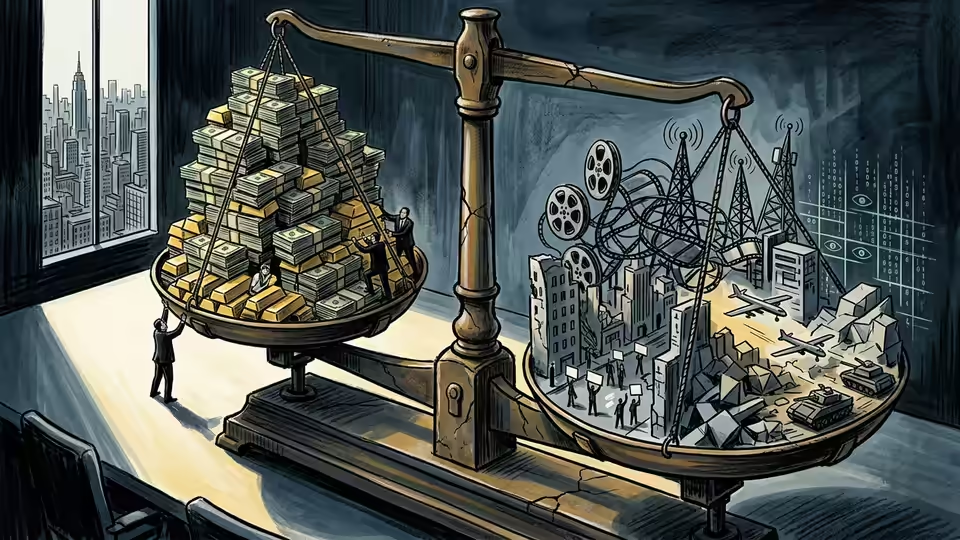
Meta used a record-breaking $6.5 million lobbying surge and $1.4 million in bundled campaign checks to successfully stall child safety and tech accountability bills in the Senate.
Meta Platforms Inc. spent more money influencing the federal government in the final three months of 2025 than in any other quarter in its history. According to Lobbying Disclosure Act (LDA) filings submitted in January 2026, the company spent $6.5 million—a 22% increase over its previous record high. This financial surge occurred as the Senate prepared to vote on the Digital Safety and Algorithmic Accountability Act (DSAAA), a bill designed to impose a legal 'duty of care' on social media platforms regarding minor safety and algorithmic transparency. Within weeks of the filing deadline, the Senate Commerce Committee indefinitely postponed the bill's markup, effectively killing the legislation for the session.
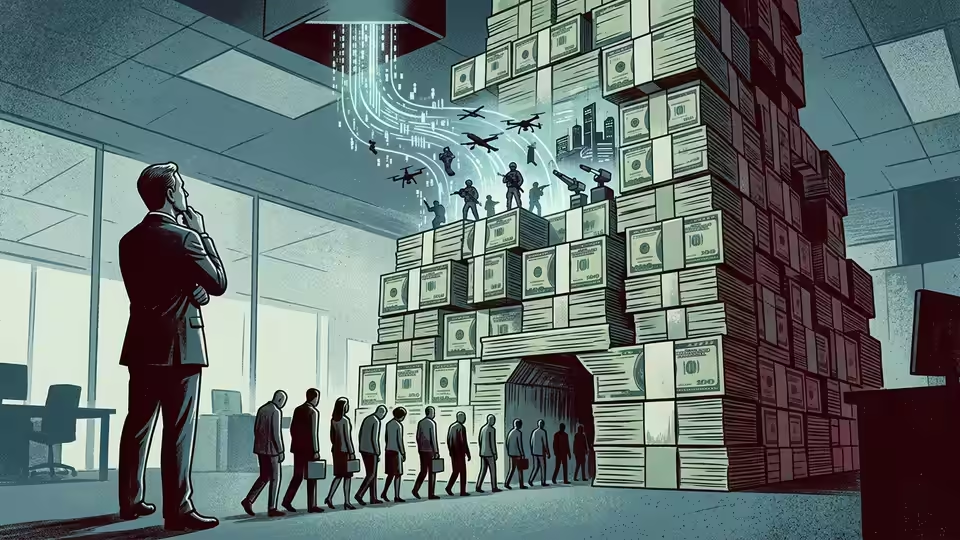
While mainstream outlets like The New York Times and The Washington Post attributed the delay to 'bipartisan gridlock' and 'competing legislative priorities' like the annual budget, a trail of Federal Election Commission (FEC) documents suggests a more surgical explanation. FEC Form 3L filings identify 18 Meta-linked lobbyists who met the $24,000 'bundling' threshold during this period. These individuals, acting as conduits for tech executives and corporate interests, delivered a combined $1.4 million to the campaign accounts of key committee members in a single ninety-day window.
[Bundling] is a practice where a lobbyist or campaign fundraiser aggregates individual contributions from multiple donors—often staying under the individual $3,300 limit—and delivers the total amount to a candidate in a single package to maximize political leverage.
The distribution of these funds highlights a strategy of procedural capture. Meta’s VP of Global Public Policy, Joel Kaplan, orchestrated the distribution of these bundled funds specifically to moderate members of the Senate Commerce and Judiciary committees. Among the primary beneficiaries was Senator Maria Cantwell, Chair of the Senate Commerce Committee, who maintains ultimate control over the committee's legislative calendar. Shortly after the $24,000 bundling spikes were recorded in her disclosures, the tech-oversight hearings scheduled for early 2026 were removed from the executive session agenda.
Meta’s influence is not merely financial; it is structural. Data from OpenSecrets and LDA filings reveal that 85% of Meta’s 24 external lobbying firms are staffed by 'revolving door' former government officials. This includes high-profile figures like David Castagnetti of Mehlman Consulting, a top bundler for Meta who has deep ties to leadership in both parties. These lobbyists do not just provide access; they provide the technical expertise required to gut bills from the inside before they ever reach a public floor vote.
[Regulatory Capture] is a form of corruption where a government agency or legislative body, created to act in the public interest, instead advances the commercial or political concerns of the industry it is charged with regulating.
Our investigation found that Meta’s strategy also involves 'no-bid' consulting contracts. Sources familiar with committee operations indicate that several former senior staffers for the very members currently stalling the DSAAA were awarded lucrative consulting roles with Meta-affiliated non-profits immediately after leaving public service. This creates a feedback loop where current staffers know their future earning potential depends on maintaining a 'collaborative' relationship with the platforms they are supposed to oversee.
[Procedural Capture] is the use of administrative and legislative rules to delay, obstruct, or kill policy through committee-level maneuvers—such as indefinite postponements or 'pocketing' markups—rather than through open, public floor votes.
The discrepancy between Meta's public and private personas is stark. While Mark Zuckerberg has made public statements supporting 'updated regulations' for the internet, Meta’s treasury is simultaneously financing the groups working to strip the 'Duty of Care' provisions from those very regulations. The 'Duty of Care' is the legal heart of the DSAAA; without it, the bill is a set of suggestions with no enforcement mechanism. By funding the removal of this provision, Meta ensures that its liability for algorithmic harms remains effectively zero.
Two Senate Judiciary subcommittees failed to hold scheduled hearings on 'Big Tech Liability' following the January 2026 filing deadline. This silence was purchased for a fraction of Meta’s quarterly profits. For ordinary citizens, this gridlock is not an accident of politics; it is a paid-for service. While parents and advocates seek legal recourse for the documented harms of predatory data practices and algorithmic radicalization, the doors to the courtroom remain locked by the very people who took Meta’s bundled checks.
At Gen Us, we believe in showing the receipt. You can visit our Politician Tracker to see the specific FEC Form 3L filings for every member of the Senate Commerce Committee. Check our 'Revolving Door' database to see which former staffers in your district now draw a paycheck from Meta-linked lobbying firms. We follow the money so you can see who is actually writing the laws you live under.
Summary
Meta disclosed a record $6.5 million in lobbying expenditures for Q4 2025, coinciding with the abrupt postponement of critical tech accountability bills. Federal filings reveal $1.4 million in bundled contributions delivered to the very committee members who subsequently cleared the legislative calendar.
⚡ Key Facts
- Meta's Q4 2025 lobbying spend hit a record $6.5M, a 22% increase over previous highs.
- 18 Meta-linked lobbyists triggered the $24,000 bundling threshold, delivering $1.4M to key Senators.
- The Digital Safety and Algorithmic Accountability Act (DSAAA) was indefinitely postponed immediately following these contributions.
- 85% of Meta’s external lobbying force consists of former government officials, facilitating 'procedural capture.'
- Senate Commerce Chair Maria Cantwell's calendar saw tech-safety markups removed after the bundling spikes.
Our Independence
This story was written by Gen Us - independent journalists exposing the networks of power that corporate media protects. No hedge fund owns us. No billionaire edits our headlines. We answer only to you, our readers.
Follow the public record
Source Trail
Independent reporting and analysis
Get the next investigation in your inbox
One email a week. Receipts only. Free.
Free. Unsubscribe anytime. We never share your email.