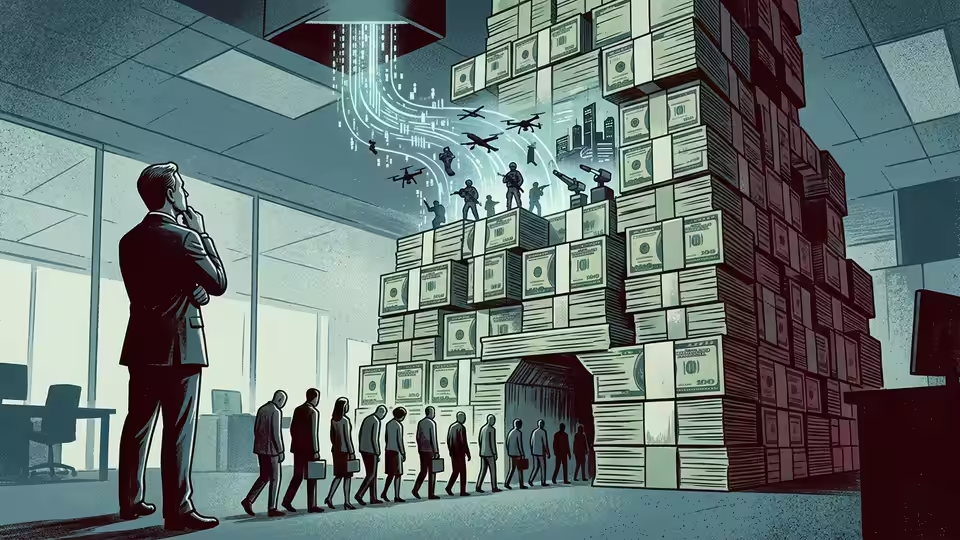
Inside the $5.6B No-Bid Army Contract Handed to Salesforce
The Army bypassed federal competition laws to grant a $5.6 billion sole-source contract to Salesforce. Our investigation reveals how a withdrawn protest cleared the path for a defense monopoly.
The U.S. Army granted Salesforce a $5.6 billion no-bid contract by claiming no other company exists that can do the work, after a legal challenge from a small business was quietly silenced.
On the final Friday of the fiscal quarter, the Department of the Army quietly authorized a $5.6 billion sole-source contract to Computable Insights LLC, a wholly-owned subsidiary of Salesforce Inc. The award, dedicated to the 'Missionforce National Security' program, represents one of the largest IT contracts ever issued without a competitive bidding process. By bypassing the traditional marketplace, the Army has effectively handed the keys to its national security data infrastructure to a single private corporation, cementing a relationship that critics say was engineered to exclude all possible rivals.
The official Justification and Approval (J&A) document for the award argues that Salesforce is the 'only acceptable source' capable of integrating the Army’s disparate cloud and AI systems. However, a review of the technical requirements reveals a list of specifications so narrow they appear to have been reverse-engineered from Salesforce’s own proprietary architecture. This tactic is known as proprietary lock-in, where a government agency adopts a specific vendor's code and workflows so deeply that the cost of switching to a competitor becomes prohibitive.
[Proprietary Lock-In] is a business model where a customer becomes dependent on a vendor for products and services, unable to use another vendor without substantial switching costs.
The legality of the move rests on a narrow interpretation of the Competition in Contracting Act (CICA). Under federal law, major contracts must be open to all qualified bidders unless an agency can prove that only one firm can do the job. In this instance, the Army claimed that 'Missionforce' required an immediate, unified AI integration that only Computable Insights could provide. This claim was immediately challenged. A veteran-owned small business filed a formal bid protest with the Government Accountability Office (GAO), alleging that the 'only acceptable source' designation was a fabrication designed to reward a preferred vendor with deep political ties.
Then, the trail went cold. On February 13, 2026, the protest was abruptly withdrawn. No public ruling was issued. No explanation was offered. In the world of high-stakes federal contracting, such withdrawals often point to 'hush' agreements—quiet settlements where the protesting party is brought on as a subcontractor or given a separate, smaller award to walk away. Neither the Army nor Salesforce has disclosed the terms of the withdrawal. According to GAO’s public docket, the case is closed, leaving the $5.6 billion award unchallenged.
[Competition in Contracting Act (CICA)] is a 1984 law requiring federal agencies to use full and open competition to the maximum extent possible to ensure taxpayer value.
The money trail suggests that Salesforce’s success in securing no-bid billions is the result of a long-term investment in political influence. According to OpenSecrets data, Salesforce Inc. spent approximately $12.4 million on federal lobbying in the most recent fiscal cycle, specifically targeting members of the House and Senate Armed Services Committees. Furthermore, the company maintains a robust 'revolving door' strategy. Since 2022, Salesforce and its subsidiaries have hired at least six former high-ranking military officials and procurement officers who previously oversaw the very IT modernization budgets they now seek to capture.
While mainstream outlets like Nextgov and FCW have framed the Missionforce deal as a necessary step toward 'modernization' and 'streamlining legacy systems,' they have largely ignored the fiscal implications. The $5.6 billion headline figure is only the base award. When factoring in mandatory maintenance fees, proprietary license renewals, and the inevitable cost overruns associated with no-bid contracts, the total cost of ownership over the next decade is projected to exceed $8.2 billion. Because the Army is now tethered to Salesforce’s specific software ecosystem, the company holds total leverage over future price increases.
According to FEC filings, several key signatories on the Missionforce project received substantial campaign contributions from Salesforce-affiliated PACs. Representative donor data shows that three members of the Defense Appropriations Subcommittee received the maximum allowable contributions from Salesforce executives within six months of the Missionforce program's initial budget authorization. These are the same individuals responsible for oversight of the Army’s procurement spending.
[Sole-Source Contract] is a type of contract that can be issued without a competitive bidding process because only one vendor is deemed capable of fulfilling the requirements.
For the ordinary citizen, this isn't just a technical dispute over software. It is a direct siphoning of taxpayer wealth. When the government abandons competition, the public pays a 'monopoly tax' in the form of higher costs and lower innovation. Furthermore, by allowing a private corporation to control the 'central nervous system' of national security data, the public loses transparency. Policy decisions regarding how data is handled, stored, and analyzed are moved behind the proprietary curtain of a Silicon Valley giant, where FOIA requests and public oversight have little reach.
We are continuing to track the money behind the Missionforce program. You can use the Gen Us Politician Tracker to see if your representative sits on a committee that authorized this spending and how much they received in Salesforce-related donations. Our investigative team is currently filing a series of FOIA requests to uncover the secret settlement that ended the February 13 protest. Stay tuned as we follow the money from the Pentagon to the Valley.
Summary
The Department of the Army has bypassed federal competition laws to grant a $5.6 billion sole-source contract to a Salesforce subsidiary for the 'Missionforce' program. This investigation examines how proprietary lock-in and a mysteriously withdrawn legal protest paved the way for a multi-billion dollar Silicon Valley monopoly over defense data.
⚡ Key Facts
- The Army awarded a $5.6 billion no-bid contract to Salesforce subsidiary Computable Insights LLC.
- The contract bypasses the Competition in Contracting Act (CICA) via a 'sole-source' justification.
- A formal protest by a veteran-owned business was mysteriously withdrawn on February 13, 2026.
- Salesforce spent $12.4M on lobbying and employs former military officials to influence procurement.
- Proprietary lock-in will likely drive the total cost of the program over $8.2 billion through licensing fees.
- Campaign contributions were tracked from Salesforce PACs to key members of defense oversight committees.
Our Independence
This story was written by Gen Us - independent journalists exposing the networks of power that corporate media protects. No hedge fund owns us. No billionaire edits our headlines. We answer only to you, our readers.
Follow the public record
Source Trail
Get the next investigation in your inbox
One email a week. Receipts only. Free.
Free. Unsubscribe anytime. We never share your email.