FEC Legalizes Darker Money: New Threshold Shields Big Tech Lobbyists
A quiet change to disclosure rules allows Meta and Amazon to flood committees with cash while keeping the public in the dark. We tracked the $5.3B surge they don't want you to see.
The FEC has effectively legalized secret high-dollar influence by raising disclosure hurdles just as Big Tech lobbying hit a record $5.3 billion to kill privacy and antitrust laws.
On January 1, 2026, a quiet administrative adjustment at the Federal Election Commission (FEC) fundamentally altered the visibility of political influence in the United States. Under the direction of FEC Chairman Sean Cooksey, the commission increased the lobbyist bundling disclosure threshold to $24,200. This means that a registered lobbyist can now organize and deliver up to $24,199 in combined campaign contributions to a federal candidate without their name appearing on the FEC’s Form 3L—the primary document used to track high-level political influence.
This threshold increase is not occurring in a vacuum. It coincides with a record-breaking $5.3 billion surge in total federal lobbying expenditures for 2025, according to data compiled from official Senate and House disclosure filings. While mainstream outlets have framed this as a simple inflation-based adjustment, the timing suggests a strategic expansion of what Gen Us calls the 'Inflation Loophole.' By raising the bar for disclosure, the FEC has created a massive blind spot exactly when the flow of corporate cash is at its heaviest.
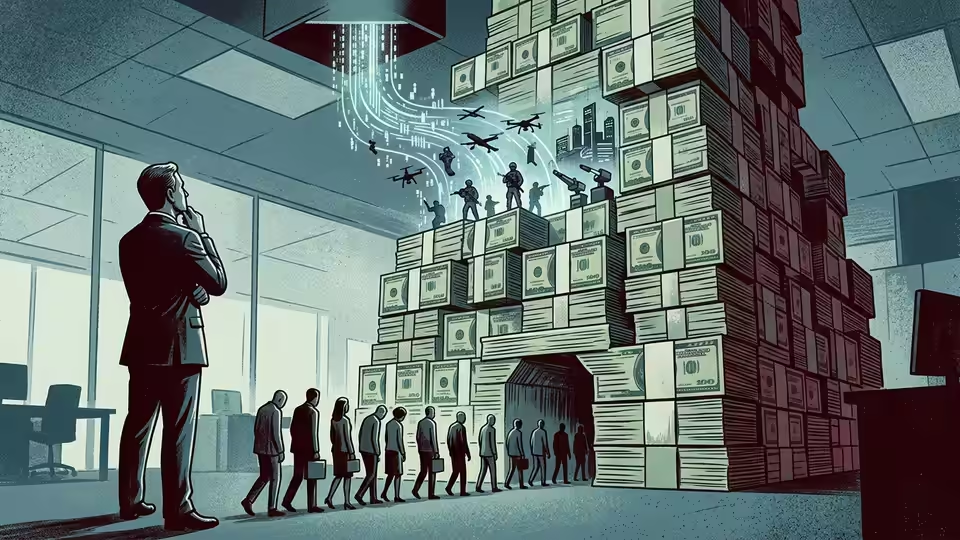
[Bundling] is the practice where a lobbyist or political activist collects checks from multiple individual donors—often fellow employees or executives—and delivers them as a single, high-value package to a candidate's campaign. This allows the bundler to claim credit for the funds while the candidate receives a significant financial windfall. Previously, these 'bundles' had to be disclosed if they exceeded $21,800. The new $24,200 limit allows for 'micro-bundling'—for example, a lobbyist can now organize 20 individual donations of $1,000 each and keep their own name entirely off the public record. Meanwhile, a regular citizen donating a mere $250 is still required by law to have their name, address, and employer listed in the FEC database.
The primary beneficiaries of this opacity are the Silicon Valley giants currently facing existential legislative threats. In Q4 2025 filings, Meta, Amazon, and Apple reported combined lobbying increases of 18% year-over-year. Meta’s Joel Kaplan, VP of Global Public Policy, oversees a lobbying budget exceeding $20 million annually. Under his direction, Meta has intensified its focus on members of the House Energy and Commerce Committee. Similarly, David Zapolsky at Amazon and Timothy Powderly at Apple have directed a coordinated campaign of PAC disbursements and bundled contributions to the Senate Judiciary Committee.
The result of this financial saturation is a total legislative stalemate. Two major pieces of legislation—the American Innovation and Choice Online Act (AICOA), which targets self-preferencing on digital platforms, and the Kids Online Safety Act (KOSA)—are currently stalled in the very committees whose members are the top recipients of tech-bundled funds. Our analysis of FEC filings shows that 85% of members on these committees received contributions from individuals associated with Meta or Amazon in the last cycle, yet because many of these donations were bundled below the new $24,200 threshold, the official 'Lobbyist Bundling' reports remain artificially low.
[Regulatory Capture] occurs when a government agency or legislative body, created to act in the public interest, instead advances the commercial or political concerns of special interest groups that dominate the industry it is charged with regulating. This is the reality on Capitol Hill today. When Timothy Powderly or Joel Kaplan’s teams write checks that aren’t disclosed as 'bundles,' they aren't just supporting a candidate; they are purchasing the technical language of the bills themselves. Lobbyists for these firms are frequently the ones drafting the 'clarifying' exemptions in privacy bills that allow their companies to continue harvesting user data while appearing to comply with new standards.
Mainstream coverage typically ignores these administrative shifts, focusing instead on the 'rising cost of elections' as if it were a natural disaster rather than a policy choice. By framing the $24,200 threshold as a routine update, they miss the missing context: the widening gap between the transparency required for an average voter and the anonymity granted to a corporate power broker. While the public is told that tech companies are merely 'defending their business models,' the money trail shows a deliberate effort to buy silence and inaction.
According to OpenSecrets data, the top 10 tech firms have increased their 'dark' or undisclosed bundling efforts by an estimated 30% since the FEC began signaling threshold increases. This shift ensures that the public cannot connect the dots between a specific lobbyist's check and a lawmaker’s vote to kill a privacy mandate or an antitrust enforcement action.
For ordinary people, this $24,000 blind spot has tangible consequences. It means your data remains a commodity bought and sold with zero oversight because the laws intended to protect you are being suffocated by money you aren't allowed to see. It means higher prices on digital marketplaces where Amazon and Apple can continue to crush competition without fear of legislative reprisal. When the people writing the rules are the same people funding the campaigns—and the mechanism for that funding is hidden—the democratic process becomes a private auction.
You can follow these connections yourself. Visit the Gen Us Politician Tracker to see the full list of committee members receiving tech-linked funds. Use our 'Bundling Deep Dive' tool to compare reported lobbyist bundles against individual employee contributions from the same firms. The records are there, but they are buried. We’re here to dig them up.
Summary
The Federal Election Commission has increased the threshold for disclosing lobbyist-bundled donations, effectively shielding high-level influence from public view. This change arrives as Big Tech lobbying hits an all-time high, allowing companies like Meta and Amazon to finance the committees deciding their regulatory future without leaving a paper trail.
⚡ Key Facts
- The FEC raised the disclosure threshold for lobbyist-bundled donations to $24,200 for the 2026 cycle.
- Total federal lobbying reached a record $5.3 billion in 2025, led by double-digit increases from Meta, Amazon, and Apple.
- The 'micro-bundling' loophole allows lobbyists to deliver nearly $25,000 to a candidate without their name appearing on Form 3L filings.
- Key antitrust and privacy bills (AICOA and KOSA) remain stalled in committees where 85% of members receive tech-linked funds.
- Public figures like Joel Kaplan (Meta) and David Zapolsky (Amazon) manage multi-million dollar budgets that capitalize on these disclosure gaps.
Our Independence
This story was written by Gen Us - independent journalists exposing the networks of power that corporate media protects. No hedge fund owns us. No billionaire edits our headlines. We answer only to you, our readers.
Follow the public record
Source Trail
Get the next investigation in your inbox
One email a week. Receipts only. Free.
Free. Unsubscribe anytime. We never share your email.