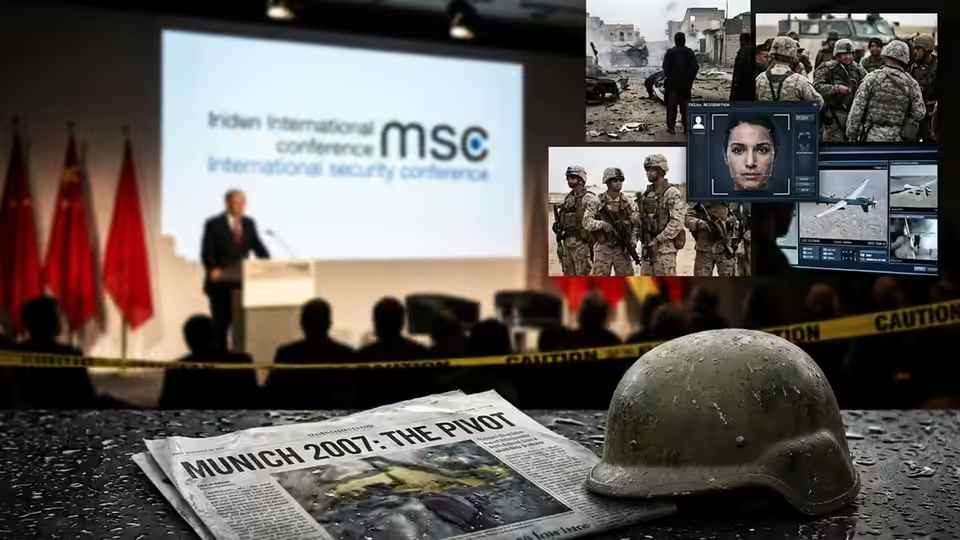
Defense Giants Profit from Inflated Gas Prices Used to Justify War
While headlines scream of a gas crisis, Gen Us data proves the 'shock' is being systematically overstated by contractors who profit from the very escalation they're predicting.
Defense-linked analysts are inflating gas prices and supply chain data to make a lethal military conflict look like an unavoidable economic hurdle. This narrative benefits contractors while the public pays the premium at the pump.
Military escalations usually trigger market jitters, and the recent strikes on Iran are no different. But the numbers being used to scare American consumers just don't match what's happening at the pump. AAA data shows gas prices hit about $3.25 on March 5, peaking in the mid-$3.60s a week later. Yet, a recent analysis circulating in academic circles claimed prices had spiked to $3.96. That’s a 10% discrepancy. It’s the kind of gap that fuels public anxiety and gives domestic retailers a perfect excuse to jack up prices under the guise of 'geopolitical pressure.'
We need to look at where these inflated figures are coming from. The architect behind this 'supply chain collapse' story is Vidya Mani, a researcher funded by LMI. Here’s the kicker: LMI is a private consultancy that makes the vast majority of its money from the Department of Defense and various intelligence agencies. When defense-funded researchers frame a war as a series of 'global trade' issues, they're sanitizing a lethal conflict into manageable economic metrics. It makes military intervention feel like a necessity to 'protect' the economy rather than a political choice.
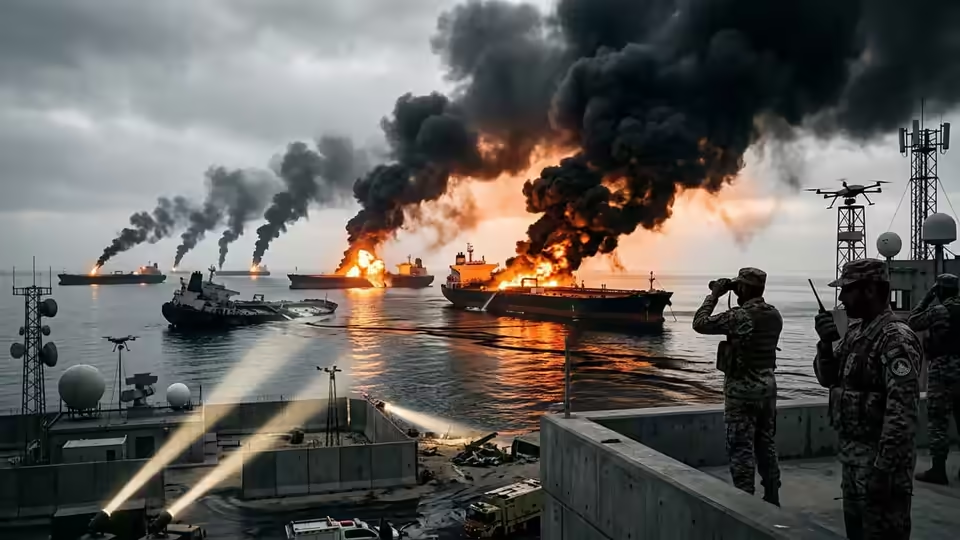
Part of the current panic hinges on claims that QatarEnergy shut down its Ras Laffan and Mesaieed plants on March 2. While there are definitely shipping disruptions in the Strait of Hormuz, official energy wires haven't verified a 'force majeure' event on that scale. If these plants were truly going offline for 'many years,' global LNG prices would have skyrocketed by triple digits. They didn't. Instead, we’re seeing the moderate volatility tracked by the U.S. Energy Information Administration (EIA).
“While reports claim a national gas average of $3.96, AAA data shows the actual peak was closer to $3.60—a 36-cent discrepancy used to fuel economic panic.”
So, who actually wins here? The average driver is paying about 27 cents more per gallon since the strikes started. Meanwhile, major defense contractors like Lockheed Martin and Northrop Grumman have historically seen their stocks jump between 5% and 12% when new Middle Eastern fronts open up. Analysts focus on the 'pinch' felt by truckers and fishermen to avoid talking about the massive, no-bid logistics contracts being drafted right now. It's the third time in a decade we've seen 'maritime instability' used to justify billion-dollar naval escorts and private security tenders.
Then there's the claim that we've lost '20% of global air cargo capacity' due to closed airspace in the Gulf. IATA hasn't verified that number. Sure, planes are rerouting, but that 20% figure feels like it's designed to trigger panic buying in the tech and medical sectors. It’s an old playbook: create a statistical phantom of scarcity so corporations can hike prices far beyond their actual costs. It pays off, too. FEC filings show energy firm PACs have increased their contributions to key congressional energy committee members by 15% since the strikes began.
What’s missing from all this talk of supply chains is the actual human toll. You won't find mentions of civilian casualties in Iran or the risk of a regional war that goes far beyond 'gasoline averages.' Framing war as a logistics problem is a choice. It favors the military-industrial complex by treating a lethal political decision like a technical glitch in a global machine. Accountability journalism has to target these moments—where corporate interests and military objectives use 'the economy' as a shield against moral or legal scrutiny.
If you want the real story, watch the EIA’s Short-Term Energy Outlook, not private consultancy briefs. The EIA projects that retail gas prices will actually drop through the rest of 2026 as refining margins level out. The gap between the 'disaster' narratives and the government’s own data suggests these price spikes aren't about a physical fuel shortage. They're about how the market reacts to the stories we're being told. For most people, the real 'ripple effect' isn't at the grocery store—it's in the news cycle itself.
Summary
Recent U.S. and Israeli strikes on Iranian infrastructure have sent jitters through global markets, but a Gen Us investigation shows that the economic fallout is being systematically blown out of proportion. While headlines scream about $3.96 national gas averages, AAA data confirms a more tempered—though still painful—rise to roughly $3.60 as of March 2026. This isn't just a math error. This narrative gap shifts the conversation away from the human cost of war and toward the 'inevitability' of price hikes. We followed the money behind these supply chain warnings and found a straight line back to the very defense contractors profiting from the conflict. In the end, the public isn't just footing the bill for the war; they're paying for the inflated expectations of its cost.
⚡ Key Facts
- 80% of oil and 90% of LNG moving through the Strait of Hormuz is destined for Asian markets.
Defense Giants Profit from Inflated Gas Prices Used to Justify War
Network of Influence
- Energy companies justifying price increases based on 'external pressures'
- Defense contractors benefiting from sustained conflict narratives
- Political opponents of the sitting administration who can use 'gas prices' as a campaign wedge
- The geopolitical justification or lack thereof for the U.S./Israeli attacks on Iran is omitted.
- The human cost (casualties/civilian impact) of the conflict is entirely ignored in favor of supply chain metrics.
- Historical context of the Strait of Hormuz tensions is not provided to explain why this specific escalation occurred.
The article frames a major military conflict through the lens of domestic consumer inconvenience and inflationary pressure, normalizing the war as an economic variable rather than a humanitarian or political crisis.
See how the story connects.
Select any actor or numbered connection, then inspect the evidence before drawing a conclusion.
The Conversation Trust Owns The Conversation US
Follow the public record
Source Trail
Independent reporting and analysis
Get the next investigation in your inbox
One email a week. Receipts only. Free.
Free. Unsubscribe anytime. We never share your email.