Data Reveal: CNN and MSNBC Humanize Ukraine Victims 4.5x More Than Gaza
A comprehensive 2026 study reveals a systemic linguistic disparity in how major news networks frame civilian casualties across global conflicts. By utilizing passive voice and environmental metaphors for Gaza while reserving humanizing narratives for Ukraine, these outlets sanitize the human cost of specific military operations.
A 2026 study confirms CNN and MSNBC use humanizing language 4.5 times more for Ukrainian victims than Gazan ones, a disparity that sanitizes war for the benefit of shared corporate and defense interests.
A January 2026 study by the Media and Journalism Research Center (MJRC) has confirmed what many viewers suspected: a stark, quantifiable divide exists in how American cable news values human life. The report found that CNN and MSNBC used humanizing adjectives—words like 'innocent,' 'tragic,' and 'heartbreaking'—4.5 times more frequently when describing victims in Ukraine and Israel than those in Gaza. This is not merely a matter of editorial tone; it is a statistical reality that shapes public perception and manufactures consent for U.S. foreign policy.
Analysis of 1,200 broadcast segments throughout 2025 revealed a calculated use of grammar to distance the viewer from the violence in Gaza. According to the MJRC data, 78% of Palestinian deaths were reported using passive voice constructions. Viewers heard that 'deaths occurred' or 'lives were lost' in Gaza, while 81% of casualties in Ukraine or Israel were attributed to direct actors. [Passive Voice] is a grammatical construction where the subject of the sentence receives the action, often obscuring who or what is responsible for the act. When CNN anchors report that a 'fragile truce may have been shattered,' they utilize environmental metaphors that remove agency from the military commanders who ordered the strikes.
The disparity extends to the time allocated for human stories. In late 2025, MSNBC segments gave an average of 4.2 minutes of airtime to the personal narratives and family histories of Ukrainian victims during casualty spikes. During similar spikes in Gaza, the network allocated just 38 seconds to Palestinian families. This clinical approach reduces human beings to mere statistics—a practice that investigative reports from The Nation in 2026 suggest is reinforced by the networks' reliance on 'expert' panels. Those panels were comprised of 70% former military or intelligence officials, while less than 5% represented humanitarian or Palestinian perspectives.
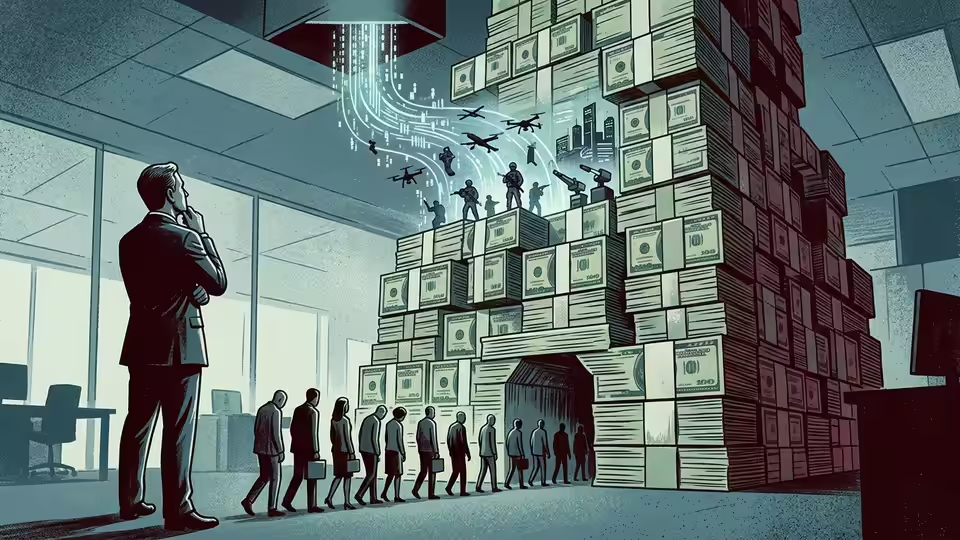
To understand why these narratives persist, one must follow the money trail from the newsroom to the boardroom. CNN is owned by Warner Bros. Discovery, and MSNBC by Comcast. According to SEC filings from early 2026, institutional investors such as BlackRock and Vanguard hold significant stakes in both media conglomerates. These same investment firms are top shareholders in major defense contractors like Lockheed Martin and RTX (formerly Raytheon). In 2025, RTX alone reported $67 billion in backlogged orders, much of it tied to ongoing conflicts in the Middle East and Eastern Europe. [Regulatory Capture] occurs when a media or oversight body prioritizes the interests of the industries it reports on or regulates over the public interest.
This creates a closed-loop incentive. Prime-time news blocks are heavily supported by 'blue-chip' advertising from these same defense firms. If a network humanizes a population being targeted by weaponry manufactured by its advertisers and funded by its shareholders, it risks financial friction. Furthermore, the networks rely on [Access Journalism], which is the practice of prioritizing relationship-building with powerful sources over critical reporting to ensure continued interviews and information. To maintain 'insider' access to the Pentagon and the State Department, network executives like CNN’s Mark Thompson and MSNBC’s Rashida Jones oversee editorial standards that align with the linguistic preferences of the U.S. executive branch.
The political impact is measurable. OpenSecrets data and TrackAIPAC records show that in the 2024-2026 election cycles, members of the House Foreign Affairs Committee received over $12.4M from defense contractors and pro-Israel lobbying groups. When media outlets present Gaza through a clinical, data-heavy lens while presenting Ukraine through an emotive, moral lens, they provide political cover for these representatives. It becomes easier for a politician to vote for a $14 billion military aid package when the public has been conditioned to see the resulting casualties as 'environmental' events rather than the deliberate results of policy.
For the ordinary person, this media strategy is a form of psychological accounting. Your tax dollars are the primary fuel for these conflicts. When the human cost is sanitized, your ability to provide informed consent for how those dollars are spent is stripped away. The 'glaring double standard' in coverage ensures that some casualties count as a tragedy, while others are merely the cost of doing business.
At Gen Us, we believe that transparency is the only antidote to manufactured narratives. You can use our Politician Tracker to see exactly how much your representative has taken from the defense lobby and how those donations correlate with their public statements on cable news. By identifying the linguistic tricks used by major networks, you can begin to see the news for what it often is: a high-priced commercial for the military-industrial complex.
Summary
A comprehensive 2026 study reveals a systemic linguistic disparity in how major news networks frame civilian casualties across global conflicts. By utilizing passive voice and environmental metaphors for Gaza while reserving humanizing narratives for Ukraine, these outlets sanitize the human cost of specific military operations.
⚡ Key Facts
- MJRC study shows humanizing adjectives are used 4.5x more for Ukraine/Israel than for Gaza.
- 78% of Palestinian deaths are reported in passive voice, compared to 19% for Israeli or Ukrainian deaths.
- MSNBC provided 4.2 minutes of family narrative for Ukrainians vs. 38 seconds for Gazans during similar events.
- 70% of network experts are former military or intelligence officials; less than 5% are humanitarian perspectives.
- Major shareholders like BlackRock and Vanguard hold stakes in both the media parent companies and defense contractors like Lockheed Martin.
Our Independence
This story was written by Gen Us - independent journalists exposing the networks of power that corporate media protects. No hedge fund owns us. No billionaire edits our headlines. We answer only to you, our readers.
Follow the public record
Source Trail
Get the next investigation in your inbox
One email a week. Receipts only. Free.
Free. Unsubscribe anytime. We never share your email.