Beyond the Theater: The Military Reality of the US-Iran 'Total War' Narrative
Talk of a total war and the supposed assassination of Supreme Leader Ali Khamenei is everywhere right now, but there's just no proof. While Netanyahu has pushed to redraw the regional map for years, the current narrative often ignores Iran’s proxy network and its refusal to follow nuclear rules. We’re looking past the diplomatic theater to the actual military moves in the Indian Ocean. This isn't just about borders—it’s about global oil prices and whether the U.S. is bypassing its own laws on war.
People are screaming about total war and Khamenei's death, but the facts aren't there. Under the noise, it's a high-stakes struggle over oil corridors and regional power that's being fought without much Congressional oversight.
Despite the sensational headlines coming out of regional outlets, there isn't any verified evidence to back up claims that Iranian Supreme Leader Ayatollah Ali Khamenei has been assassinated. These rumors are everywhere, often using weirdly outdated terms like 'Secretary of War' for modern officials. It looks like a deliberate push toward a 'total war' narrative, but global markets and official military channels aren't biting yet. Prime Minister Benjamin Netanyahu has wanted a 'regional remakingLoaded Language' for a long time, but what we're seeing now is a series of intense strikes—not the full-scale invasion some commentators are selling.
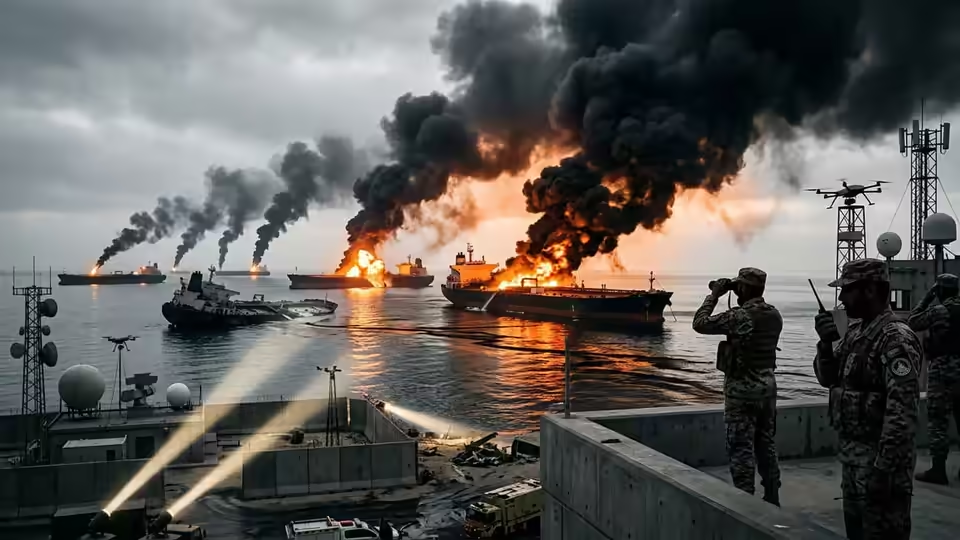
If you want the real story, follow the money. This is about energy leverage as much as it is about ideology. A direct clash with the full weight of the U.S. military would immediately choke the Strait of Hormuz, where 20% of the world’s oil flows. Critics of Western intervention love to talk about 'imperial overreach,' but they often skip the financial reality of Iran’s 'Axis of Resistance.' Tehran pours billions into Hezbollah, Hamas, and the Houthis, and that’s what’s really driving the current U.S. and Israeli posture. The chaos in the Gulf is a goldmine for energy speculators and defense contractors who thrive on this 'talk peace, prepare for war' choreography.
“The script of 2003 is being dusted off, but the actors now include a deeply integrated Iranian military and a fragmented Western political consensus.”
There's a big piece of context missing from the 'empire in decline' talk: the October 7 attacks and Iran's history of ignoring nuclear oversight. Iranian diplomats might act 'flexible' when they're in Oman or Geneva, but their proxies are still out there engaging in kinetic operations. It's easy to frame Iran as a rational victim of aggression, but that ignores Tehran’s own expansionist goals. The 'Greater Israel' rhetoric from the Israeli right is a massive factor, certainly, but it doesn't exist in a vacuum. You can't ignore the Iranian-led coalition’s stated goal of dismantling the entire regional order.
For the American public, the most important thing to watch isn't the rhetoric—it's how Congress is being bypassed. This escalation is happening without any formal declaration of war, a trend that started with Iraq and hasn't slowed down since. If the U.S. moves from a 'show of force' to a sustained campaign, you'll feel it in the price of gas and shipping costs long before you see it on the news. Right now, there’s a massive gap between military reality and diplomatic theaterLoaded Language. Until the Strait of Hormuz is actually contested, the 'fall of empire' remains just a theory, not a fact.
Summary
Talk of a total war and the supposed assassination of Supreme Leader Ali Khamenei is everywhere right now, but there's just no proof. While Netanyahu has pushed to redraw the regional map for years, the current narrative often ignores Iran’s proxy network and its refusal to follow nuclear rules. We’re looking past the diplomatic theater to the actual military moves in the Indian Ocean. This isn't just about borders—it’s about global oil prices and whether the U.S. is bypassing its own laws on war.
⚡ Key Facts
Beyond the Theater: The Military Reality of the US-Iran 'Total War' Narrative
Network of Influence
- The Iranian government (portrayed as a rational, flexible victim of aggression)
- Anti-interventionist political movements in the West
- Geopolitical rivals of the United States looking to see a decline in 'US Empire'
- The role of Iranian proxies (Hezbollah, Houthis, Hamas) in regional destabilization is omitted.
- The events of October 7, 2023, and their direct impact on Israeli security posture are not mentioned.
- Iran's history of non-compliance with IAEA inspections is glossed over as 'readiness for oversight'.
- The internal domestic pressures within Iran and its own expansionist 'Axis of Resistance' ideology are ignored.
The article frames the conflict as an artificial war of choice manufactured by Benjamin Netanyahu and forced upon a compliant US, while stripping Iran of its agency as a regional military power.
See how the story connects.
Select any actor or numbered connection, then inspect the evidence before drawing a conclusion.
Fadaat Media Ltd Parent company Middle East Eye
Follow the public record
Source Trail
Independent reporting and analysis
Get the next investigation in your inbox
One email a week. Receipts only. Free.
Free. Unsubscribe anytime. We never share your email.