$90 Oil and Dead Troops: The Cost of Trump’s ‘Unconditional Surrender’
As gas prices skyrocket and three U.S. service members are killed, the White House is demanding a total Iranian surrender without Congressional approval.
Trump is demanding 'unconditional surrender' in Iran, pushing a week-old conflict toward an open-ended regional war. He's bypassing Congress to do it, and the consequences—$90 oil and rising U.S. casualties—are already being felt at home.
Seven days into 'Operation Epic Fury,' the goalposts have shifted. President Trump has moved past simple military objectives, now demanding an 'unconditional surrenderLoaded Language' from Tehran. It's a massive escalation in rhetoric, and he's doing it without a new Authorization for Use of Military Force (AUMF) from Congress. Instead, the administration is leaning on a very broad reading of Article II power. Press Secretary Karoline Leavitt claims we're looking at a four-to-six-week window, but without a clear exit strategy or any real Congressional oversight, this is starting to look a lot like the 'forever wars' of the past.
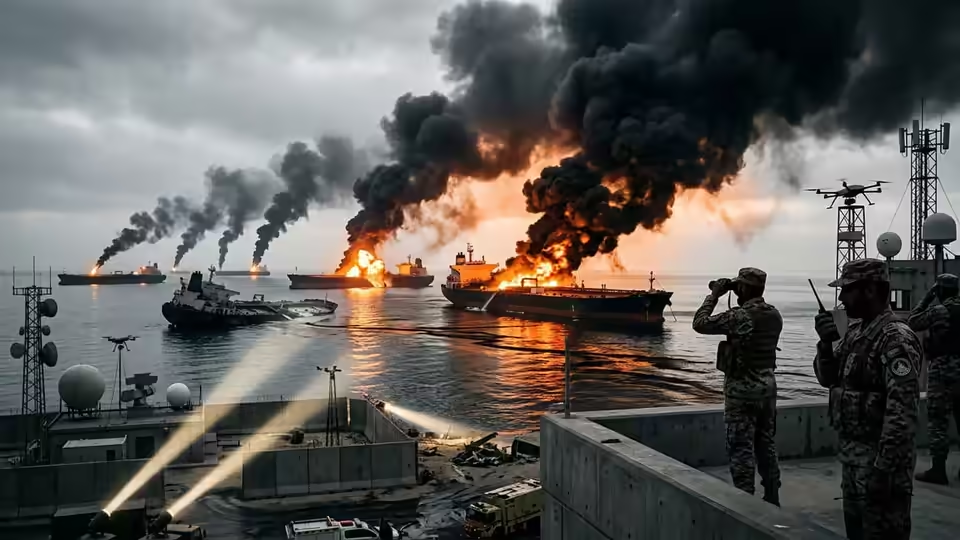
The fallout isn't just happening overseas—it’s hitting Americans at the pump and on Wall Street. Brent crude futures surged to $90 a barrel this morning after Qatar warned that Gulf energy flows could flatline within days. The kicker? This chaos is actually helping Russia, as global demand for their energy spikes while U.S. consumers take the hit. Meanwhile, defense contractors are seeing their stock prices climb as the Pentagon prepares to send the 82nd Airborne Division’s headquarters from Fort Liberty straight to the front lines.
“Unconditional surrender could be that [the Iranians] announce it. But it could also be when they can't fight any longer.”
Casualty counts are already becoming a battlefield of their own. You’ll hear sensational reports claiming six U.S. service members have died, but the verified count stands at three. This 'fog of war' is being used to justify even more aggressive bombing runs. Tehran’s government districts are currently under heavy bombardment, but the administration isn't saying a word about civilian deaths. Instead, they’re promising to 'nation-build' and make Iran 'economically bigger'—but only after the systematic destruction is complete.
The risk of this turning into a global firestorm is real. The U.S. is currently batting away every offer for mediation, even as intelligence suggests China is ready to help Iran dodge sanctions with missile parts and cash. Russia is reportedly feeding Tehran intel on U.S. military movements, too. Despite a call for talks from Iranian President Masoud Pezeshkian, the White House has made it clear: they’ll only talk to a new leadership team they’ve picked themselves. For regular people, the immediate worry is the looming energy crisis and the fact that thousands of U.S. troops are heading into a war that still has no clear legal boundaries.
Summary
Donald Trump is digging in. A week into the conflict with Iran, the President is now demanding nothing less than 'unconditional surrender,' even as gas prices spike and the legal ground for the war remains shaky. While the White House insists this won't take more than six weeks, the reality on the ground is different: three U.S. service members are dead, oil has hit $90 a barrel, and there’s still no official green light from Congress.
⚡ Key Facts
- Oil prices (Brent) have surged to around $90 due to the conflict.
$90 Oil and Dead Troops: The Cost of Trump’s ‘Unconditional Surrender’
Network of Influence
- Domestic political figures seeking a 'strongman' image in military conflicts
- Defense contractors and the military-industrial complex
- Russian energy interests benefiting from the surge in oil prices and disruption of Gulf flows
- The legal justification or Congressional authorization for 'Operation Epic Fury' is not mentioned.
- The specific event that 'ignited' the conflict seven days prior is not detailed.
- The civilian casualty counts in Tehran are omitted, focusing instead on military 'success' and 'nation-building' promises.
The narrative frames the conflict as an inevitable path toward total US victory and 'reconstruction' while portraying Iran as a purely terrorist entity that must be forced into unconditional surrender.
See how the story connects.
Select any actor or numbered connection, then inspect the evidence before drawing a conclusion.
ABC Media Ltd (Bulgaria) Parent company ZeroHedge
Follow the public record
Source Trail
Independent reporting and analysis
Get the next investigation in your inbox
One email a week. Receipts only. Free.
Free. Unsubscribe anytime. We never share your email.