$120 Oil: The 1945 U.S.-Saudi Security Deal Faces Its Death Knell
As Brent crude nears $120, a security alliance that has stabilized the world since WWII is fracturing. We examine how Gulf sovereign wealth is outmaneuvering Western interests.
The Middle East conflict is sending oil prices to record levels, proving that the West no longer calls the shots in a region backed by $3 trillion in sovereign wealth.
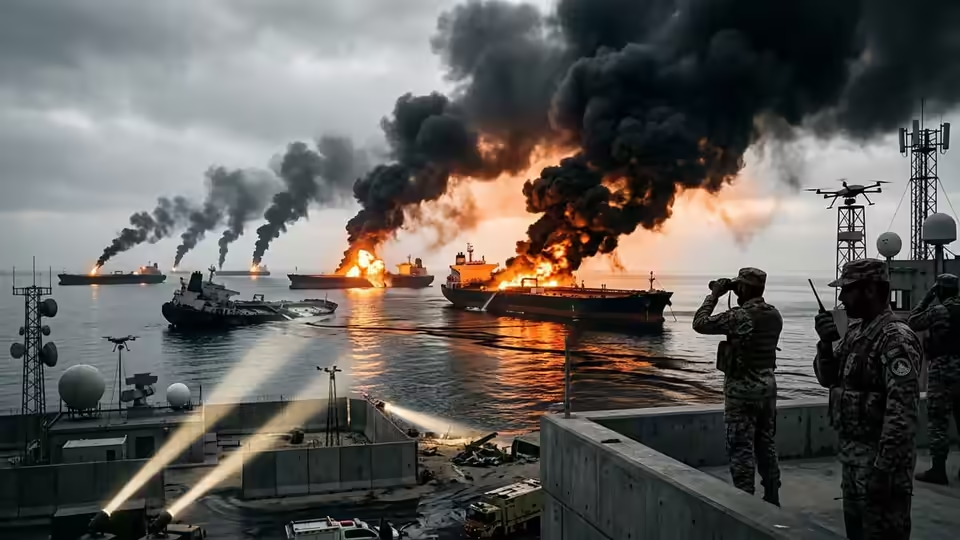
Oil prices blew past $100 a barrel this week. That’s the direct result of the US and Israel ramping up operations against Iran, triggering retaliatory strikes that have basically paralyzed the Strait of Hormuz. We’re talking about a choke point that handles 20% of the world’s liquid petroleum; when it shuts down, the markets panic. Most historians look back at that 1945 meeting between FDR and King Abdul Aziz on the USS Quincy as the start of the modern Middle East. But that 'oil-for-security' pact is being rewritten in real-time. This isn't just about resources anymore. It’s a test of whether a century-old Western security umbrella can even function when players like Iran and Saudi Arabia are chasing their own, often conflicting, strategic goals.
The real kicker, though, is how much the financial landscape has shifted. Gulf nations aren't just extraction points for Western oil companies anymore—they’re global financial titans in their own right. Sovereign wealth funds from Saudi Arabia (PIF), the UAE (ADIA), and Qatar (QIA) now control over $3 trillion. That’s roughly 40% of the world’s total sovereign wealth. This kind of capital gives these countries the power to weather—or even profit from—the kind of market chaos that crushes Western consumers. When OPEC+ announced that 'measured increase' in output this March, it wasn't just a favor to Washington. It was a cold, calculated move to protect their own long-term market share.
“Gulf sovereign wealth funds now control over $3 trillion in assets, giving them the financial leverage to weather disruptions that cripple Western economies.”
There's a common narrative that Middle East wars are just external 'imperial' impositions, but that ignores the local regimes fighting for their own survival. The Sunni-Shia divide and the power struggles between monarchies and revolutionary states are the real fuel for this fire. These regional players use the 'oil curseLoaded Language' to fund their own wars and internal crackdowns, often without checking in with the West. And while the US is still the main military backer in the Gulf, those same states are increasingly looking toward Russia and China. They're diversifying. They aren't acting like the '51st states' they were during the Cold War.
We still don't know the full extent of the damage to Iranian export sites or how long the Strait of Hormuz will stay a battleground. For now, the only real winners are defense contractors and energy speculators. For the rest of us, it means a beating at the gas pump and another spike in inflation. The kicker is that the true cost of this conflict isn't just the price of a barrel. It's the failure of a geopolitical system that would rather protect the flow of hydrocarbons than focus on actual regional stability or human security.
Summary
The mounting tension between the US-Israel alliance and Iran is pushing Brent crude toward the $120 mark, and it’s making the world's energy supply look incredibly fragile. While most analysts just talk about Western 'imperialism,' there's a deeper story here involving the $3 trillion held by Gulf sovereign wealth funds. The chaos in the Strait of Hormuz is forcing a total rethink of a security deal that’s been around since 1945. We're looking at how regional regimes are using this volatility for their own political survival, proving they aren't just following a Western script anymore.
⚡ Key Facts
- The Middle East and North Africa (MENA) region has seen the highest number of armed conflicts since 1945.
- The US-Saudi alliance was foundationalized in February 1945 during a meeting between FDR and King Abdul Aziz on the USS Quincy.
- Gulf state sovereign wealth funds own over $3 trillion in assets, roughly 40% of the world's total.
- The prevalence of war in the Middle East is primarily driven by the 'oil curse' and the strategies of great powers to control hydrocarbons.
$120 Oil: The 1945 U.S.-Saudi Security Deal Faces Its Death Knell
Network of Influence
- Socialist and anti-imperialist political movements
- Critics of US foreign policy and military spending
- The Jacobin Foundation (via subscription drives embedded in the text)
- Anti-war activist organizations seeking a structural economic explanation for conflict
- Sectarian tensions (Sunni-Shia divide) that exist independent of Western influence
- Ethnic conflicts and internal regional power struggles not related to hydrocarbon extraction
- The role of local authoritarian regimes in initiating conflicts for regime survival or internal suppression
- Historical religious and territorial disputes that pre-date the 1945 oil era
The article centers an economic determinist perspective, framing complex Middle Eastern conflicts as exclusively the result of Western imperialist competition for oil and capital control while marginalizing local agency and cultural/religious factors.
See how the story connects.
Select any actor or numbered connection, then inspect the evidence before drawing a conclusion.
Jacobin Foundation Publishes Jacobin
Follow the public record
Source Trail
Independent reporting and analysis
Get the next investigation in your inbox
One email a week. Receipts only. Free.
Free. Unsubscribe anytime. We never share your email.