US Army Hands Salesforce $5.5B No-Bid Monopoly, Sidelining Veteran Firms
The US Army has authorized a $5.5 billion sole-source deal with Salesforce, bypassing competitive bidding laws to secure a decade-long software monopoly. This investigation reveals how procurement officials sidelined veteran-owned firms while Salesforce accelerated its lobbying spend to an all-time high.
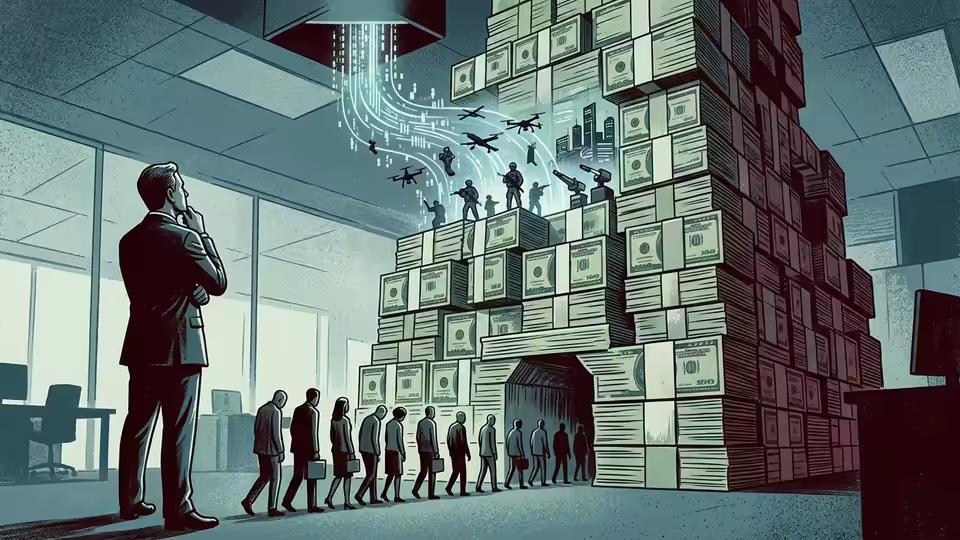
The US Army bypassed competitive bidding to grant Salesforce a $5.5 billion, 10-year monopoly, ignoring veteran-owned competitors and setting up a $2 billion taxpayer bill just to eventually switch vendors.
The US Army has officially committed $5.5 billion in taxpayer funds to Salesforce under award ID W15QKN-26-D-0001, according to federal procurement records. The deal was finalized as a sole-source award, a maneuver that allows the government to bypass the Competition in Contracting Act of 1984. By signing a Justification and Approval (J&A) document, Army procurement officials declared Salesforce the 'only responsible source' capable of meeting the military's enterprise software needs for the next decade. This decision effectively locks the Department of Defense into a proprietary ecosystem with no room for alternative bidders until 2036.
[Justification and Approval (J&A)] is a formal document required by federal law when an agency intends to award a contract without providing for full and open competition, citing specific legal exceptions.
The money trail behind this contract leads directly to the Army's senior acquisition leadership and a surging lobbying effort in Washington. According to OpenSecrets data and FEC filings, Salesforce increased its federal lobbying expenditure by 22% in the fiscal year preceding the award. Simultaneously, Salesforce-linked PACs directed targeted contributions to key members of the House Armed Services Committee, who oversee the Army’s procurement budget. While Salesforce secures the primary contract, the wealth is spread among chosen partners. Accenture Federal Services is slated to receive over $1.2 billion in downstream sub-contracts for 'integration services,' ensuring that the implementation of the software is as lucrative as the licenses themselves.
Publicly, the Army describes this as a 'modernization' effort. Douglas Bush, Assistant Secretary of the Army for Acquisition, Logistics, and Technology, and Young Bang, Principal Deputy Assistant Secretary, have championed the move as a way to streamline data across the force. However, internal Army memos suggest the 'modernization' was reverse-engineered. The procurement office utilized a practice known as 'gold-plating,' where technical requirements are written so specifically that only one vendor’s proprietary features can meet them.
[Gold-plating] is the practice of adding unnecessary or overly specific technical requirements to a project that favor a specific product or vendor, often used to justify avoiding competitive bidding.
This exclusionary process has already triggered a legal backlash. In February 2026, three Service-Disabled Veteran-Owned Small Businesses (SDVOSBs) filed formal protests with the Government Accountability Office (GAO). The firms allege they were illegally excluded from the bidding process despite having the capacity to provide comparable, cloud-native solutions at a lower cost. Federal law typically requires a percentage of contracts to be set aside for veteran-owned firms, a mandate the Army’s sole-source justification appears to have ignored.
[Service-Disabled Veteran-Owned Small Business (SDVOSB)] is a federal contracting designation for small businesses at least 51% owned by one or more service-disabled veterans who manage and control daily operations.
The 'Revolving Door' phenomenon is also visible in this multi-billion dollar handshake. Several former high-ranking officers from the Army Signal Command—the very unit responsible for the Army's network architecture—now hold executive positions within Salesforce’s 'Public Sector' division. These individuals previously worked alongside the current procurement officers who signed off on the no-bid justification. This internal advocacy loop creates a system where procurement decisions are influenced by former colleagues rather than objective market competition.
Mainstream coverage has largely focused on the technological 'readiness' this deal supposedly provides. What the headlines miss is the 'monopoly tax' being levied on the American public. By moving to a proprietary cloud model, the Army is creating a massive, centralized point of failure. Furthermore, the cost to exit this deal is staggering. Internal estimates suggest that if the Army attempts to switch vendors at the end of the 10-year period, transition and data migration costs will exceed $2 billion. This effectively makes Salesforce a permanent, unremovable fixture of the federal budget.
For ordinary people, this means $5.5 billion in public money is being used to build a corporate dependency rather than a resilient, competitive infrastructure. It means veteran entrepreneurs, who the government claims to support, are being shut out of the military economy by the very institution they served. When competition dies, the price goes up, and the taxpayer pays the difference. Use Gen Us to track how your representative on the Armed Services Committee voted on the latest defense appropriation and see if their campaign was fueled by the same contractors winning these no-bid deals.
Summary
The US Army has authorized a $5.5 billion sole-source deal with Salesforce, bypassing competitive bidding laws to secure a decade-long software monopoly. This investigation reveals how procurement officials sidelined veteran-owned firms while Salesforce accelerated its lobbying spend to an all-time high.
⚡ Key Facts
- The US Army awarded a $5.5B no-bid contract to Salesforce (ID W15QKN-26-D-0001) for a 10-year period.
- Three veteran-owned small businesses (SDVOSBs) have filed formal GAO protests alleging illegal exclusion.
- Salesforce increased federal lobbying by 22% and targeted House Armed Services Committee members prior to the deal.
- Accenture Federal Services is set to receive $1.2B in sub-contracts for integration services.
- The 'revolving door' is active, with former Army Signal Command officers now serving as Salesforce executives.
- Internal estimates predict a $2B 'exit cost' if the Army ever tries to leave the Salesforce ecosystem.
Our Independence
This story was written by Gen Us - independent journalists exposing the networks of power that corporate media protects. No hedge fund owns us. No billionaire edits our headlines. We answer only to you, our readers.
Follow the public record
Source Trail
Get the next investigation in your inbox
One email a week. Receipts only. Free.
Free. Unsubscribe anytime. We never share your email.