The DOJ's 315 AI Spies: How the Government Bypasses Your Constitutional Privacy
While you watch your smart fridge, the DOJ is scaling a massive AI-driven surveillance network using 'data broker' loopholes to buy your private information without a warrant.
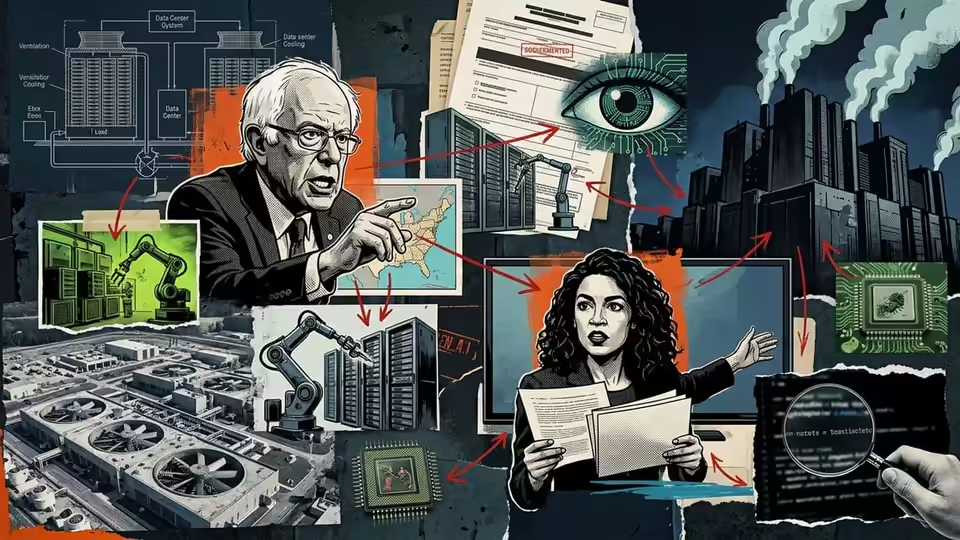
Uncle Sam is skipping the warrant process by buying personal data from private brokers. They’re plugging that info into 315 new AI programs, all backed by billions in taxpayer cash.
The biggest move in federal oversight just happened quietly. On April 18, 2026, the White House signed off on a short-term extension for FISA Section 702. It's the law that lets the government vacuum up foreign communications, but 'incidentally' grabs plenty of Americans' data too. Forget the stuff you've heard about Ring cameras. The real story is the ticking clock. This extension only lasts until April 30, 2026. That sets the stage for a massive fight in Congress over privacy rights that'll stick around for a decade.
Let’s be clear about what Section 702 actually does. It is a provision of the Foreign Intelligence Surveillance Act that lets the U.S. spy on foreigners abroad, but it frequently snares the communications of citizens here at home. The latest DOJ inventory from FedScoop shows they’ve scaled up to 315 different AI use cases. This isn't some science experiment anymore. These tools are baked into how cases are managed and how crimes are predicted. And the kicker is that the government doesn't always need a warrant for the data they’re crunching. They can just buy it on the open market.
You can see the scale of this in the 2025 tax-and-spending law. Transparency is thin, but we know ICE got about $86 billion. A huge chunk of that goes straight into data buying and AI analytics. This is how agencies exploit the 'Fourth Amendment Is Not For Sale' loophole. If they want your location or behavior patterns, they don't have to prove probable cause to a judge. They just hit up a commercial broker and write a check for information they'd otherwise need a warrant to seize.
“The Department of Justice’s 2025 inventory reveals 315 active AI use cases, signaling a shift from reactive investigation to predictive enforcement.”
So what's a data broker? Think of them as information scavengers. They grab your info from public and private sources and sell it to the highest bidder. On February 9, 2026, the FTC sent warning letters to 13 big brokers about their duties under the Protecting Americans’ Data from Foreign Adversaries Act. But while the FTC is trying to stop sales to foreign enemies, there’s no rule stopping local cops or federal agents from being the top bidder. It's a circular economy. Your app usage basically pays for your own federal profile.
This surveillance is moving into local 911 centers too. DOJ reports show federal grants are now funding AI platforms that swallow 911 call data. They use it to build 'predictive geospatial heat maps.' In plain English: they're flagging neighborhoods for more police before a crime even happens. Proponents say it's efficient. But the ACLU points out a glaring flaw. These algorithms learn from old arrest data, which means they often just repeat the same biases against marginalized communities. It's a cycle that's hard to break.
Then there are the contractors. Everyone knows Palantir and Clearview AI, but there's a whole world of smaller aggregators operating in the shadows. It’s what you might call 'purchased jurisdiction.' If the law says a government agency can't do something, they just hire a private firm that isn't bound by the same constitutional rules. This administration’s reliance on these partners makes one thing clear: those 315 AI use cases identified this year are just the starting line for what's coming next.
We still don't know the full cost because 'black budget' programs usually dodge public audits. But the direction is obvious. As that April 30 deadline for Section 702 creeps closer, the real concern isn't just the phone in your pocket. It's the contracts being signed in D.C. The mix of private data brokers and federal AI has pretty much killed the idea of a digital perimeter for the average citizen.
Summary
While people often worry about their smart home devices listening in, the real story is how the government is building a workaround for the Constitution. On April 18, 2026, President Trump signed a short-term renewal of Section 702, keeping mass surveillance alive through the end of the month. This isn't just about old-school spying. The Department of Justice is leaning hard into automation, with its 2025 inventory listing 315 active AI programs. We're looking at a system where agencies like ICE use a 'data broker loophole' to buy sensitive information that would normally require a warrant. It is a multi-billion dollar shift that turns private data harvesting into a permanent tool for federal law enforcement.
⚡ Key Facts
- The U.S. government purchases massive quantities of sensitive personal data from commercial data brokers to bypass direct collection restrictions.
- DHS is funding AI platforms to acquire all 911 call center data for predictive geospatial heat maps.
- Tinder is planning to use AI to scan users' entire camera rolls.
The DOJ's 315 AI Spies: How the Government Bypasses Your Constitutional Privacy
Network of Influence
- Civil liberties advocacy groups (ACLU, EFF) seeking public support for privacy legislation.
- Privacy-focused tech companies (VPN providers, encrypted messaging apps) that market themselves as alternatives to the 'surveillance capitalism' described.
- Political factions critical of Department of Homeland Security (DHS) expansion and government overreach.
- The article does not discuss the legal justifications or specific use-cases (such as counter-terrorism, child safety, or national security) used by the government to defend these practices.
- It omits mention of specific legislative efforts like the 'Fourth Amendment Is Not For Sale Act' which seeks to close the data broker loophole mentioned in the text.
- The piece focuses on federal spending without acknowledging that many of these technologies are also deployed by local law enforcement under different funding structures.
The article frames the modern digital lifestyle as a trap where everyday conveniences are weaponized by a collaboration between predatory corporations and an unchecked government surveillance state.
See how the story connects.
Select any actor or numbered connection, then inspect the evidence before drawing a conclusion.
The Conversation US, Inc. Parent company The Conversation
Follow the public record
Source Trail
Independent reporting and analysis
Get the next investigation in your inbox
One email a week. Receipts only. Free.
Free. Unsubscribe anytime. We never share your email.