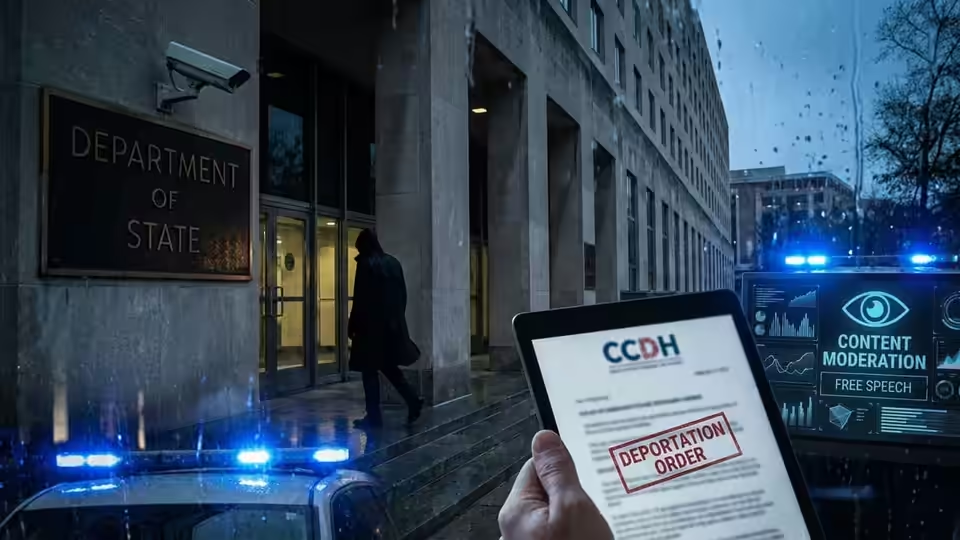
Musk’s X Claims ‘Free Speech’ to Hide $140M Ad Transparency Violations
Behind the 'censorship' rhetoric, EU regulators are actually targeting X’s use of 'dark patterns' and deceptive UI. While Musk frames this as a battle for the First Amendment, the $140M fine stems from a systematic refusal to disclose who is buying political influence on the platform.
X is suing to block a $140M EU fine, claiming it's a victim of censorship. However, European regulators say the penalty is actually about 'deceptive' paid verification badges and the platform's failure to show who is buying political ads.
The $140 million fine, handed down on December 5, 2025, is the first real hammer to drop under the Digital Services Act (DSA). Despite the narrative that the Commission is punishing X for refusing to censor content, the actual findings focus on three technical failures. Specifically, they're looking at the deceptive design of verified accounts, a lack of advertising transparency, and X’s refusal to give researchers access to public data. The Commission’s point is simple: the 'Blue Check' system doesn't actually verify identity anymore—it's just a paid subscription. They argue this tricks users into trusting profiles that might actually be fraudulent.
But there's more to this legal fight than just technicalities. The case is getting a massive boost from ADF International, the global arm of Alliance Defending Freedom. This U.S.-based group brings in over $100 million a year and has a very specific goal: dismantling European hate speech laws that they feel threaten religious expression. By siding with Musk, ADF is using X’s massive platform to fight the DSA’s requirement that tech companies follow local national laws—including things like Germany’s strict protections for politicians.
“The Commission argues X's 'Blue Check' system lacks authentication standards, effectively misleading users into believing a profile is verified for identity when it is merely paid for.”
Here’s the thing that often gets lost in the 'censorship' debate: the DSA doesn’t actually create new categories of illegal speech. Instead, it forces platforms to enforce the laws that already exist across the 27 EU member states. If a Bible verse breaks a specific criminal code in Finland, the DSA requires X to provide a way to take it down there. The EU isn't necessarily hunting for specific words. They’re looking at 'systemic risk.' If X’s algorithms are found to be boosting content that incites violence, the company could be on the hook for up to 6% of its global revenue.
For the people actually using the app, the case isn't just about high-level philosophy. It’s about knowing what you’re looking at. The Commission’s investigation found that X basically stopped maintaining a searchable, reliable library for ads. That makes it incredibly difficult for anyone to track who’s paying to influence an election or spread misinformation. If X wins this challenge, it’ll likely keep using the verification system regulators call 'deceptive by design.' If it loses? Musk is going to have to choose between paying recurring, massive fines or redesigning the platform’s core features to play by Europe's rules.
Now that the case is in front of the EU General Court, the focus is going to stay on one question: is 'transparency' just a sneaky way to control content, as Musk claims? Or is X simply failing to meet the basic consumer standards required of any big utility in Europe? We don't have proof yet that the Commission is privately leaning on X for its political views, but for now, the public legal battle is firmly anchored in the mechanics of data and checkmarks.
Summary
Elon Musk’s X is heading to court to fight a $140 million (€120 million) fine from the European Commission. While Musk’s team and outlets like ZeroHedge are painting this as an ideological battle over censorship, the official paperwork tells a different story. Regulators aren't just looking at posts; they're targeting X’s 'Blue Check' system and its lack of advertising transparency. Backed by the conservative legal group ADF International, X is trying to pivot the conversation toward global free speech, even as the EU claims the platform uses 'dark patterns' to mislead its users.
⚡ Key Facts
- Elon Musk’s X launched a legal challenge against a $140 million fine issued by the European Commission under the Digital Services Act (DSA).
- The DSA requires 'Very Large Online Platforms' to remove 'illegal content' and mitigate 'systemic risks' to civic discourse.
Musk’s X Claims ‘Free Speech’ to Hide $140M Ad Transparency Violations
Network of Influence
- Elon Musk and X (by framing regulatory non-compliance as a civil rights struggle)
- ADF International (increased visibility for their legal advocacy)
- ZeroHedge (catering to its audience's anti-EU and anti-establishment sentiments)
- The article omits the specific regulatory findings of the EU's preliminary investigation which cited deceptive 'Blue Check' practices and lack of advertising transparency, rather than specific content moderation cases.
- It fails to explain that the DSA primarily harmonizes existing member state laws rather than creating new categories of 'illegal content'.
- It does not mention the ideological background of ADF International, the group supporting the case.
The article frames a complex regulatory and procedural fine as a deliberate, ideological assault by a bureaucratic 'superstate' against a heroic defender of global free speech.
See how the story connects.
Select any actor or numbered connection, then inspect the evidence before drawing a conclusion.
ABC Media Ltd Owns ZeroHedge
Follow the public record
Source Trail
Independent reporting and analysis
Get the next investigation in your inbox
One email a week. Receipts only. Free.
Free. Unsubscribe anytime. We never share your email.