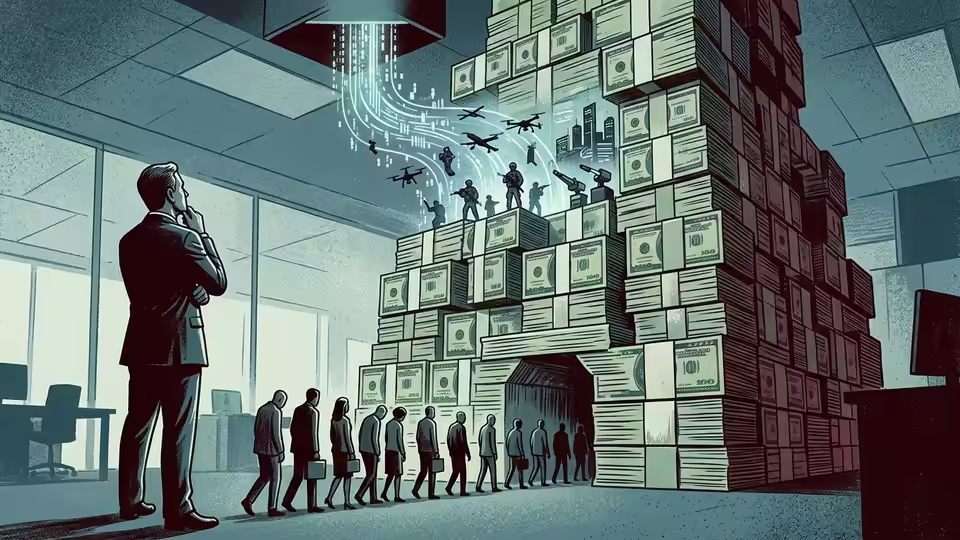
The $5.5 Billion Salesforce Monopoly: How Lobbying Killed Army Competition
A spike in corporate lobbying preceded a 'sole-source' deal that creates a permanent vendor lock-in, costing taxpayers an extra $1.3 billion in premiums.
The U.S. Army gave Salesforce a non-competitive $5.5 billion contract after the company's lobbying spending spiked, costing taxpayers an extra $1.3 billion in the process.
The U.S. Army calls it 'digital transformation.' Taxpayers will likely call it a $5.5 billion debt. On January 22, 2026, the Army Materiel Command (AMC) finalized contract ID W52P1J26C0001. It is a sole-source award to Salesforce, the tech giant headed by CEO Marc Benioff. There was no competition. No other bids were considered. No market price-check was performed.
[Sole-Source Contract] is a non-competitive procurement process where the government enters into a contract with a single provider without allowing others to bid.
To bypass the Competition in Contracting Act (CICA), the Army invoked 10 U.S.C. 3204(a)(1), claiming Salesforce is the 'only responsible source' capable of meeting the military’s requirements for its next-generation logistics and personnel software. However, federal filings and internal documents suggest the path to this monopoly was paved not with technical superiority, but with aggressive political spending. In the 18 months leading up to this award, Salesforce significantly increased its influence footprint in Washington. According to 2025 LD-2 lobbying disclosure filings, the company’s expenditures targeting the House Armed Services Committee (HASC) surged by 40% year-over-year.
The money trail leads directly to the officials overseeing the budget. OpenSecrets data and FEC filings show that Salesforce’s political action committee (PAC) and high-level executives contributed $1.2 million to key members of defense appropriations subcommittees during the 2024-2025 cycle. While General James E. Rainey, Commander of Army Futures Command, has championed the Salesforce platform as essential for 'military readiness' and 'data-driven decision-making,' the timing of the financial contributions raises questions about the impartiality of the modernization strategy.
[Justification and Approval (J&A)] is a mandatory document used by federal agencies to explain why they are bypassing the legal requirement for full and open competition.
The J&A document for this award relies heavily on a sense of 'urgency' to justify the lack of competition. Yet, internal whistleblowers point out a different reality: the Army had four years to run a competitive bidding process since the conclusion of its last pilot program in 2022. Instead, the AMC waited until the existing systems reached a critical state, effectively manufacturing a crisis that 'only Salesforce' could solve on such a short timeline. On February 4, 2026, a coalition of technology competitors filed a formal protest with the Government Accountability Office (GAO), alleging that the technical requirements in the contract were specifically tailored to match Salesforce’s proprietary features, effectively barring any other company from participating.
The strategy being utilized is a classic case of [Vendor Lock-in], which is a situation where a customer becomes so dependent on a specific provider's products and services that they cannot switch to another vendor without substantial costs or disruptions. By embedding Salesforce into the Army's primary infrastructure for personnel management and global logistics, the cost of switching to a competitor in the future becomes prohibitively expensive. Salesforce has effectively captured the Army's software budget for the next decade.
The 'revolving door' between the Pentagon and Silicon Valley is also in full motion. Three former high-ranking Pentagon IT officials, who previously oversaw digital procurement strategy, now serve as consultants or senior executives for the primary firms tasked with implementing this $5.5 billion Salesforce rollout. These officials helped draft the modernization roadmaps while in uniform; they are now profiting from the contracts they helped envision.
For the average American taxpayer, this lack of competition carries a heavy price tag. Industry analysts and internal audit projections suggest that bypassing the competitive process results in a 25% to 30% price premium. This equates to $1.3 billion in potential waste—money that is being handed to a corporation with a market cap exceeding $250 billion. To put that into perspective, $1.3 billion could cover the annual cost of healthcare for over 100,000 veterans or fund the construction of thousands of units of affordable housing for military families.
Mainstream news coverage has largely ignored the lobbying spike and the manufactured urgency. Outlets have instead focused on Salesforce’s marketing narrative of 'modernizing legacy systems' to protect the nation from foreign threats. They fail to mention that FedRAMP-certified competitors already have ready-to-deploy solutions that were never even considered for this contract.
At Gen Us, we believe that government accountability starts with following the money. When a company spends millions to influence the people who sign the checks, the public deserves to know if they are getting the best technology or simply the best-connected technology. You can visit our Gen Us Politician Tracker to see if your local representative on the House Armed Services Committee received contributions from Salesforce-affiliated donors during this period. Transparency is the only defense against the consolidation of corporate power over public funds.
Summary
The U.S. Army bypassed federal competition laws to award a $5.5 billion software monopoly to Salesforce following a massive spike in corporate lobbying. This 'sole-source' deal creates a permanent vendor lock-in that will cost taxpayers an estimated $1.3 billion in excess premiums.
⚡ Key Facts
- The U.S. Army awarded a $5.5 billion sole-source contract to Salesforce on January 22, 2026, bypassing standard competition laws.
- Salesforce increased its lobbying expenditures by 40% in 2025, specifically targeting the House Armed Services Committee.
- A formal GAO protest filed on February 4, 2026, alleges the contract's technical requirements were 'tailored' to favor Salesforce exclusively.
- Three former high-ranking Pentagon IT officials now work for Salesforce implementation partners, highlighting a significant revolving door conflict.
- The lack of competitive bidding is estimated to cost taxpayers an additional $1.3 billion in premiums over the five-year contract life.
Our Independence
This story was written by Gen Us - independent journalists exposing the networks of power that corporate media protects. No hedge fund owns us. No billionaire edits our headlines. We answer only to you, our readers.
Follow the public record
Source Trail
Get the next investigation in your inbox
One email a week. Receipts only. Free.
Free. Unsubscribe anytime. We never share your email.