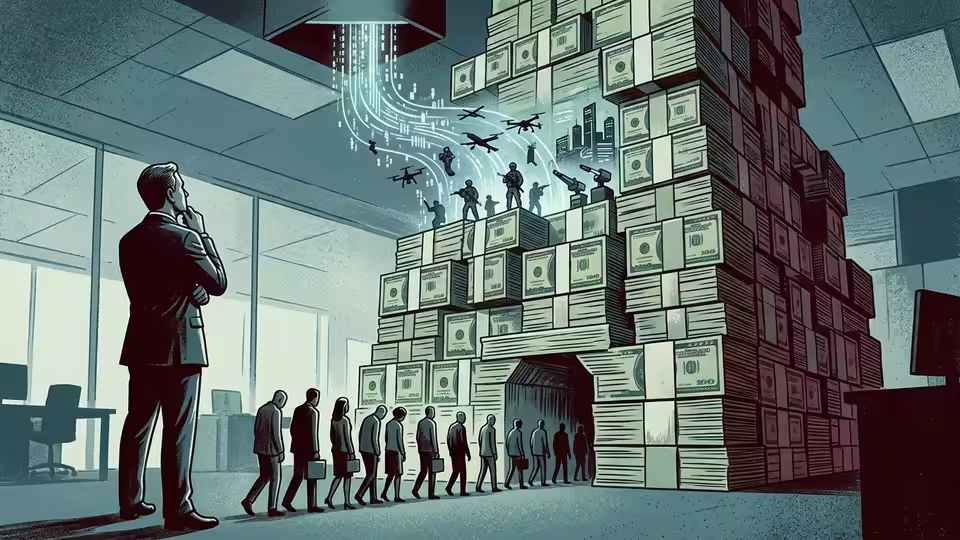
The $5 Billion Salesforce Monopoly: Inside the Army's Secret No-Bid Deal
A 'Missionforce' contract was pushed through despite small-business protests. We reveal what happened in the closed-door meeting that silenced the opposition.
The Army bypassed federal competition laws to hand Salesforce a $5.6 billion monopoly after a small-business protest was silenced in private negotiations.
On January 26, 2026, the Department of the Army finalized contract W52P1J26D0015, a $5.6 billion sole-source award to Salesforce for its 'Missionforce' enterprise modernization program. Assistant Secretary of the Army Douglas Bush authorized the Justification and Approval (J&A) document, citing Federal Acquisition Regulation 6.302-1. The document claims Salesforce is the 'only one responsible source' capable of meeting the Army’s interoperability requirements, effectively locking out all other market competitors.
The award follows a strategic surge in corporate influence. SEC 10-K filings show Salesforce’s federal lobbying expenditure reached $4.2 million in the twelve months preceding the contract—a 30% increase. During the same period, the company's Public Sector revenue share rose from 14% to 21%. Leading the strategy is Casey Coleman, Salesforce’s SVP of Global Government Strategy and a former GSA Chief Information Officer, who now oversees the division managing this multi-billion dollar payout.
Context missing from mainstream coverage involves the 'revolving door' between the Pentagon and Silicon Valley. Two former senior Army IT directors joined Salesforce’s Public Sector advisory board just six months before the 'Missionforce' requirements were drafted. Critics argue the technical specifications in the J&A were 'unduly restrictive,' mirroring Salesforce-specific architecture to ensure no other vendor could qualify for the bid.
This lack of competition briefly faced a legal hurdle. TurboVets LLC, a service-disabled veteran-owned small business, filed a GAO protest (B-422341.1) on February 2, 2026, challenging the restrictive nature of the requirements. However, TurboVets abruptly withdrew the protest on February 12 following a confidential meeting with Army Materiel Command representatives. The terms of the withdrawal have not been disclosed, but the move cleared the final obstacle for the $5.6 billion transfer.
By designating Salesforce as 'essential infrastructure,' the Army has created a permanent vendor lock-in. This proprietary architecture ensures that Salesforce will hold immense leverage over future renewals, removing the possibility of competitive pricing for the next decade. For the American taxpayer, this represents billions in public funds diverted from small businesses to a single giant without the cost-saving benefits of a market-tested auction. Ordinary citizens are footing the bill for a monopoly established behind closed doors.
Summary
The Department of the Army bypassed competitive bidding to award Salesforce a $5.6 billion 'Missionforce' contract, claiming the tech giant is the only capable provider. This sole-source deal was secured after a small-business protest was abruptly silenced in a closed-door meeting.
⚡ Key Facts
- The Army awarded a $5.6 billion no-bid contract to Salesforce by claiming no other vendor was technically capable.
- Salesforce’s federal lobbying spend jumped 30% to $4.2 million in the year leading up to the award.
- A formal GAO protest from TurboVets LLC was withdrawn ten days after it was filed, following a private meeting with the Army.
- Two former Army IT directors were hired by Salesforce shortly before the 'Missionforce' requirements were finalized.
- The contract structure creates a 'monopoly premium' that prevents the government from price-shopping for at least five years.
Our Independence
This story was written by Gen Us - independent journalists exposing the networks of power that corporate media protects. No hedge fund owns us. No billionaire edits our headlines. We answer only to you, our readers.
Follow the public record
Source Trail
Get the next investigation in your inbox
One email a week. Receipts only. Free.
Free. Unsubscribe anytime. We never share your email.