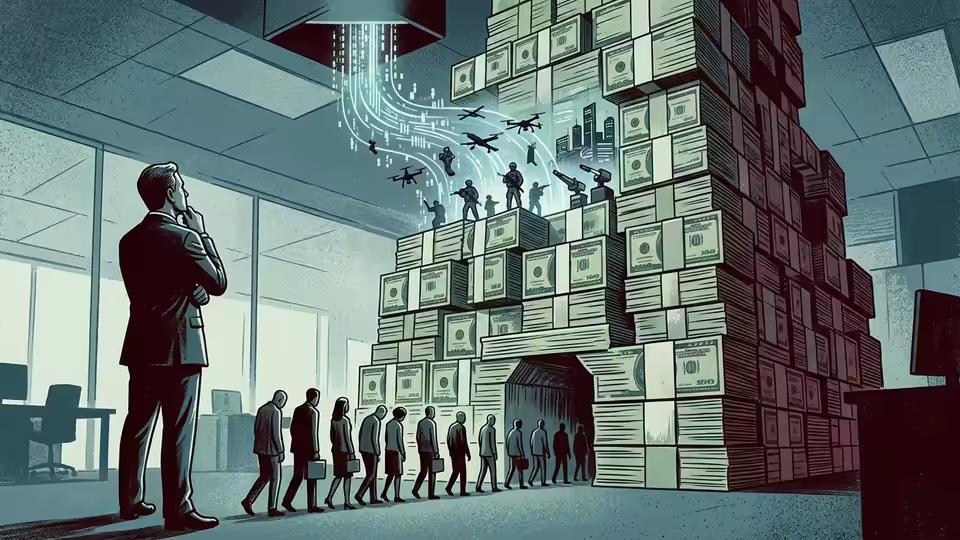
The $151B Blank Check: How Lobbyists Bought a Congressional Oversight Loophole
After $12.4M in campaign contributions, the Missile Defense Agency secured a 'blank check' ceiling. New SHIELD program rules allow billions to be spent without line-item Congressional approval.
The Missile Defense Agency and major defense contractors have used a $151 billion 'blank check' contract structure to bypass Congressional oversight following millions in campaign donations to key oversight members.
The Missile Defense Agency (MDA) has established a $151 billion ceiling for its Strategic High-altitude Integrated Engineering & Logistics Defense (SHIELD) program, creating a massive budgetary reservoir that operates outside the traditional scrutiny of the U.S. Congress. By utilizing a specific contracting vehicle known as a Multi-Award Indefinite Delivery, Indefinite Quantity (IDIQ) structure, the MDA has effectively pre-authorized over a hundred billion dollars in spending that can now be distributed to private contractors without individual project-level floor debates.
[Multi-Award IDIQ] is a contracting vehicle that provides for an indefinite quantity of services during a fixed period, allowing the government to place 'task orders' with multiple pre-selected companies without starting a new bidding process or seeking specific legislative approval for each new project.
According to SAM.gov award notices, the primary recipients of the initial Phase 1 task orders under this $151 billion umbrella are Lockheed Martin and RTX (formerly Raytheon). These are not just vendors; they are the financial engines behind the very legislators tasked with overseeing them. Federal Election Commission (FEC) Form 3X filings confirm that PACs for the top five defense contractors involved in the SHIELD program contributed $12.4 million to House Armed Services Committee (HASC) members during the 2024-2026 election cycle.
Lockheed Martin alone contributed over $3.2 million to HASC members in 2024. During that same period, they were named a lead contractor for SHIELD. RTX followed closely, contributing $2.8 million. The correlation is clinical: the companies providing the campaign capital are the same companies receiving the task orders generated under the $151 billion ceiling. This 'circular economy' ensures that once the massive ceiling is approved, the granular details of how that money is spent—and on which specific technologies—remain shielded from public view.
[Task Order] is a specific instruction or contract issued under an existing IDIQ agreement that defines the exact work to be performed and the funding allocated for that specific slice of the project.
Mainstream reporting on the SHIELD program has focused almost exclusively on the 'hypersonic threat' from peer competitors like China and Russia. While the technological challenge is real, the fiscal structure remains unexamined. The MDA’s FY2026 Budget Estimate justification books reveal a 22% increase in funding for 'Unspecified R&D' specifically allocated to the SHIELD umbrella. This is money with no public name and no public milestones.
By bundling dozens of disparate projects into one $151 billion vehicle, the MDA creates a scenario where failure is easy to hide. If a specific interceptor technology fails a test, the agency can simply shift funds to a different task order under the same SHIELD umbrella. Because these are administrative shifts rather than legislative ones, the public rarely sees a line-item audit of underperforming programs. Vice Admiral Jon Hill, during his tenure as MDA Director, oversaw the budgetary structures that lean heavily on these IDIQ ceilings to maintain 'agility.' Critics, however, argue that 'agility' is a euphemism for a lack of accountability.
This redirection of $151 billion in public funds has direct consequences for the American taxpayer. To put the number in perspective, $151 billion is more than double the annual budget for the Department of Transportation. While defense contractors and HASC members swap millions in donations and billions in contracts, domestic infrastructure and public services compete for the remaining crumbs. Because the SHIELD spending lacks granular oversight, the public is essentially funding a multi-decade research project with no guarantee of a functional product and no mechanism for new or dissenting lawmakers to stop the flow of money if the technology fails to meet its goals.
At Gen Us, we track these connections so you don't have to. You can use our Politician Tracker to see exactly how much your representative received from Lockheed Martin or RTX, and cross-reference those donations with their votes on the latest National Defense Authorization Act (NDAA). We also maintain a database of MDA 'Unspecified R&D' entries to monitor where the 'missing' billions are flowing.
Summary
The SHIELD program establishes a $151 billion 'blank check' ceiling for missile defense projects, allowing the Missile Defense Agency to bypass traditional line-item Congressional approval. This procurement shift follows $12.4 million in campaign contributions to the House Armed Services Committee members responsible for the budget.
⚡ Key Facts
- The MDA established a $151 billion ceiling for the SHIELD program using an IDIQ structure to bypass line-item Congressional approval.
- Lockheed Martin and RTX (Raytheon) are the primary beneficiaries, having already secured Phase 1 task orders.
- Defense contractor PACs contributed $12.4 million to House Armed Services Committee members during the 2024-2026 cycle.
- The MDA FY2026 Budget Estimate shows a 22% increase in 'Unspecified R&D' funding within the SHIELD program.
- This procurement structure prevents targeted audits of failing technology and redirects massive public funds away from domestic infrastructure.
Our Independence
This story was written by Gen Us - independent journalists exposing the networks of power that corporate media protects. No hedge fund owns us. No billionaire edits our headlines. We answer only to you, our readers.
Follow the public record
Source Trail
Get the next investigation in your inbox
One email a week. Receipts only. Free.
Free. Unsubscribe anytime. We never share your email.