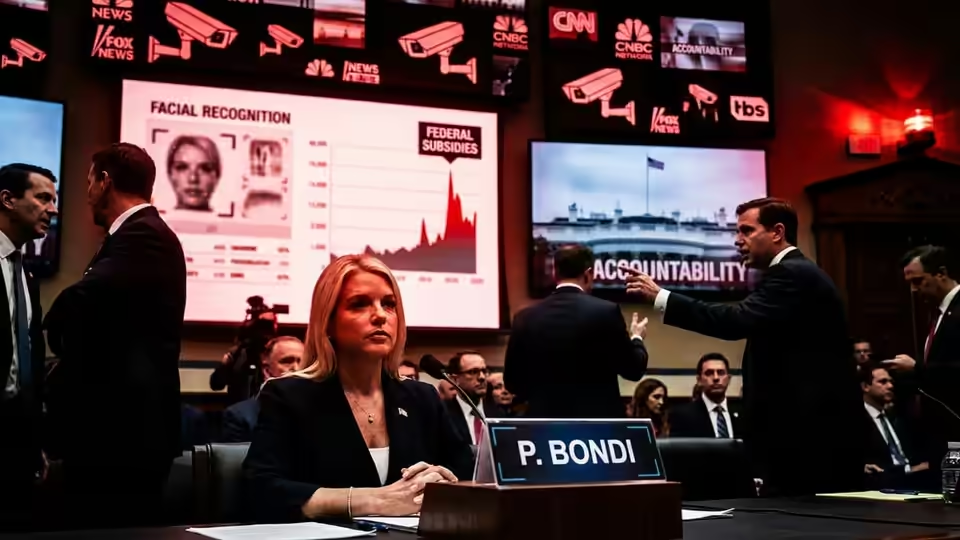
The $10M Lobbying Blitz That Fused U.S. and Israeli Weapon Programs
While the House voted to curb war powers against Iran, a massive $10M lobbying surge quietly passed Section 224—effectively merging U.S. military supply chains with Israel's offensive operations.
The House voted to curb the president's power to hit Iran but kept the taps open for Israel's war in Lebanon. It's a move that highlights the power of the defense lobby and a new plan to permanently link U.S. and Israeli military technology.
On Wednesday, June 3, 2026, the House passed a war powers resolution 215-208. It's the first real check on President Trump’s Iran policy during this conflict. The bill now heads to the Senate, and its future there is anyone's guess. It basically tells the administration they can't start a fight with Tehran without asking Congress first. Most of the votes fell along party lines, but four Republicans crossed the aisle. One was Representative Thomas Massie. That's worth a look: Massie just lost a record-breaking May primary. It was the most expensive in GOP history, fueled by pro-Israel groups like the United Democracy Project. They spent millions to make sure he's gone by January 2027.
The push for restraint didn't make it to the Lebanese border. On Thursday, June 4, the House crushed H.Con.Res.84. That was Rep. Rashida Tlaib’s attempt to end U.S. involvement in Lebanon. The 324-92 vote wasn't even close. Most Democrats joined Republicans to keep the logistics and intelligence flowing to Israel. While some critics focused on Tlaib’s use of the term "genocidalLoaded Language war," most lawmakers pointed to a different reality: the threat from Hezbollah. Since October 2023, the group has been raining rockets on northern Israel. Leaders from both parties used that to argue that pulling out would just wreck regional stability.
The [War Powers Resolution] is a federal law that keeps the president from dragging the U.S. into an armed conflict without Congress saying it’s okay. [Section 224] is a piece of the 2027 defense budget. It's designed to merge U.S. and Israeli weapons development and tech into one single pipeline.
“The House rejected the Lebanon resolution 324-92, even as data shows 20% of Lebanon’s population has been forcibly displaced since March 2026.”
If you want to know what’s really at stake, look at Section 224 of the upcoming military budget. This isn't just a partnership. It's a formal merger of U.S. and Israeli weapons research. Groups like the think tank "A New Policy" and former Biden officials are sounding the alarm. They say this merger hides military aid from the public. It makes transparency almost impossible. By tying these programs together, the U.S. might be handing over sensitive intelligence and locking American contractors into deals with Israeli rivals. But the House Armed Services Committee is pushing ahead anyway. They're looking to lock in billions in long-term procurement deals.
Massie’s defeat wasn't just a local loss: it was a warning to the rest of the GOP. TrackAIPAC data shows that pro-Israel PACs are targeting anyone who votes against military aid packages, even if they're solid conservatives. The $10 million spent to unseat Massie is a loud message to the dozen Republicans who skipped the Lebanon vote. By staying home, these lawmakers didn't just avoid a fight with Trump. They also avoided getting caught in the financial crosshairs of the defense lobby.
The human cost in Lebanon is real, but for the House majority, it's a secondary concern. During the debate, lawmakers cited data showing 128 paramedics and health workers have died since March. About a million people, roughly 20 percent of Lebanon, are displaced. But House leadership isn't budging. Their alternative, H.Con.Res.108, calls for a "cautious path." In plain English, that means keeping the military support exactly where it is while hoping for a diplomatic fix down the road.
These moves tell a story. Direct "forever wars" with Iran are a tough sell, but the shadow war infrastructure is alive, well, and fully funded. Section 224 means that even if a president can't start a new war, the U.S. taxpayer is stuck paying for the regional conflicts of its allies. All eyes are on the Senate now. If the Iran resolution dies there, the House’s big stand will look like nothing more than a symbolic gesture for an election year defined by massive defense spending.
Summary
On June 3, 2026, the House sent a message to the White House by limiting war-making powers against Iran in a narrow 215-208 vote. But the mood shifted fast. Less than a day later, lawmakers overwhelmingly shot down a resolution to pull military support from Israel’s operations in Lebanon. The math shows a clear, calculated strategy: Congress is willing to curb the president's power for a direct war with Iran, yet it's doubling down on institutional ties to the Israeli military. This shift comes as a $10 million lobbying blitz ousted dissenters and a new budget rule, Section 224, basically fuses U.S. and Israeli weapons programs together.
⚡ Key Facts
- The US House of Representatives voted 215-208 to curb President Trump's war-making authority on Iran.
- A resolution to end US support for Israel's war in Lebanon was rejected by the House with a vote of 324 to 92.
- Republican Congressman Thomas Massie voted with Democrats and is set to leave office in January after a primary defeat.
The $10M Lobbying Blitz That Fused U.S. and Israeli Weapon Programs
Network of Influence
- Political opponents of the Trump administration
- Regional adversaries of Israel including the Iranian government and Hezbollah
- The political platform of Rashida Tlaib and the 'A New Policy' think tank
- The reason for Israel's military actions in Lebanon, specifically Hezbollah's daily rocket fire into northern Israel since October 8, 2023.
- The status of Hezbollah as a US-designated foreign terrorist organization.
- The arguments made by the 324 lawmakers who voted against the resolution, who likely cited security alliances or the threat of Iranian proxies.
- A clear definition of what constitutes a 'joint war' on Iran, as there is currently no formal declared war between the US/Israel and Iran.
The article frames US support for Israel through the lens of 'war crimes' and 'genocide' by centering the rhetoric of a small minority of dissenters while marginalizing the bipartisan majority and omitting the security justifications for the conflict.
See how the story connects.
Select any actor or numbered connection, then inspect the evidence before drawing a conclusion.
Fadaat Media Ltd Parent company Middle East Eye
Follow the public record
Source Trail
Independent reporting and analysis
Get the next investigation in your inbox
One email a week. Receipts only. Free.
Free. Unsubscribe anytime. We never share your email.