SpaceX Bags $6B Space Force Monopoly via 5-Week Procurement Loophole
A specialized procurement loophole allowed SpaceX to bag $6 billion in five weeks without a single open bid. Taxpayers are now funding a private monopoly over critical US satellite infrastructure.
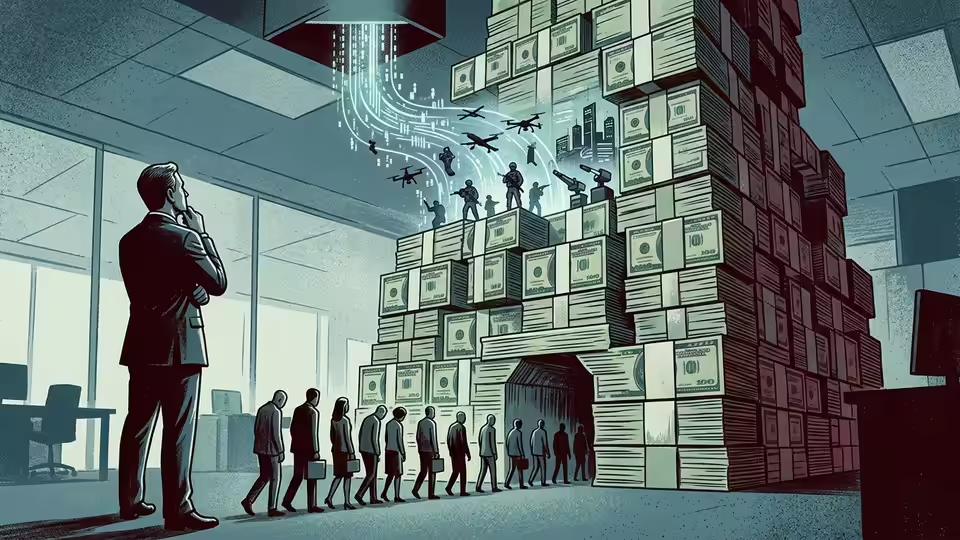
The Space Force utilized a restrictive bidding process to award Elon Musk’s SpaceX $6.1 billion in five weeks, effectively using taxpayer money to fund a private monopoly over national security hardware.
Between May 1 and June 8, 2026, the U.S. Space Force (USSF) committed $6.16 billion to SpaceX through a series of tactical awards that cement the company’s dominance over national security infrastructure. The centerpiece of this windfall is a $4.16 billion contract for the Space-Based Adaptive Moving Target Indicator (SB-AMTI). While official announcements characterize these awards as the result of a 'competitive' process, a Gen Us investigation reveals that the technical requirements and procurement framework were specifically tailored to match the existing Starlink manufacturing line.
The funding flows through 'Lane 1' of the National Security Space Launch (NSSL) Phase 3 acquisition framework. [Lane 1 Procurement] is a streamlined acquisition path that allows the military to select from a pre-approved list of commercial vendors rather than opening a full public tender for every mission. By utilizing this 'closed loop' system, the Space Force bypassed the rigorous transparency requirements of traditional open-market bidding. According to Department of Defense Justification and Approval (J&A) records, the USSF prioritized 'speed-to-orbit' above all other metrics. Because SpaceX owns both the launch vehicle and the satellite bus manufacturing, they are the only entity currently capable of meeting these accelerated timelines.
This strategy is the brainchild of Frank Calvelli, Assistant Secretary of the Air Force for Space Acquisition. Calvelli has consistently pushed for a 'proliferated' approach to space. [Proliferated Warfighter Space Architecture] is a defense strategy that relies on hundreds of small, cheap satellites in low-Earth orbit rather than a few large, expensive ones. While the move to smaller satellites is intended to make U.S. networks more resilient to attack, it has also created a situation where the government is effectively subsidizing the expansion of SpaceX's private Starshield program. Taxpayers are paying $4.16 billion to develop sensors that will be integrated into SpaceX’s proprietary satellite buses, which the military will then pay to use.
The financial scale of this capture is unprecedented. In addition to the $4.16 billion for SB-AMTI, SpaceX secured approximately $2 billion for launch services and auxiliary hardware during this 38-day window. This brings the total federal commitment to the company to levels that rival traditional defense giants like Lockheed Martin or Boeing, but with significantly less regulatory friction. General B. Chance Saltzman, Chief of Space Operations, has operationalized this shift, arguing that the military must 'leverage commercial innovation' to outpace adversaries. However, the data suggests this is less about innovation and more about 'vertical capture.' Because SpaceX controls the Falcon 9 and Starship launch platforms, they can underbid any competitor who must purchase a ride to orbit from a third party.
Mainstream reporting from outlets like the Wall Street Journal and SpaceNews has largely mirrored the Pentagon's talking points, framing the $6.16 billion as a win for low-cost space access. Missing from those reports is the political weight behind these decisions. According to OpenSecrets data for the 2024 and 2026 election cycles, SpaceX-affiliated employees and PACs have targeted key members of the House Armed Services Committee with over $4.2 million in contributions. These contributions often precede votes on defense appropriations that specifically earmark funds for 'proliferated' constellations. TrackAIPAC and OpenSecrets records further indicate that lobbyists representing SpaceX have held over 40 meetings with Congressional staffers regarding the NSSL Phase 3 framework in the last fiscal year alone.
The risks of this dependency are not theoretical. Elon Musk, CEO of SpaceX, has previously demonstrated a willingness to restrict military use of his network based on his own geopolitical preferences, most notably during the early stages of the Ukraine conflict. By tethering the SB-AMTI—a system designed to track ground and air threats in real-time—to SpaceX's private architecture, the U.S. government is surrendering control over a primary national security asset to a single private individual. Unlike a government-owned satellite, these assets operate under the financial and political stability of a private corporation that is not subject to the Freedom of Information Act (FOIA) in the same way a public agency would be.
For ordinary people, this $6.16 billion represents more than just a large check. It marks the end of a competitive market in the space sector. When the government uses public funds to build out a private monopoly's infrastructure, it kills the incentive for other companies to innovate or compete on price. In the long run, this lack of competition leads to 'cost-plus' style bloat, even in the supposedly lean commercial sector. Your tax dollars are not just buying security; they are buying a permanent seat for one company at the head of the table, with no way to force them to leave.
Gen Us will continue to track the flow of funds from the Department of the Air Force to private contractors. You can use our Politician Tracker to see if your representative sits on the Armed Services Committee and how much they have received from SpaceX or other defense contractors. Our 'Follow the Money' database now includes the full list of Lane 1 vendors and their 2026 contract totals.
Summary
The U.S. Space Force awarded SpaceX over $6 billion in five weeks using a specialized procurement framework that favors existing private satellite infrastructure. This shift effectively creates a taxpayer-funded monopoly over critical space-based tracking systems with minimal public oversight.
⚡ Key Facts
- SpaceX was awarded $6.16 billion between May 1 and June 8, 2026, primarily through the SB-AMTI program.
- The 'Lane 1' procurement framework allowed the Space Force to bypass traditional open-market bidding in favor of a closed vendor pool.
- Technical requirements for the new tracking satellites were tailored to match SpaceX’s existing Starlink/Starshield manufacturing capabilities.
- SpaceX PACs and employees contributed over $4.2 million to key House Armed Services Committee members during the 2024-2026 cycles.
- The contracts effectively subsidize private SpaceX infrastructure which the government then leases back for military use.
Follow the public record
Source Trail
Get the next investigation in your inbox
One email a week. Receipts only. Free.
Free. Unsubscribe anytime. We never share your email.