Soros Pledges $300M as Feds Quietly Gut Funding for 'Disapproved' Nonprofits
A Gen Us investigation reveals the regulatory backdoors being used to bypass Congress and defund groups handling everything from student loans to LGBTQ+ healthcare, forcing a choice: mission or survival.
The feds are using regulatory loopholes and the death of USAID to starve out nonprofits they don't like. It's forcing big donors like George Soros to step in with $300 million in emergency funding just to keep things afloat.
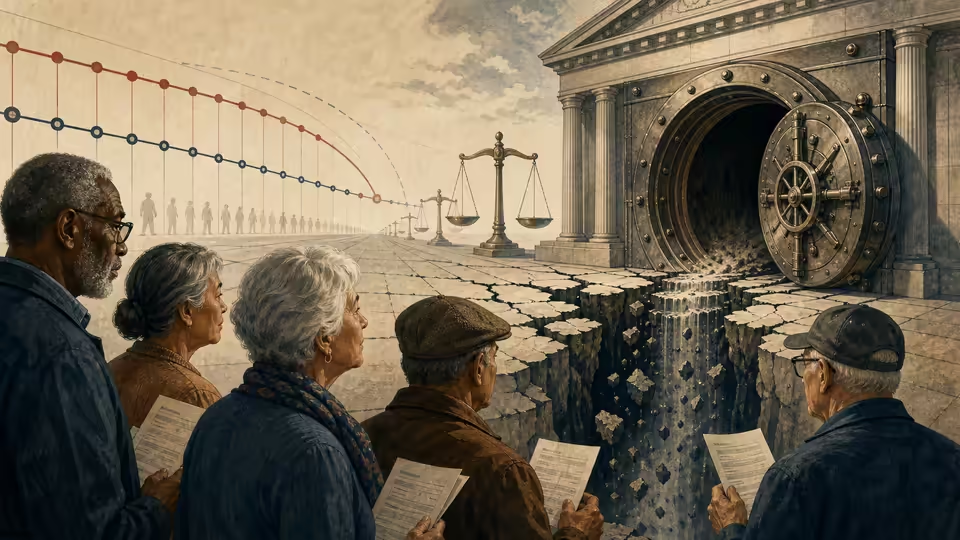
When the U.S. Agency for International Development (USAID) was dismantledLoaded Language in late 2025, it wasn't just a move to trim the fat. It was a clean break. The primary financial lifeline for global NGOs like Oxfam, Save the Children, and the International Rescue Committee (IRC) just disappeared. The agency handled roughly $27 billion in annual funding back in 2024. But by May 2026, over 60% of that money has been diverted or frozen. That leaves a massive, gaping hole in the world's humanitarian safety net.
Then there's the Public Service Loan Forgiveness (PSLF) program. It used to be a simple deal: work for a nonprofit for 10 years and your student debt is gone. Not anymore. By May 2026, the administration successfully changed the rules to shut out anyone working for groups that provide gender-affirming care or help undocumented immigrants. It's a calculated brain drain. If your job choice costs you tens of thousands of dollars in debt relief, you're probably going to quit. No laws had to pass to make this happen. Just a few strokes of an administrative pen.
Private donors are trying to plug the leak. On May 20, 2026, George Soros’ Open Society Foundations (OSF) put up $300 million over five years to protect democratic rights. It's a lot of money, sure. But it's a drop in the bucket compared to what's being lost. The 501(c)(3) sector pulls in $2.6 trillion a year, about 5% of the U.S. GDP. While disapproved groups are starving, organizations that mirror the administration's 'America First' agenda have seen a 15% bump in federal grant eligibility over the last 18 months.
“The Open Society Foundations' $300 million pledge covers less than 2% of the total revenue lost by the international aid sector since the 2025 dismantling of USAID.”
These 501(c)(3) groups are supposed to be charitable and educational. They can't run political campaigns, but they can advocate. Now, that legal status is under fire. The House of Representatives is holding hearings and pointing fingers at mainstays like the Future Farmers of America (FFA), claiming they have foreign entanglements. In February 2026, Representatives Jason Smith, David Schweikert, and Tracey Mann alleged ties to Chinese interests. They haven't proven any crimes yet. But they don't have to. The goal is to scare off private donors and dry up the cash flow.
The pressure ramped up in September 2025. After activist Charlie Kirk died on September 10, Vice President JD Vance promised to go after the nonprofit networks he sees as the opposition. Since then, the administration has been threatening to prosecute groups for legal advocacy. They haven't actually locked up any nonprofit leaders for smuggling as of May 2026, but the threat is doing its job. Organizations are burning millions on lawyers instead of services. A report from the National Committee for Responsive Philanthropy (NCRP) says 22% of nonprofits have already started scrubbing DEI language from their missions just to stay under the radar.
This isn't just about politics. It's a massive shift in who pays for what. When federal money for domestic healthcare and childcare dries up, the bill goes to the states or the private market. This is the third time in two years the White House has used rule-making to bypass the House Appropriations Committee. They aren't cutting the programs. They're just changing who's allowed to use them. It lets them hit their ideological targets without the mess of a public vote in Congress.
The big question now is whether the private-donor-as-defender model can actually hold up. The Soros pledge is a band-aid, nothing more. For everyone else, it means your local food bank or legal aid clinic is now living on the whims of billionaires rather than a predictable federal budget. The upcoming FY2027 budget hearings will show us if these temporary shifts are here to stay. That's when we'll see if the nonprofit landscape has been changed forever.
Summary
Since late 2025, the federal government has been aggressively gutting the financial floor of the $1.5 trillion nonprofit sector. By scrap-heaping USAID and turning student loan forgiveness into a political weapon, the administration is squeezing groups that handle everything from LGBTQ+ healthcare to international aid. It's not just a budget cut. It's a chilling effect meant to force a choice: stick to your mission or stay solvent. This Gen Us investigation looks at the regulatory backdoors being used to bypass Congress and defund disapproved groups.
⚡ Key Facts
- The Trump administration dismantled USAID and cut funding to major foreign aid nonprofits like Oxfam and the International Rescue Committee.
- The administration changed student loan forgiveness rules to exclude employees of nonprofits supporting LGBTQ+ care, undocumented immigrants, or certain political protests.
- Vice President JD Vance pledged to target nonprofit networks following the death of Charlie Kirk on Sept. 10, 2025.
- A September 2025 national security memo defined 'left-wing terrorism' broadly to include protected speech and allow the designation of NGOs as domestic terrorist organizations.
- The U.S. nonprofit sector is mobilizing a defensive 'pushback,' supported by significant philanthropic funding.
Soros Pledges $300M as Feds Quietly Gut Funding for 'Disapproved' Nonprofits
Connections in this story
- Non-governmental organizations (NGOs) seeking to preserve federal funding and tax-exempt status
- Democratic Party political interests through the characterization of Republican leadership as 'authoritarian'
- Academic and media institutions that position themselves as the 'defensive playbook' for democracy
- The article uses dates in the future (2025, 2026) as if they are past or current events, suggesting it is a speculative or 'future-history' piece, yet it presents these scenarios as factual evidence of a trend.
- It omits the legal arguments or legislative motivations behind investigating nonprofit foreign influence or financial transparency.
- It doesn't clarify if the 'second Trump administration' references are based on existing policy platforms or hypothetical scenarios.
The narrative frames any government oversight, funding reduction, or investigation into nonprofit organizations as a calculated strategy within an 'authoritarian playbook' rather than standard policy shifts or legal accountability.
See how the story connects.
Select any actor or numbered connection, then inspect the evidence before drawing a conclusion.
The Conversation US, Inc. → The Conversation (US)
Owns/Publishes
Follow the public record
Source Trail
Independent reporting and analysis
Get the next investigation in your inbox
One email a week. Receipts only. Free.
Free. Unsubscribe anytime. We never share your email.