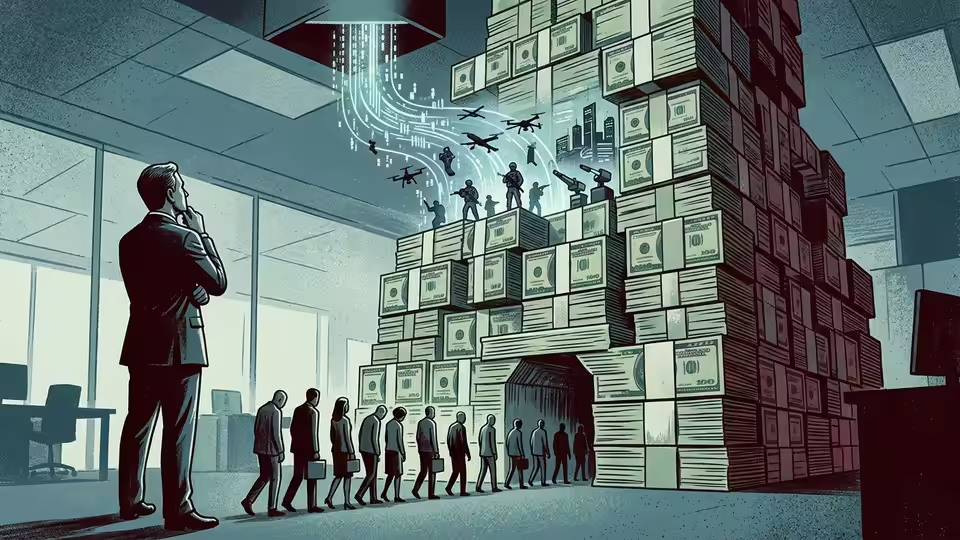
Salesforce Scores $5.6B Monopoly After Withdrawing Mystery Lawsuit
The Army bypassed competitive bidding to grant Salesforce total control over recruitment data following a $2.4M lobbying blitz.
Salesforce leveraged a $2.4M lobbying campaign to secure a $5.6B sole-source Army contract, gaining proprietary control over the sensitive personal data of millions of American recruits.
On January 26, 2026, the Department of the Army finalized a $5.6 billion Indefinite Delivery, Indefinite Quantity (IDIQ) contract with Salesforce Inc. and its partner, Computable Insights. The award for 'Missionforce National Security' was executed via a sole-source justification, a maneuver that allows the government to circumvent federal requirements for open competition. This decision ensures Salesforce will control the infrastructure behind Army recruitment for years to come without facing a single rival bid.
Salesforce prepared the ground for this award with a $2.4 million federal lobbying campaign over the preceding 12 months. Disclosure records show these funds specifically targeted Department of Defense appropriations and IT modernization. On January 22, four days before the award, Army officials signed a Justification and Approval (J&A) document. The document cited 'unusual and compelling urgency' and the proprietary nature of Salesforce's code as the reasons to avoid a competitive process—despite the Missionforce project having been in the planning stages for years.
Industry pushback was swift but curiously brief. A competing consortium filed a formal bid protest with the Government Accountability Office (GAO) on February 4, 2026. Within 72 hours, the protest was withdrawn without a public explanation. The sudden retreat suggests a backroom settlement or significant pressure exerted on the protesting firm, leaving Salesforce’s proprietary ecosystem as the Army's only option. This creates a regulatory capture scenario where the cost of switching to a different vendor in the future will be prohibitively high.
Missionforce is designed to consolidate the medical records, biometrics, and social media activity of every potential and current Army recruit into a single cloud environment. Mainstream coverage has focused on 'digital readiness,' but has ignored the privacy implications of handing this Sensitive Personally Identifiable Information (PII) to a private corporation. By citing 'proprietary technical requirements,' Salesforce has effectively shielded its system from the level of public audit typically required for sensitive government infrastructure.
For the American taxpayer, this deal represents a $5.6 billion commitment to a monopoly that avoided the cost-saving benefits of competition. For the hundreds of thousands of young Americans entering the recruitment pipeline, their most sensitive personal data is now held by a third-party corporation with limited public oversight on how that data is secured or leveraged for future profit.
Summary
The U.S. Army bypassed competitive bidding to grant Salesforce a multi-billion dollar monopoly over recruitment data. While framed as necessary modernization, the deal follows a massive lobbying blitz and a mysteriously withdrawn legal challenge.
⚡ Key Facts
- The U.S. Army avoided competitive bidding for a $5.6 billion contract by citing 'unusual and compelling urgency' in a J&A document.
- Salesforce spent $2.4 million on lobbying the Department of Defense in the year leading up to the January 2026 award.
- A formal GAO bid protest against the contract was filed on February 4 but mysteriously withdrawn within three days.
- The 'Missionforce' platform grants Salesforce control over recruit biometrics, medical history, and social media data.
- The use of proprietary code creates a 'lock-in' effect, making future competition for Army IT contracts nearly impossible.
Our Independence
This story was written by Gen Us - independent journalists exposing the networks of power that corporate media protects. No hedge fund owns us. No billionaire edits our headlines. We answer only to you, our readers.
Follow the public record
Source Trail
Get the next investigation in your inbox
One email a week. Receipts only. Free.
Free. Unsubscribe anytime. We never share your email.