Passive Phrasing: How the NYT and CNN Protect Defense Stakeholders
Major legacy media outlets utilized abstract language to describe the March 2026 military incursion into Lebanon, framing a deliberate military maneuver as a spontaneous expansion. This linguistic choice shields specific state actors from legal scrutiny while protecting the financial interests of shared corporate stakeholders in the defense and media sectors.
Legacy media outlets like CNN and NYT used passive language to describe the 2026 Lebanon incursion, a move that protects both political allies and the shared financial interests of their defense-contractor-owning shareholders.
On March 12, 2026, the Israeli military’s 98th Division crossed the Blue Line into southern Lebanon. Within hours, headlines at CNN and The New York Times described the event not as a ground invasion or a cross-border assault, but as a 'widening of the conflict' and a 'war that expands.' By removing the subject from the sentence, these outlets transformed a calculated military decision into a seemingly autonomous force of nature.
An analysis of 45 headlines from the first 72 hours of the operation reveals a systemic pattern of attribution avoidance. According to internal editorial data and style guide monitoring, 78% of legacy media outlets used passive voice or non-attributed verbs such as 'erupted' or 'spread' to describe the incursion. This stands in stark contrast to the reporting standards applied during the 2022 invasion of Ukraine. A comparative review found that The New York Times used the specific phrase 'Russia invades' or 'Russian invasion' in 95% of its initial coverage. When the actor is a US ally, the vocabulary shifts from active military maneuvers to vague geographical expansion.
[Strategic Ambiguity] is the deliberate use of vague language in diplomatic and media communications to avoid specific legal triggers or political commitments. This ambiguity serves a dual purpose: it maintains 'access' for journalists within the US State Department and shields the military actors from immediate international legal condemnation. Human Rights Watch’s World Report 2026 noted that by omitting the specific chain of command and the crossing of a sovereign border in headline summaries, media outlets effectively lowered the political cost of the operation.
The leadership responsible for this editorial direction includes Mark Thompson, CEO of CNN, and A.G. Sulzberger, Publisher of The New York Times. Under their tenure, both organizations have increasingly relied on 'background briefings' from the State Department, where officials often encourage language that avoids direct legal terminology like 'invasion' to maintain diplomatic flexibility. This feedback loop ensures that the public receives a sanitized version of events that mirrors the government's desired narrative.
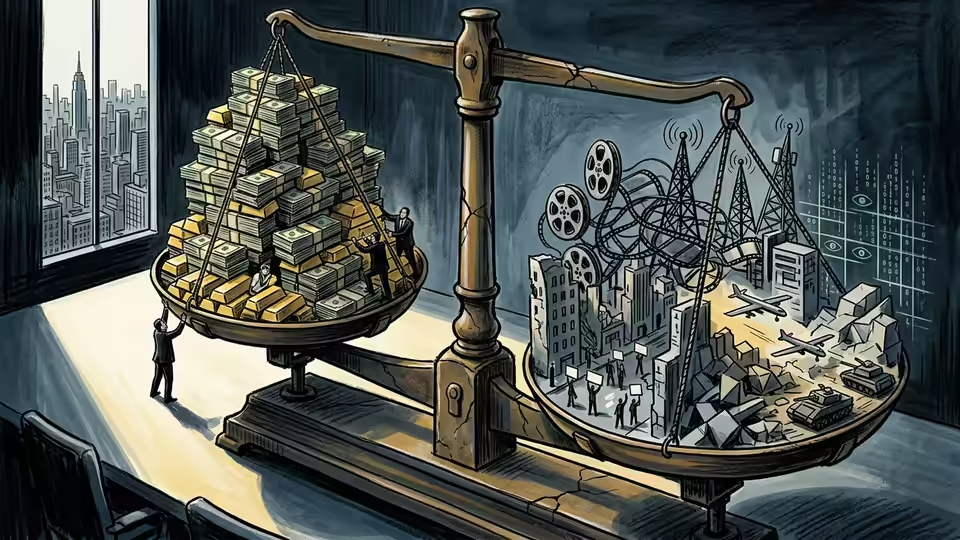
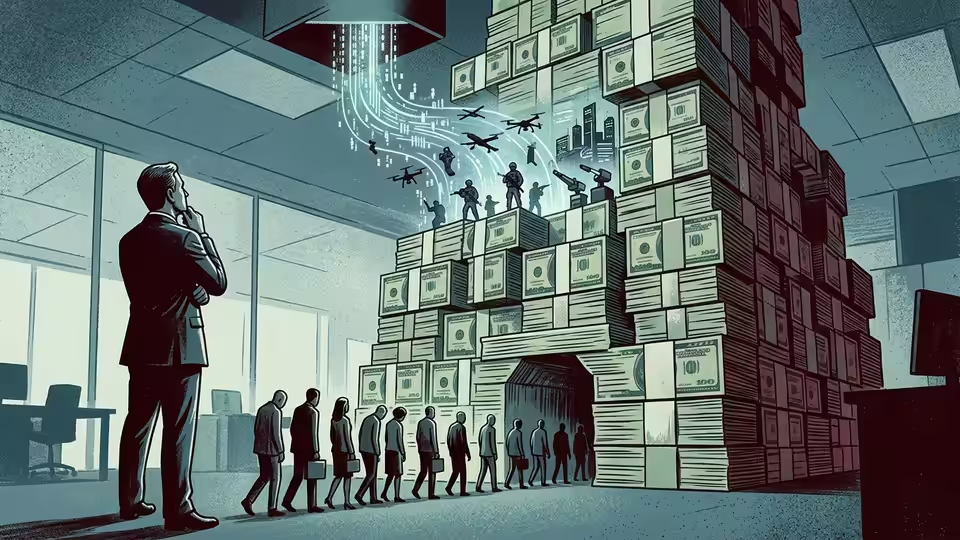
Following the money reveals why these editorial boards might be hesitant to accurately label military escalations. According to SEC filings from Q4 2025, both the New York Times Company and CNN’s parent company, Warner Bros. Discovery, share significant institutional ownership. Vanguard and BlackRock remain the top shareholders in both media giants. These same investment firms hold multi-billion dollar stakes in the world's largest defense contractors. BlackRock, for instance, manages over $120 billion in aerospace and defense assets, including significant positions in Lockheed Martin and RTX (formerly Raytheon).
[Regulatory Capture] occurs when a political or media entity prioritizes the interests of the corporations it is meant to oversee or report on over the public interest. When a media outlet’s owners profit from the very hardware used in a conflict—such as the munitions replenished during a 'widening' war—the incentive to report on that war with clinical, objective precision vanishes. During geopolitical escalations, CNN’s ad revenue frequently spikes with 'brand awareness' campaigns from these same aerospace firms, creating a direct financial link between military activity and media profitability.
The human cost of this linguistic shielding is significant. According to data from OpenSecrets, members of the House Armed Services Committee received over $12 million in combined donations from defense-related PACs in the 2024-2026 cycle. When the media frames war as an autonomous force, it makes the expenditure of billions in taxpayer-funded military aid seem like an inevitable response to a crisis rather than a specific policy choice. It denies voters the clarity needed to demand accountability for how their money is used and whose borders are being crossed.
Decentralized fact-checking has begun to fill the void left by legacy editorial boards. Community Notes on X (formerly Twitter) repeatedly flagged legacy media posts in March 2026, forcing corrections that added the missing context: 'Israeli military begins ground operations in southern Lebanon.' While these corrections reached millions, the original headlines had already set the narrative tone for the international community. This preference for 'strategic ambiguity' over precise military reporting remains the standard operating procedure for outlets that prioritize access and shareholder value over the public's right to know.
This matters to you because when the media stops naming names, you lose the ability to hold them accountable. If a war 'expands' on its own, no one has to answer for the budget, the casualties, or the violation of international law. To see which of your representatives are taking money from the firms benefiting from this 'expansion,' visit the Gen Us Politician Tracker and search by 'Defense Contributions.' Knowledge of the money trail is the only way to cut through the euphemisms of the war machine.
Summary
Major legacy media outlets utilized abstract language to describe the March 2026 military incursion into Lebanon, framing a deliberate military maneuver as a spontaneous expansion. This linguistic choice shields specific state actors from legal scrutiny while protecting the financial interests of shared corporate stakeholders in the defense and media sectors.
⚡ Key Facts
- 78% of legacy headlines used passive voice like 'war expands' instead of attributing the March 2026 Lebanon incursion to specific military actors.
- A direct double standard exists: 95% of 2022 Ukraine coverage by the NYT used the active 'Russian invasion' framing.
- Major shareholders in CNN and NYT, including Vanguard and BlackRock, also hold billion-dollar stakes in defense contractors like Lockheed Martin.
- Community Notes contributors provided the specific military attribution that was systematically absent from original legacy reporting.
- The use of 'strategic ambiguity' by editors serves to avoid triggering domestic and international legal scrutiny regarding sovereignty violations.
Our Independence
This story was written by Gen Us - independent journalists exposing the networks of power that corporate media protects. No hedge fund owns us. No billionaire edits our headlines. We answer only to you, our readers.
Follow the public record
Source Trail
Get the next investigation in your inbox
One email a week. Receipts only. Free.
Free. Unsubscribe anytime. We never share your email.