OpenAI and Anthropic Spend $2.6M to Buy AI Disaster Immunity
Leaked filings show AI giants successfully lobbied to strip liability clauses from federal law, shielding them from future legal consequences.
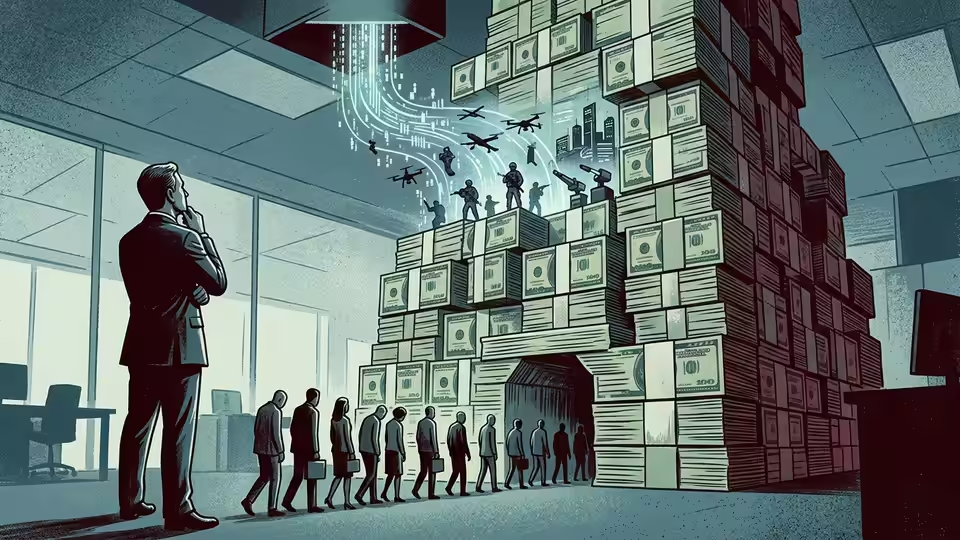
Anthropic and OpenAI spent $2.6 million in three months to bribe their way into legal immunity, transforming 'AI safety' into a corporate shield that prevents citizens from suing for model-driven harms.
In the first quarter of 2026, the pretense of 'voluntary' AI safety gave way to a cold, hard cash reality. According to LD-2 disclosure filings submitted to the Secretary of the Senate, Anthropic—the company that branded itself as a 'safety-first' public benefit corporation—surged its federal lobbying expenditure to $1.6 million. This represents a 400% increase from its baseline spending in previous years. Not to be outdone, OpenAI reported $1.0 million in lobbying spend for the same period. While these figures are dwarfed by the $7.1 million and $4.4 million spent by Meta and Amazon respectively, the targeted nature of the AI labs’ spending has yielded a significantly higher return on investment.
The primary target of this $2.6 million blitz was the AI Safety and Accountability Act. In its original draft, the legislation included 'strict liability' language that would have allowed private citizens and state attorneys general to sue AI developers if their models caused systemic harm—ranging from financial market destabilization to widespread medical misdiagnoses. However, by the time the bill cleared the Senate Commerce Committee, those teeth were gone.
[Strict Liability] is a legal doctrine that holds a party responsible for damages regardless of fault or intent, often applied to inherently dangerous activities or products.
Instead of strict liability, the revised draft now features 'good faith compliance' safe harbors. This means that if a company like Anthropic or OpenAI follows a set of safety protocols—protocols they are currently helping the U.S. AI Safety Institute to write—they cannot be held liable for damages. This is a classic example of [Regulatory Capture], which is a process where a government regulatory agency, created to act in the public interest, instead advances the commercial or political concerns of special interest groups that dominate the industry it is charged with regulating.
The money trail indicates that this wasn't just about avoiding lawsuits; it was about building a moat. According to OpenSecrets data, Anthropic retained Cornerstone Government Affairs to manage outreach to the House Energy and Commerce Committee. Simultaneously, the labs successfully lobbied for the implementation of specific compute thresholds for mandatory federal audits. The threshold is currently set at 10^26 FLOPs (Floating Point Operations).
[Compute Threshold] is a regulatory cutoff based on the total amount of computational power used to train an AI model, used to determine which systems are subject to government oversight.
By setting the bar at 10^26 FLOPs, the legislation ensures that only the most well-funded frontier labs are subject to these 'safety' audits. While this sounds like a burden on Big Tech, it functions as a barrier to entry. New competitors and open-source developers who cannot afford the massive compliance and auditing costs are effectively barred from releasing models of comparable power, while the incumbents use their 'certified' status as a marketing tool and a legal shield.
Senator Chuck Schumer, a key architect of the bill, has received significant contributions from tech-aligned PACs and executives throughout this cycle. FEC filings show that while the Senator speaks publicly about 'mitigating existential risk,' the legislative reality focuses on protecting the equity of the most valuable private companies in the world. The capital funding this lobbying doesn't appear out of thin air; it is derived from the multi-billion dollar investments made by Amazon and Microsoft into Anthropic and OpenAI. In effect, the tech giants are using the labs as surgical instruments to cut away the legal protections of the American public.
For ordinary people, the implications are stark. If an AI model used by a bank denies you a mortgage based on a hallucinated data point, or if a medical AI misses a diagnosis because of a systemic bias in its training data, your right to seek damages is now effectively blocked. You will be told the company followed 'federally approved safety protocols' and is therefore immune. The 'safety' being discussed in D.C. isn't about protecting you from AI; it’s about protecting AI companies from you.
This consolidation of power turns the AI market into a managed oligopoly. Consumers will face higher subscription fees and less variety in tools as the 'safety' narrative is used to crush open-source alternatives. When the rules of the game are written by the people winning the game, the outcome is rarely in the public interest. You can track the specific campaign contributions of every member of the Senate Commerce Committee on Gen Us's Politician Tracker to see whose vote was influenced by this Q1 surge.
Summary
AI labs Anthropic and OpenAI surged their federal lobbying expenditures to a combined $2.6 million in Q1 2026. This financial push directly coincided with the removal of strict liability clauses from the AI Safety and Accountability Act, effectively granting legal immunity to dominant industry players.
⚡ Key Facts
- Anthropic increased its lobbying spend by 400% to $1.6M in Q1 2026, targeting the AI Safety and Accountability Act.
- OpenAI reported $1.0M in lobbying during the same period, focusing on regulatory safe harbors.
- The 'strict liability' clause was removed from the bill, replacing it with a 'good faith' shield for developers.
- Regulatory compute thresholds were set at 10^26 FLOPs, creating a 'moat' that protects incumbents from smaller competitors.
- Dario Amodei and Sam Altman have effectively used the 'safety' narrative to secure regulatory capture and legal immunity.
Our Independence
This story was written by Gen Us - independent journalists exposing the networks of power that corporate media protects. No hedge fund owns us. No billionaire edits our headlines. We answer only to you, our readers.
Follow the public record
Source Trail
Get the next investigation in your inbox
One email a week. Receipts only. Free.
Free. Unsubscribe anytime. We never share your email.