Mining Firm Offloads Financial Risks to Taxpayers After $400k Lobbying Play
NioCorp was failing. Then they paid Javelin Advisors $400,000. Now, the Department of Energy has changed the rules to let them access massive federal loans. This is how private risk becomes public debt.
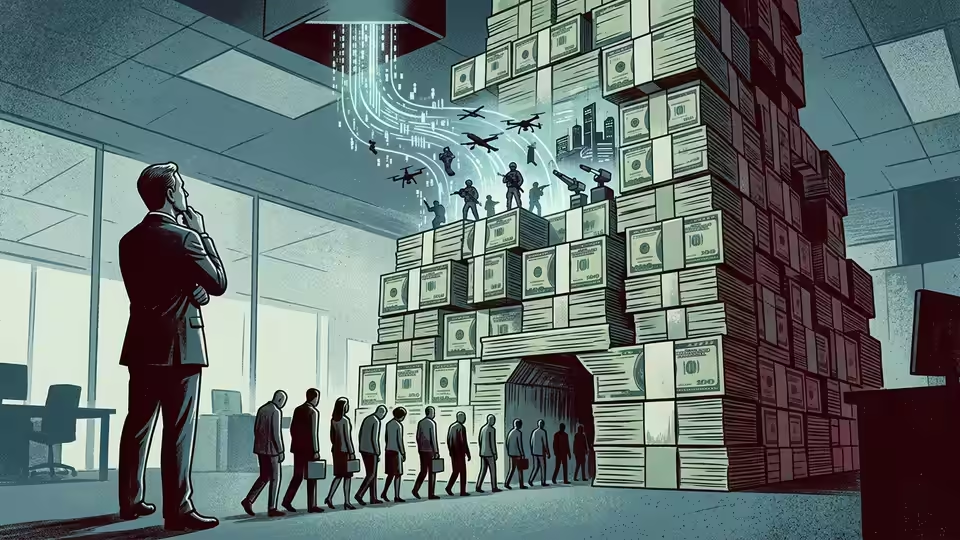
NioCorp is using a $400,000 lobbying campaign to secure $800 million in taxpayer-backed loans for a mining project its own auditors warn may not be financially viable.
In January 2026, NioCorp Developments Ltd disclosed a $400,000 payment to Javelin Advisors LLC, a specialist lobbying firm tasked with navigating the intricate bureaucracy of federal energy financing (LDA Filing 48041be0-2026-4ae3-8e3c-066de9889501). The payment was not for equipment or site preparation at the company’s Elk Creek project in Nebraska; it was for access. Specifically, the lobbying campaign focused on influencing the Department of Energy (DOE) Loan Programs Office (LPO) and the reclassification of niobium under federal guidelines.
The timing is precise. Shortly after the $400,000 disbursement, the DOE’s Loan Programs Office updated its guidance for 'Advanced Material Processing' eligibility. This shift directly benefits NioCorp, which is seeking federal loan guarantees that could exceed $800 million. This represents a potential 2,000x return on their lobbying investment. [Regulatory Capture] is the process by which a government agency, created to act in the public interest, instead advances the commercial or political concerns of special interest groups that dominate the industry it is charged with regulating.
NioCorp CEO Mark Smith is a veteran of this landscape. As a former executive at Molycorp, Smith witnessed that company’s meteoric rise and subsequent 2015 bankruptcy, which occurred despite its positioning as a 'strategic' American asset against Chinese rare earth dominance. Now, Smith is using a similar playbook. He has positioned the Elk Creek project as a matter of national security, framing the extraction of niobium and scandium as essential for the U.S. defense and electric vehicle sectors.
However, NioCorp’s internal financial health tells a different story than its marketing materials. In its FY2025 SEC Form 10-K filing, the company issued a 'going concern' warning. [Going Concern] is an accounting term indicating that a company has the resources needed to continue operating indefinitely; a 'warning' means the company may not survive the next twelve months without a significant cash infusion. According to SEC records, the company has accumulated a deficit of over $150 million since its inception and currently lacks the private capital to move the Elk Creek project into full-scale production.
Despite these red flags, the DOE's Loan Programs Office, under Director Jigar Shah, remains the target of NioCorp’s strategy. The LPO currently manages a staggering $400 billion in loan authority. Shah has publicly stated the office's mission is to provide a 'bridge to bankability' for projects that private lenders deem too risky. In this case, 'risk' is being shifted directly onto the American taxpayer. If the project succeeds, Mark Smith and NioCorp’s private shareholders reap the rewards. If the project fails—following the path of Smith’s former venture, Molycorp—taxpayers are left holding the bill for hundreds of millions in defaulted loan guarantees.
The lobbying push specifically targeted Title XVII of the Energy Policy Act of 2005. [Title XVII] is a federal program that provides loan guarantees for projects that 'avoid, reduce, or sequester air pollutants or anthropogenic emissions of greenhouse gases.' By lobbying to have niobium classified as a 'primary critical mineral' for the energy transition, NioCorp effectively rewrote the rules to ensure their specific project qualified for a slice of the federal pie. According to the Lobbying Disclosure Act database, Javelin Advisors focused their efforts on the 'technical requirements' for Title XVII, ensuring NioCorp's pre-revenue status would not be a disqualifying factor.
Mainstream media coverage has largely ignored the financial instability of the company, instead focusing on the 'strategic win' for American energy independence. Outlets have parroted press releases regarding the 'vital step' in breaking the Chinese monopoly. What they leave out is the cost of this independence: the socialization of corporate risk. According to OpenSecrets, the mining industry has spent over $25 million in lobbying annually since 2022, with a specific focus on streamlining environmental reviews and unlocking federal credit facilities.
This is a classic 'heads they win, tails you lose' scenario for the public. While the rhetoric is about 'securing the supply chain,' the mechanics are about securing the balance sheet of a struggling corporation. The $400,000 paid to Javelin Advisors in January 2026 bought more than just advice; it bought a seat at the table where the definitions of 'critical' are written and where $800 million of your money is at stake.
At Gen Us, we believe in following the money to its ultimate conclusion. If the federal government is going to act as a venture capital firm, the public deserves to know the success rate and the true cost of these 'strategic' investments. You can explore our Politician Tracker to see which members of the Senate Energy and Natural Resources Committee have received contributions from mining PACs, and use our LPO Dashboard to track every dollar of the $400 billion currently being deployed by the DOE.
Summary
NioCorp Developments Ltd paid $400,000 to Javelin Advisors just as the Department of Energy revised eligibility for massive federal loans. This maneuver seeks to shift financial risk from private investors to the U.S. taxpayer for a project the company admits is financially unstable.
⚡ Key Facts
- NioCorp disclosed a $400,000 payment to Javelin Advisors LLC in January 2026 to lobby the Department of Energy.
- The payment coincided with a DOE update to 'Advanced Material Processing' rules that favored NioCorp's Elk Creek project.
- NioCorp's 2025 SEC Form 10-K contains a 'going concern' warning, indicating the company is at risk of insolvency.
- The company is seeking federal loan guarantees exceeding $800 million, shifting project risk to taxpayers.
- CEO Mark Smith previously led Molycorp, a 'strategic' mining firm that ended in a high-profile bankruptcy.
Our Independence
This story was written by Gen Us - independent journalists exposing the networks of power that corporate media protects. No hedge fund owns us. No billionaire edits our headlines. We answer only to you, our readers.
Follow the public record
Source Trail
Get the next investigation in your inbox
One email a week. Receipts only. Free.
Free. Unsubscribe anytime. We never share your email.